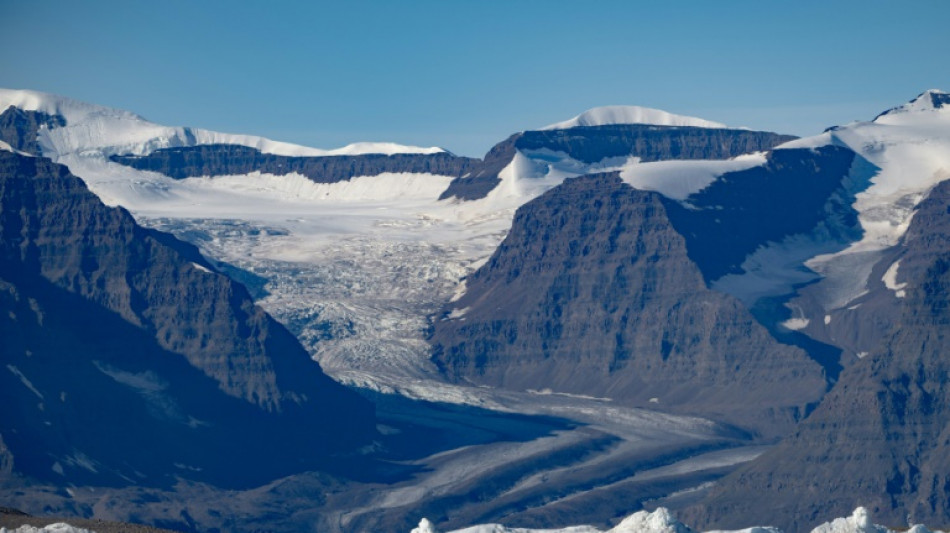
Oh my (long) days: Melting ice caps slow Earth's spin / Photo: Olivier MORIN - AFP/File

 Inter Milan and Italy icon Mazzola dies aged 83

 Saudi capital issues first air raid alert since renewed fighting in Yemen

 Martin edges title rival Marquez for Austrian MotoGP pole

 Indonesia accepts Malaysia's help to tackle wildfires

 Indians living in Japan on stand-by to house Asian Games athletes
 Trump signs bill authorizing sweeping Russia sanctions

 Protesters form human chain at Kennedy Center after Trump threat

 Death toll from attack at police HQ in Pakistan rises to 31

 Trump says Denmark to give US 'permanent control' over Greenland security

 Kennedy Center: future unclear for iconic Washington arts hub

 Trump claims 'infinite' Greenland security deal with Denmark

 Helicopters battle wildfire threatening Ecuador's capital

 Brentford batter Chelsea to undo Alonso's promising start

 Kane hits Bundesliga century as Bayern rout Union

 Trump says CNN, MS NOW, Politico banned from White House

 Hushing and hedging: US companies retreat on climate

 Springboks to face Fiji before 2027 Rugby World Cup

 Nigeria miners struggled to breathe in cell before 37 died: survivors

 McIlroy on the charge at PGA Championship as Reed withdraws

 McIlroy on the charge at PGA Championship

 Crisis-wracked Volkswagen warns of 10-bn-euro hit to profits

 Costa Rica's Grynspan tops third informal poll for UN chief: diplomat

 Stock markets retreat after central bank rate hikes

 Russia labels director of Cannes Grand Prix winner a 'foreign agent'

 Macron warns of Russian 'hybrid' threat after meeting presidential hopefuls

It's well known that as far as the climate crisis goes, time is of the essence.
Now a study out Monday shows that the melting of the polar ice caps is causing our planet to spin more slowly, increasing the length of days at an "unprecedented" rate.
The paper, published in Proceedings of the National Academy of Sciences, shows that water flowing from Greenland and Antarctica is resulting in more mass around the equator, co-author Surendra Adhikari of NASA's Jet Propulsion Laboratory told AFP.
"It's like when a figure skater does a pirouette, first holding her arms close to her body and then stretching them out," added co-author Benedikt Soja of ETH Zurich.
"The initially fast rotation becomes slower because the masses move away from the axis of rotation, increasing physical inertia."
Earth is commonly thought of as a sphere, but it's more accurate to call it an "oblate spheroid" that bulges somewhat around the equator, a bit like a satsuma.
What's more, its shape is constantly changing, from the impacts of the daily tides that affect the oceans and crusts, to longer term effects from drift of tectonic plates, and abrupt, violent shifts caused by earthquakes and volcanoes.
The paper relied on observational techniques like Very Long Baseline Interferometry, where scientists can measure the difference in how long it takes for radio signals from space to reach different points on Earth, and use that to infer variations in the planet's orientation and length of day.
It also used the Global Positioning System, which measures Earth's rotation very precisely, to about one-hundredth of a millisecond, and even looked at ancient eclipse records going back millenia.
- Implications for space travel -
If the Earth turns more slowly, then the length of day increases by a few milliseconds from the standard measure of 86,400 seconds.
A currently more significant cause of slowdown is the gravitational pull of the Moon, which pulls on the oceans in a process called "tidal friction" that has caused a gradual deceleration of 2.40 milliseconds per century over millions of years.
But the new study comes to a surprising conclusion that, if humans continue to emit greenhouse gases at a high rate, the effect of a warming climate will be greater than that of the Moon's pull by the end of the 21st century, said Adhikari.
Between the year 1900 and today, climate has caused days to become around 0.8 milliseconds longer -- and under the worst-case scenario of high emissions, climate alone would be responsible for making days 2.2 milliseconds longer by the year 2100, compared to the same baseline.
That might not sound like a great deal, and certainly not something that humans are able to perceive.
But "there are definitely a lot of implications for space and Earth navigation," said Adhikari.
Knowing the exact orientation of Earth at any given moment is crucial when attempting to communicate with a spaceship, such as the Voyager probes that are now well beyond our solar system, where even a slight deviation of a centimeter can end up being kilometers off by the time it reaches its destination.
E.Raimundo--PC



