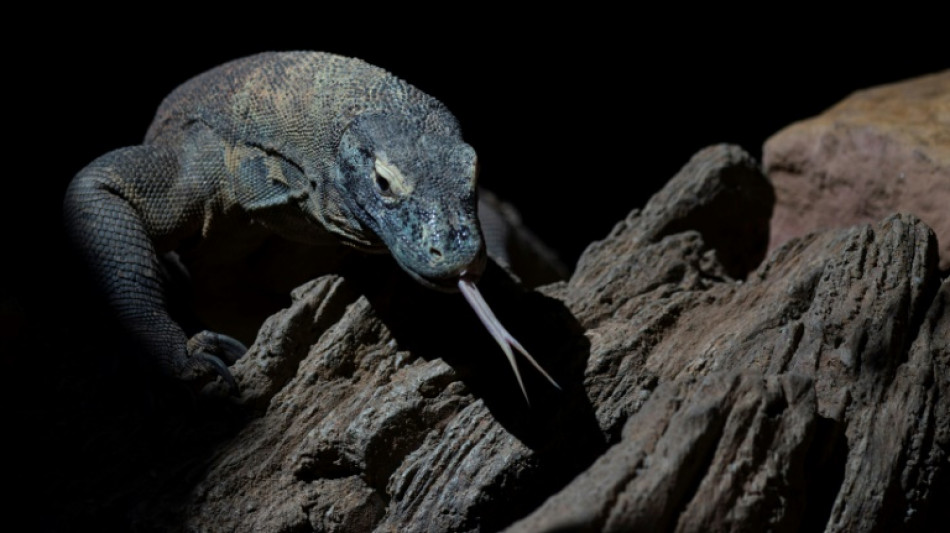
Komodo dragons have teeth coated in iron to kill prey: study / Photo: JORGE GUERRERO - AFP/File

 Inter Milan and Italy icon Mazzola dies aged 83

 Saudi capital issues first air raid alert since renewed fighting in Yemen

 Martin edges title rival Marquez for Austrian MotoGP pole

 Indonesia accepts Malaysia's help to tackle wildfires

 Indians living in Japan on stand-by to house Asian Games athletes

 Trump signs bill authorizing sweeping Russia sanctions

 Protesters form human chain at Kennedy Center after Trump threat

 Death toll from attack at police HQ in Pakistan rises to 31

 Trump says Denmark to give US 'permanent control' over Greenland security

 Kennedy Center: future unclear for iconic Washington arts hub

 Trump claims 'infinite' Greenland security deal with Denmark

 Helicopters battle wildfire threatening Ecuador's capital

 Brentford batter Chelsea to undo Alonso's promising start

 Kane hits Bundesliga century as Bayern rout Union

 Trump says CNN, MS NOW, Politico banned from White House

 Hushing and hedging: US companies retreat on climate

 Springboks to face Fiji before 2027 Rugby World Cup

 Nigeria miners struggled to breathe in cell before 37 died: survivors

 McIlroy on the charge at PGA Championship as Reed withdraws

 McIlroy on the charge at PGA Championship

 Crisis-wracked Volkswagen warns of 10-bn-euro hit to profits

 Costa Rica's Grynspan tops third informal poll for UN chief: diplomat

 Stock markets retreat after central bank rate hikes

 Russia labels director of Cannes Grand Prix winner a 'foreign agent'

 Macron warns of Russian 'hybrid' threat after meeting presidential hopefuls

The fearsome Komodo dragon, native to Indonesia and the world's largest living lizard, has a coat of iron on its razor-like teeth to help it kill its prey, scientists found in a study published Wednesday.
A study led by researchers from King's College London, who carried out their work with advanced chemical and structural imaging, revealed protective iron coats in orange pigment found in the tips and serrations of Komodo dragon teeth.
"This feature has never been reported before in a carnivorous reptile," said the study published in the journal Nature Ecology & Evolution.
The researchers found iron-rich coatings most prominently on Komodo dragon teeth, although similar coverings were also found on the teeth of other living reptiles, including monitor lizards, crocodiles and alligators.
The study said concentrated iron played "a crucial role in supporting serrated teeth" in the huge lizards, who use them to kill their prey.
They prey on a range of animals from rodents to water buffalo and kill using a one-two punch of sharp teeth and a venomous bite.
The researchers believe the iron coatings may have existed in carnivorous dinosaurs but were lost over time because they could not find evidence of them on the fossilised teeth of reptiles and dinosaurs closely related to Komodo dragons.
Komodo dragons are found only in the national park of the same name and neighbouring Flores island. Only 3,458 adult and baby Komodo dragons are left in the wild, according to the International Union for the Conservation of Nature.
Thousands of tourists descend annually on the cluster of islands in the eastern part of Indonesia, the only place in the world where Komodo dragons can be seen in their natural habitat.
The reptiles, which can grow to three metres (10 feet) in length and weigh up to 90 kilograms (200 pounds), are threatened by human activity and climate change destroying their habitat.
T.Batista--PC



