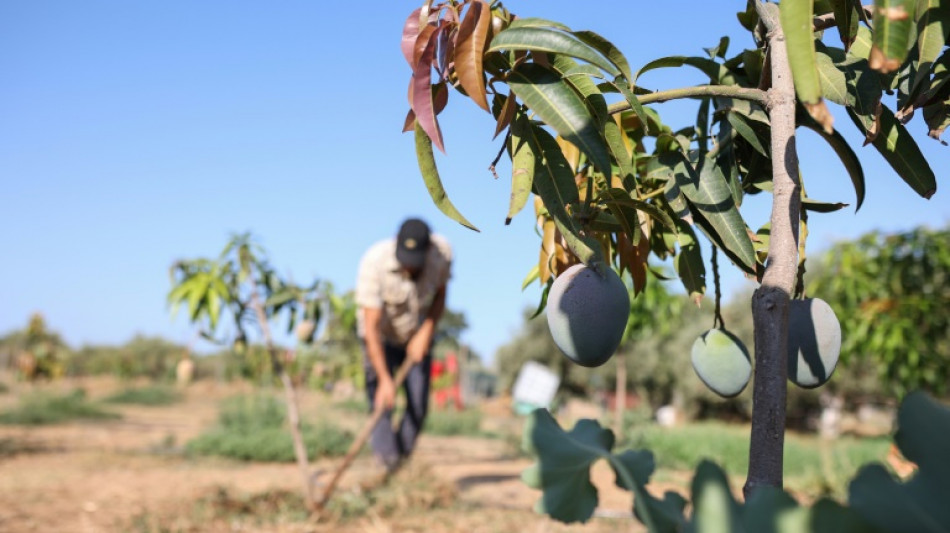
Greeks try tropical crops in climate change experiment / Photo: Aris Oikonomou - AFP

 Inter Milan and Italy icon Mazzola dies aged 83

 Saudi capital issues first air raid alert since renewed fighting in Yemen

 Martin edges title rival Marquez for Austrian MotoGP pole

 Indonesia accepts Malaysia's help to tackle wildfires

 Indians living in Japan on stand-by to house Asian Games athletes
 Trump signs bill authorizing sweeping Russia sanctions

 Protesters form human chain at Kennedy Center after Trump threat

 Death toll from attack at police HQ in Pakistan rises to 31

 Trump says Denmark to give US 'permanent control' over Greenland security

 Kennedy Center: future unclear for iconic Washington arts hub

 Trump claims 'infinite' Greenland security deal with Denmark

 Helicopters battle wildfire threatening Ecuador's capital

 Brentford batter Chelsea to undo Alonso's promising start

 Kane hits Bundesliga century as Bayern rout Union

 Trump says CNN, MS NOW, Politico banned from White House

 Hushing and hedging: US companies retreat on climate

 Springboks to face Fiji before 2027 Rugby World Cup

 Nigeria miners struggled to breathe in cell before 37 died: survivors

 McIlroy on the charge at PGA Championship as Reed withdraws

 McIlroy on the charge at PGA Championship

 Crisis-wracked Volkswagen warns of 10-bn-euro hit to profits

 Costa Rica's Grynspan tops third informal poll for UN chief: diplomat

 Stock markets retreat after central bank rate hikes

 Russia labels director of Cannes Grand Prix winner a 'foreign agent'

 Macron warns of Russian 'hybrid' threat after meeting presidential hopefuls

Stirring the leaves of a shrub on his farm in Kyparissia, western Greece, Panos Adamopoulos spied the first soon-to-be-ripe mangoes -- his share of a state experiment against climate change.
"Right there!" he exclaimed.
For decades, this fertile land on the shores of the Ionian Sea has been mainly known for olives, in addition to watermelon and other crops.
But even this part of Greece that sees more rain than other parts of the country is grappling with the effects of drought.
After the warmest winter on record, Greece also experienced the hottest June and July since reliable data collection began in 1960.
"There is no winter," Adamopoulos, 38, told AFP, adding that his property has not received a drop of rain since March.
"No water, no cultivation," said the farmer, whose trees seem to grow right into the Ionian Sea.
Most of Adamopoulos' income currently comes from iceberg lettuce.
But with increasingly arid seasons in sight, he may soon have to give up on some of his lucrative, yet water-intensive crops, such as watermelon.
Adamopoulos is among a small number of Greek growers turning to tropical fruits -- mangoes, avocados, lychees, cherimoya and macadamia nuts -- which he says are "more resistant" to the increasingly intense heat in the Mediterranean region.
For now, he only grows a few dozen mango and avocado trees on his 80-hectare (198-acre) estate.
The exotic fruits are adapting so well to their new surroundings that Adamopoulos now plans to plant a further 300 trees. He he said he had already received orders for his first harvests, due later this month.
The initiative is part of a study by Greek state agriculture institute Demeter to determine whether tropical fruits could help address the country's looming drought problem.
- Not a miracle solution -
Study supervisor Teresa Tzatzani says the point is to "find new ways to face this climate change, and make it work in our favour".
"It is hotter all year round now, and this is good for these crops," she said.
Although avocado already grows on the island of Crete, scientists were unsure whether the tree would adapt to conditions on the Greek mainland.
And while mango trees need very little rainfall, the last two winters have been unusually dry, Tzatzani noted.
This type of innovation is essential to save the sector from future climate disasters, said Antonis Paraskevopoulos, head of agriculture for the local region of Triphylia.
But for now, tropical fruits are not a miracle solution.
The programme currently has only a dozen farmers and around 10 hectares under cultivation.
And while it is not intended to replace staple local products such as olives or oranges, it can act as a complement, said Tzatzani, who plans to extend the experiment to other Greek regions.
Neighbouring countries are experiencing similar problems. In Italy, Sicilian farmers have started producing mangoes, bananas and papayas.
The Intergovernmental Panel on Climate Change (IPCC) estimates that the Mediterranean basin, one of the "hotspots" of climate change, will experience more frequent heat waves and droughts.
- A 'bad year'? -
Theodoros Dimitrakakis, another Greek farmer taking part in the initiative, estimates that it will take years for tropical fruit production to become profitable in Greece.
Despite his enthusiasm for the experiment, the 34-year-old says he can't afford to devote all his time to it, as his main source of income, olive trees, requires all of his attention.
His village, like many in Greece, is often without water for several hours during the day due to scheduled cuts.
Last year, his olive yield was 60 percent below average, Dimitrakakis said.
Despite being an environmental activist during his university years, Dimitrakakis acknowledges that he only recently realised that climate change would impact him so soon.
He now hopes to convince other local farmers, some of whom prefer to think it's just a "bad year".
H.Portela--PC



