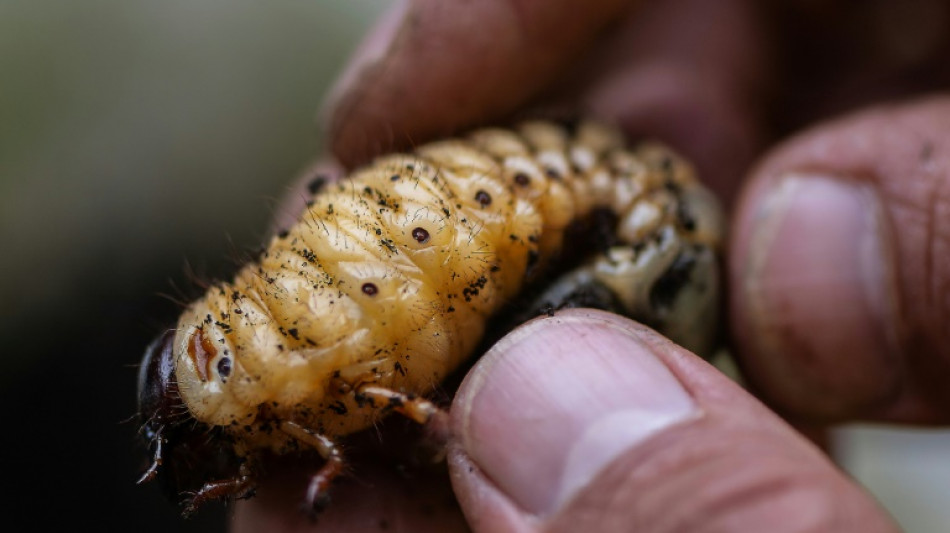
In Colombia, hungry beetle larvae combat trash buildup / Photo: Luis ACOSTA - AFP

 Inter Milan and Italy icon Mazzola dies aged 83

 Saudi capital issues first air raid alert since renewed fighting in Yemen

 Martin edges title rival Marquez for Austrian MotoGP pole

 Indonesia accepts Malaysia's help to tackle wildfires

 Indians living in Japan on stand-by to house Asian Games athletes
 Trump signs bill authorizing sweeping Russia sanctions

 Protesters form human chain at Kennedy Center after Trump threat

 Death toll from attack at police HQ in Pakistan rises to 31

 Trump says Denmark to give US 'permanent control' over Greenland security

 Kennedy Center: future unclear for iconic Washington arts hub

 Trump claims 'infinite' Greenland security deal with Denmark

 Helicopters battle wildfire threatening Ecuador's capital

 Brentford batter Chelsea to undo Alonso's promising start

 Kane hits Bundesliga century as Bayern rout Union

 Trump says CNN, MS NOW, Politico banned from White House

 Hushing and hedging: US companies retreat on climate

 Springboks to face Fiji before 2027 Rugby World Cup

 Nigeria miners struggled to breathe in cell before 37 died: survivors

 McIlroy on the charge at PGA Championship as Reed withdraws

 McIlroy on the charge at PGA Championship

 Crisis-wracked Volkswagen warns of 10-bn-euro hit to profits

 Costa Rica's Grynspan tops third informal poll for UN chief: diplomat

 Stock markets retreat after central bank rate hikes

 Russia labels director of Cannes Grand Prix winner a 'foreign agent'

 Macron warns of Russian 'hybrid' threat after meeting presidential hopefuls

In the far-flung Colombian highlands, beetles are the secret weapon in an innovative project to combat the ever-growing problem of trash buildup.
Here, larvae of the enormous rhinoceros beetle eat through piles of organic garbage that would otherwise end up in polluting landfills.
But that's not all. The larvae poop is gathered and sold as fertilizer, and when the beetles reach adulthood, they are sold as pets to clients as far afield as Japan.
"The beetles have the answer" to rubbish disposal, said environmental and health engineer German Viasus, who runs the project in Colombia's central Boyaca region.
The concept is simple, cheap and, Viasus believes, an example that would be easy to replicate elsewhere in the world.
Each week, his facility in the city of Tunja receives about 15 tons of waste generated by some 40,000 inhabitants of neighboring municipalities.
It is piled up as food for the voracious larvae, which can grow to the length of a human hand.
Other larvae are held in tanks where they consume leachate -- a fluid produced by organic waste decomposition that can be damaging to ecosystems.
- 'Cutting edge' -
Official Colombian estimates are that the South American country produces some 32,000 tons of garbage every day -- more than 2,600 school buses -- about half of it organic.
Worldwide, some 11.2 billion tons of trash are generated each year, according to the UN.
With the landfill in Tunja fast approaching its end date, Viasus's larvae offer an alternative solution to a major headache.
The engineer stumbled on the idea by chance when in 2000, after a similar project using earthworms had failed, he found scarab beetle larvae feasting on the contents of a garbage bag.
The ones he has today are all descendents of those first foundlings.
The larvae live for about four months before starting their metamorphosis and acquiring their characteristic hard shells. The beetles have a lifespan ranging from a few months to about three years.
At this point, Viasus sells them to clients in countries including Germany, Canada, France, the United States and Japan -- where they are a popular pet.
Some find homes in Colombia, where many see them as good luck charms.
To avoid the fees associated with payments in yen, euros and dollars, Viasus teamed up with crypto wiz Carmelo Campos to develop a digital currency called Kmushicoin after the Japanese name for a horned beetle.
Today in Tunja, but also cities such as Bogota and Medellin, a handful of businesses accept the currency as payment.
"The world is so polluted, we are suffocating with this junk," electronics vendor Jefferson Bastidas told AFP in Tunja, saying he joined the initiative to aid the environment and place his business at the "cutting edge of technology."
R.J.Fidalgo--PC



