Climate change fuelled deadly India landslides, say scientists / Photo: Idrees MOHAMMED - AFP

 Indonesia accepts Malaysia's help to tackle wildfires

 Indians living in Japan on stand-by to house Asian Games athletes

 Trump signs bill authorizing sweeping Russia sanctions

 Protesters form human chain at Kennedy Center after Trump threat

 Death toll from attack at police HQ in Pakistan rises to 31

 Trump says Denmark to give US 'permanent control' over Greenland security

 Kennedy Center: future unclear for iconic Washington arts hub

 Trump claims 'infinite' Greenland security deal with Denmark

 Helicopters battle wildfire threatening Ecuador's capital

 Brentford batter Chelsea to undo Alonso's promising start

 Kane hits Bundesliga century as Bayern rout Union

 Trump says CNN, MS NOW, Politico banned from White House

 Hushing and hedging: US companies retreat on climate

 Springboks to face Fiji before 2027 Rugby World Cup

 Nigeria miners struggled to breathe in cell before 37 died: survivors

 McIlroy on the charge at PGA Championship as Reed withdraws

 McIlroy on the charge at PGA Championship

 Crisis-wracked Volkswagen warns of 10-bn-euro hit to profits

 Costa Rica's Grynspan tops third informal poll for UN chief: diplomat

 Stock markets retreat after central bank rate hikes

 Russia labels director of Cannes Grand Prix winner a 'foreign agent'

 Macron warns of Russian 'hybrid' threat after meeting presidential hopefuls

 UN holds third informal poll for new chief

 Kulusevski return can spark Spurs: De Zerbi

 Shakira to cap off world tour with Madrid 12-gig run

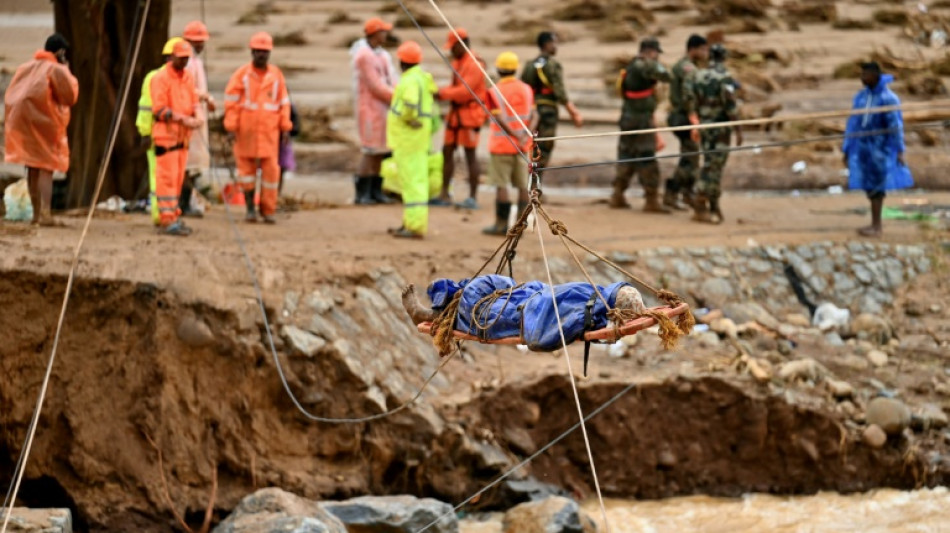
Climate change played a key factor in torrential rains in India that triggered catastrophic landslides killing at least 200 people last month, a group of scientists said Wednesday.
Monsoon rains battered the southern coastal state of Kerala and triggered landslides on July 30, burying homes and residents in Wayanad district under tonnes of rock and soil.
World Weather Attribution, a network of scientists who have pioneered peer-reviewed methods for assessing the possible role of climate change in specific extreme events, said the link between the intense rainfall and a warming planet was clear.
"The landslides... were triggered by a burst of rainfall that was made about 10 percent heavier by human-caused climate change," the WWA analysis by 24 scientists said, noting more than 140mm (5.5 inches) of rain fell in a single day.
"Before climate change, similar downpours in Kerala were incredibly rare," it said.
The scientists say higher temperatures due to fossil fuel emissions mean the atmosphere can hold more moisture, resulting in heavier rainfall.
It also said there had been a staggering 62 percent decrease in forest cover in the Wayanad region since 1950, "reducing slope stability" and increasing the landslide risk.
"The Wayanad landslides is another catastrophic example of climate change playing out in real time," said study member Mariam Zachariah, from Imperial College London.
Monsoon rains from June to September offer respite from the summer heat and are crucial for agriculture and replenishing water supplies, but they also bring regular destruction.
WWA said the rain that caused the landslides was the third heaviest one-day event on record in the area -- beaten only by storms in 2019 and in 1924 -- and warned worse will come without rapid change.
"One-day bursts of monsoon rainfall will continue to become even heavier, risking even deadlier landslides, until the world replaces fossil fuels with renewable sources of energy", researchers said.
India is the world's third-biggest emitter of greenhouse gases but has committed to achieve a net zero emissions economy by 2070 -- two decades after most of the industrialised West.
For now, it is overwhelmingly reliant on coal for power generation.
"These direct threats to people in India will continue to escalate as the climate warms and humans continue to regulate natural systems," said WWA scientist Arpita Mondal, from the Indian Institute of Technology.
A.Santos--PC



