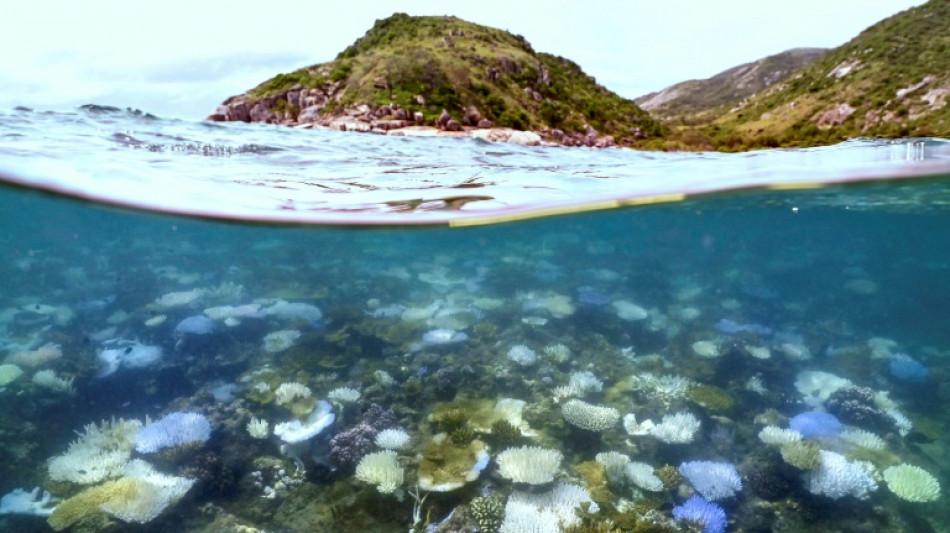
Australia tackles poor Great Barrier Reef water quality / Photo: DAVID GRAY - AFP/File

 Indonesia accepts Malaysia's help to tackle wildfires
 Indians living in Japan on stand-by to house Asian Games athletes
 Trump signs bill authorizing sweeping Russia sanctions

 Protesters form human chain at Kennedy Center after Trump threat

 Death toll from attack at police HQ in Pakistan rises to 31

 Trump says Denmark to give US 'permanent control' over Greenland security

 Kennedy Center: future unclear for iconic Washington arts hub

 Trump claims 'infinite' Greenland security deal with Denmark

 Helicopters battle wildfire threatening Ecuador's capital

 Brentford batter Chelsea to undo Alonso's promising start

 Kane hits Bundesliga century as Bayern rout Union

 Trump says CNN, MS NOW, Politico banned from White House

 Hushing and hedging: US companies retreat on climate

 Springboks to face Fiji before 2027 Rugby World Cup

 Nigeria miners struggled to breathe in cell before 37 died: survivors

 McIlroy on the charge at PGA Championship as Reed withdraws

 McIlroy on the charge at PGA Championship

 Crisis-wracked Volkswagen warns of 10-bn-euro hit to profits

 Costa Rica's Grynspan tops third informal poll for UN chief: diplomat

 Stock markets retreat after central bank rate hikes

 Russia labels director of Cannes Grand Prix winner a 'foreign agent'

 Macron warns of Russian 'hybrid' threat after meeting presidential hopefuls

 UN holds third informal poll for new chief

 Kulusevski return can spark Spurs: De Zerbi

 Shakira to cap off world tour with Madrid 12-gig run

Australia on Friday launched a multi-million dollar effort to stop pesticide runoff and other water quality issues on the Great Barrier Reef, the latest effort to save the ailing natural wonder.
Environment Minister Tanya Plibersek unveiled a US$130 million bid to reduce nutrient and pesticide runoff, improve invasive species management, and support better land management across some of the most vulnerable spots along the reef.
Often dubbed the world's largest living structure, the Great Barrier Reef is a 2,300-kilometre (1,400-mile) long expanse, home to a stunning array of biodiversity that includes more than 600 types of coral and 1,625 fish species.
But repeated mass bleaching events -- when extreme heat saps the coral of nutrients and colour -- threaten the reef's fragile ecosystem.
Mass bleaching events along the reef occurred in 1998, 2002, 2016, 2017, 2020, 2022 and now 2024.
Such is the damage to the reef that the UN's cultural organisation UNESCO has weighed labelling the world heritage site "at risk", a move that could put millions of tourist dollars at risk.
Plibersek said the latest funding was vital to stop some of the other problems plaguing the ecosystem and "make sure the beauty and majesty of the Reef can be enjoyed for our kids and grandkids".
"Sediment run-off is one of the biggest threats to the Great Barrier Reef," she said.
"Poor water quality stops coral from regrowing, kills seagrass, and blocks the sunlight needed for a healthy reef."
- Beyond recovery? -
This year's bleaching event has left 81 percent of the reef with extreme or high levels of damage -- one of the most severe and widespread on record, the latest government data shows.
It will take scientists a few more months to determine how much of the reef is beyond recovery.
Coral bleaching occurs when water temperatures rise more than one degree Celsius (1.8 degrees Fahrenheit).
Australian Marine Conservation Society marine ecologist Lissa Schindler welcomed the government's funding boost but said more needed to be done to address the root cause of climate change.
Historically, investment had been spread thin across the reef rather than a targeted approach, she said.
"Water pollution is one of the biggest threats to the reef outside of climate change," she told AFP.
"The reef needs every bit of help it can get."
But Australia, one of the world's largest gas and coal exporters, has only recently set targets to become carbon neutral.
R.J.Fidalgo--PC



