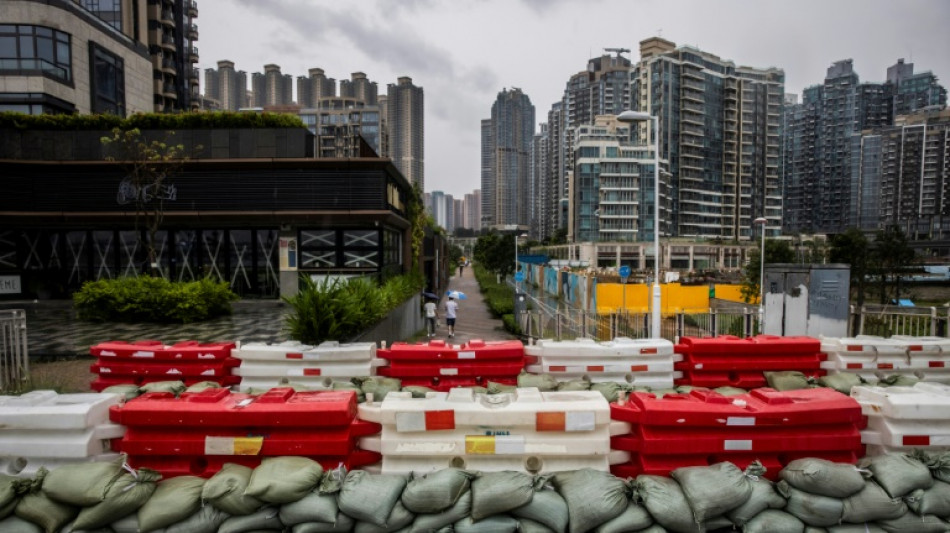
Coastal cities alarmingly slow to adapt to climate change: study / Photo: ISAAC LAWRENCE - AFP/File

 Indonesia accepts Malaysia's help to tackle wildfires

 Indians living in Japan on stand-by to house Asian Games athletes
 Trump signs bill authorizing sweeping Russia sanctions

 Protesters form human chain at Kennedy Center after Trump threat

 Death toll from attack at police HQ in Pakistan rises to 31

 Trump says Denmark to give US 'permanent control' over Greenland security

 Kennedy Center: future unclear for iconic Washington arts hub

 Trump claims 'infinite' Greenland security deal with Denmark

 Helicopters battle wildfire threatening Ecuador's capital

 Brentford batter Chelsea to undo Alonso's promising start

 Kane hits Bundesliga century as Bayern rout Union

 Trump says CNN, MS NOW, Politico banned from White House

 Hushing and hedging: US companies retreat on climate

 Springboks to face Fiji before 2027 Rugby World Cup

 Nigeria miners struggled to breathe in cell before 37 died: survivors

 McIlroy on the charge at PGA Championship as Reed withdraws

 McIlroy on the charge at PGA Championship

 Crisis-wracked Volkswagen warns of 10-bn-euro hit to profits

 Costa Rica's Grynspan tops third informal poll for UN chief: diplomat

 Stock markets retreat after central bank rate hikes

 Russia labels director of Cannes Grand Prix winner a 'foreign agent'

 Macron warns of Russian 'hybrid' threat after meeting presidential hopefuls

 UN holds third informal poll for new chief

 Kulusevski return can spark Spurs: De Zerbi

 Shakira to cap off world tour with Madrid 12-gig run

Coastal cities are not doing enough to adapt to climate change, taking too long and implementing insufficient measures, according to a major study published this week.
While flood barriers and pumping systems are a step in the right direction, "across all regions and income groups, scientifically reported adaptation in coastal cities remains at rather low depth, scope and speed," said the study published in Nature Cities, which looked at 199 cities worldwide.
Given the high exposure and vulnerability of many coastal cities, "this finding is alarming as adaptation to future climate change will require many cities to go beyond business as usual risk management," it said.
Short- and mid-term solutions, as many cities are implementing, could even have an adverse effect, the study warned, leading to a "lock-in and maladaptive path dependency in the long-term."
Instead, adaptation must aim at "transformation" of cities -- a change both of infrastructure and at the institutional level.
Positive models cited in the report include Singapore, Hong Kong and several Swedish cities.
But in the majority, the study found that coastal cities focus primarily on combating sea level rise, various types of flooding, and to a lesser extent the risks posed by erosion and storms.
And for scientists such a scope is too narrow -- cities need to address other problems linked to climate change, such as heatwaves.
- Institutions and households -
By comparing data from 199 cities, listed in 683 scientific articles, the researchers found that the actors driving adaptation changed according to the country and income category.
The richest coastal areas take a technological approach to dealing with climate change and the major players are institutions.
Meanwhile, lower-income cities located mainly in Africa, Asia, and South and Central America, have no other choice but to rely on a "behavioural and cultural" effort for populations to adapt.
In lower-income coastal cities, there is a lack of institutional and/or technological support, making it "more likely individuals/households are reported as prime adaptation actors."
The poorest economies remain under-represented in the scientific literature, which complicates their adaptation.
"A considerable gap in research that needs to be addressed urgently," the study warned.
G.Machado--PC



