
South Korea sees highest average summer temperature on record / Photo: ANTHONY WALLACE - AFP/File

 Indonesia accepts Malaysia's help to tackle wildfires

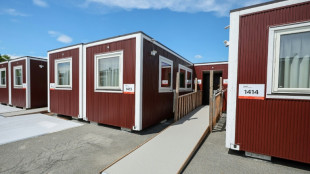
 Indians living in Japan on stand-by to house Asian Games athletes
 Trump signs bill authorizing sweeping Russia sanctions

 Protesters form human chain at Kennedy Center after Trump threat

 Death toll from attack at police HQ in Pakistan rises to 31

 Trump says Denmark to give US 'permanent control' over Greenland security

 Kennedy Center: future unclear for iconic Washington arts hub

 Trump claims 'infinite' Greenland security deal with Denmark

 Helicopters battle wildfire threatening Ecuador's capital

 Brentford batter Chelsea to undo Alonso's promising start

 Kane hits Bundesliga century as Bayern rout Union

 Trump says CNN, MS NOW, Politico banned from White House

 Hushing and hedging: US companies retreat on climate

 Springboks to face Fiji before 2027 Rugby World Cup

 Nigeria miners struggled to breathe in cell before 37 died: survivors

 McIlroy on the charge at PGA Championship as Reed withdraws

 McIlroy on the charge at PGA Championship

 Crisis-wracked Volkswagen warns of 10-bn-euro hit to profits

 Costa Rica's Grynspan tops third informal poll for UN chief: diplomat

 Stock markets retreat after central bank rate hikes

 Russia labels director of Cannes Grand Prix winner a 'foreign agent'

 Macron warns of Russian 'hybrid' threat after meeting presidential hopefuls

 UN holds third informal poll for new chief

 Kulusevski return can spark Spurs: De Zerbi

 Shakira to cap off world tour with Madrid 12-gig run

South Korea experienced its highest average summertime temperature since such records began half a century ago, nearly two degrees higher than the historic average, the weather agency said Thursday.
From June to August, the average temperature in the country was 25.6 degrees Celsius (78.08 Fahrenheit), the Korea Meteorological Administration said.
That is the highest figure since the agency set up nationwide observation posts in 1973, it said, and is 1.9 degrees higher than the historical average for summer.
"From mid-June, temperatures remained higher than in previous years, even during the monsoon season when temperatures traditionally drop," the KMA said.
KMA head Jang Dong-un said climate change was altering South Korea's weather patterns.
"We experienced heavy downpours during the monsoon season, and the prolonged heat wave and tropical nights caused significant discomfort and damage to the public," Jang said.
"As climate change is altering the climate characteristics of our country, the Korea Meteorological Administration will work hard to strengthen its monitoring and analysis capabilities for abnormal weather conditions."
Much of the world is enduring a blisteringly hot summer, with UN Secretary-General Antonio Guterres warning in July that humanity is suffering an "extreme heat epidemic" and calling for action to limit the impacts of heat waves intensified by climate change.
"This record-breaking figure is not surprising at all, as it was predicted earlier this year by the World Meteorological Organization regarding abnormal temperatures," said Kim Hae-dong, professor of meteorology at Keimyung University.
"I expect the same pattern to emerge next year, with climate change verging on a climate crisis in many parts of the world, including South Korea."
- Tropical nights -
South Korea also experienced the longest stretch of tropical nights on record, averaging 20.2 days for the June to August period -— triple the previous average of 6.5 days, the KMA said in a press release.
The phenomenon of "tropical nights" refers to nights when the temperature does not fall below 25C.
"With a consistent influx of hot and humid air carried by southwesterly winds, tropical nights occurred without a drop in night-time temperatures," the KMA said.
Seoul, the capital of around 10 million, shattered its previous record and experienced 39 consecutive tropical nights this summer, far surpassing the previous high of 26 days.
The European Copernicus Climate Change Service reported that the global average temperature for the 12 months from July 2023 to June 2024 was the highest on record.
According to the International Institute for Environment and Development (IIED), the number of days with temperatures reaching 35C in the world's largest capital cities has surged by 52 percent over the past 30 years.
Scientists stress that frequent heatwaves are a hallmark of global warming, driven by climate change.
Last week, South Korea's Constitutional Court ruled that much of the country's climate goals were unconstitutional, handing a landmark victory to young environmental activists, and forcing the government to revise its climate targets.
The plaintiffs had argued that unless Seoul moved more quickly on climate goals, future generations would not only have to live in a degraded environment, but also have to bear the burden of undertaking massive greenhouse gas reductions.
This, the case claims, would mean that the state has violated its duty to protect their fundamental rights.
F.Cardoso--PC



