Floods hit millions in West and Central Africa / Photo: BOUREIMA HAMA - AFP/File

 Indonesia accepts Malaysia's help to tackle wildfires

 Indians living in Japan on stand-by to house Asian Games athletes
 Trump signs bill authorizing sweeping Russia sanctions

 Protesters form human chain at Kennedy Center after Trump threat

 Death toll from attack at police HQ in Pakistan rises to 31

 Trump says Denmark to give US 'permanent control' over Greenland security

 Kennedy Center: future unclear for iconic Washington arts hub

 Trump claims 'infinite' Greenland security deal with Denmark

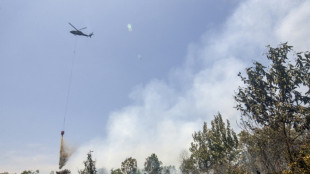
 Helicopters battle wildfire threatening Ecuador's capital

 Brentford batter Chelsea to undo Alonso's promising start

 Kane hits Bundesliga century as Bayern rout Union

 Trump says CNN, MS NOW, Politico banned from White House

 Hushing and hedging: US companies retreat on climate

 Springboks to face Fiji before 2027 Rugby World Cup

 Nigeria miners struggled to breathe in cell before 37 died: survivors

 McIlroy on the charge at PGA Championship as Reed withdraws

 McIlroy on the charge at PGA Championship

 Crisis-wracked Volkswagen warns of 10-bn-euro hit to profits

 Costa Rica's Grynspan tops third informal poll for UN chief: diplomat

 Stock markets retreat after central bank rate hikes

 Russia labels director of Cannes Grand Prix winner a 'foreign agent'

 Macron warns of Russian 'hybrid' threat after meeting presidential hopefuls

 UN holds third informal poll for new chief

 Kulusevski return can spark Spurs: De Zerbi

 Shakira to cap off world tour with Madrid 12-gig run

Parts of Central and West Africa have seen heavy flooding over an unusually intense rainy season, unleashing a humanitarian crisis in which hundreds have been killed and hundreds of thousands displaced.
The summer of 2024 was the hottest ever recorded on Earth and record after record has tumbled over the past year.
Heatwaves, droughts and deadly flooding have followed in their wake, provoked by unrelentless global warming.
Here is a round-up of the impact of the flooding:
- Chad: 1.5 million victims -
Weeks of torrential rains in Chad have left 341 people dead and some 1.5 million affected since July, the UN's Office for the Coordination of Humanitarian Affairs (OCHA) said in early September.
The flooding has hit all of the country's 23 provinces, it said.
It cited government data which said some 164,000 houses had been destroyed, 66,700 heads of cattle lost, with 259,000 hectares (640,000 acres) of fields ruined.
It said refugee communities in the east of the country are particularly vulnerable, with 40,000 refugees hit, according to the UN refugee agency, UNHCR.
- Niger: nearly 650,000 displaced -
In Niger, heavy rains since June have killed 273 and affected more than 700,000, authorities said early this month.
The flooding has devastated infrastructure, destroyed nearly 50,000 houses and disrupted the education of more than 39,000 children, according to the UNHCR.
The disruption has particularly hit southern regions where a large number of refugees have sought shelter.
- Nigeria: 225,000 displaced -
Neighbouring Nigeria has seen 29 of its 36 states -- mostly in the north -- hit by rising waters in the River Niger and its major Benue tributary since mid-July.
More than 600,000 people have been affected, the UNHCR says.
At least 200 people have been killed and more than 225,000 displaced, many of whom were already uprooted by conflicts and climate change.
The Nigerian government says over 115,265 hectares of farmland have also been damaged, and one child in six had faced hunger between June and August, an increase of 25 percent compared to the same period last year.
- South Sudan, Sudan: 1.2 million uprooted -
Meanwhile, in the east, in Sudan and South Sudan, floods have left dozens dead and uprooted 1.2 million people, according to the UN's humanitarian agencies.
South Sudan, one of the poorest countries in the world, has lived through its most serious floods for decades.
The UN's humanitarian agency, OCHA, said that as of September 5 "flooding has affected more than 710,000 people across 30 of 78 counties".
"Floods have caused extensive damage to homes, crops and critical infrastructure, disrupting education and health services and increasing the risk of disease outbreaks," it said.
Neighbouring Sudan is hit by flooding every year but the war between rival generals which has been going on for more than 16 months has driven millions of displaced into flood-vulnerable zones.
OCHA says that more than 490,000 people are affected by rain and flooding, especially in the north and east of the country.
At least 132 people have died, according to the health ministry on August 26.
The UNHCR on September 6 said that more than 35,000 houses had been destroyed and nearly 45,000 damaged. Thousands of children were threatened by a cholera epidemic caused by the floods and the stagnation of flood waters.
Ferreira--PC