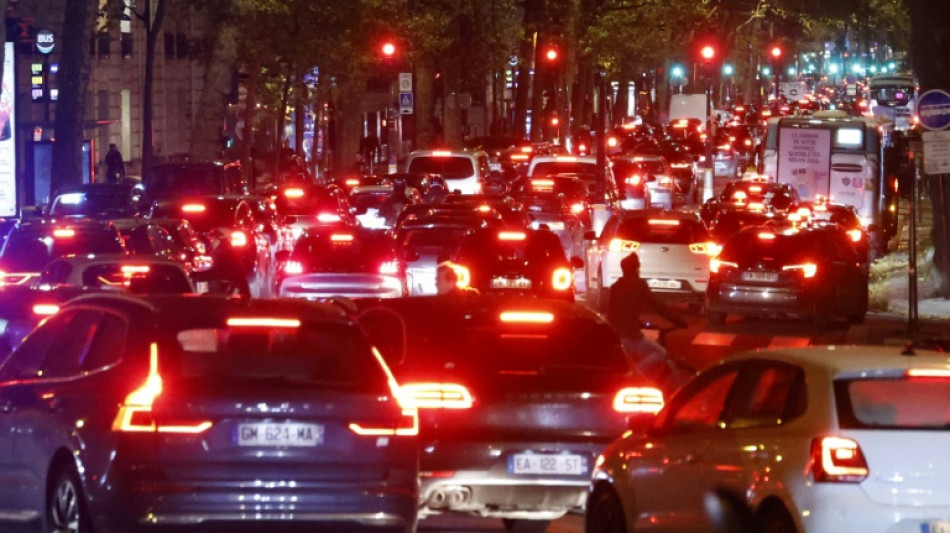
Fine particle pollution blamed for nearly 240,000 EU deaths in 2022 / Photo: Ludovic MARIN - AFP

 Equitas Small Finance Bank rebounds after naming interim chief executive

 Titan quarterly profit seen rising as jewellery business drives growth

 Kuwait finance minister holds economic cooperation talks at COMCEC

 Abdul El-Sayed declares victory in Michigan Senate contest

 Democrats capture US Congress in sweeping midterm victory

 Manchester United rallies past Roma as PSG dominates in Champions League

 Qatar sees tentative opening for renewed regional diplomacy

 Qatar Tourism joins Pacific Asia Travel Association at London travel market

 Abdul El-Sayed Wins Michigan Senate Seat in Historic Election

 Qatar media bodies discuss support for humanitarian initiatives

Fine particle air pollution killed nearly 240,000 people in the European Union in 2022, a five percent fall on the previous year, the European Environment Agency said in a report published Tuesday.
The agency estimated there were "at least 239,000" deaths attributable to exposure to above-recommended levels of PM2.5, the smallest particulate matter that can be inhaled and the most dangerous to human health.
The number of deaths was highest in Italy, Poland and Germany.
Across the continent the figure was down compared with 2021, when particulate matter, which can penetrate deep into the lungs, caused the premature deaths of 253,000 people.
Overall the agency said the estimated impact on health from long-term exposure to three key air pollutants -- fine particulate matter, nitrogen dioxide and ozone -- was improving.
Between 2005 and 2022, the number of deaths attributable to PM2.5s dropped 45 percent, keeping the continent on target to cut such deaths by 55 percent by 2030.
The report said there were 70,000 deaths attributable to exposure to ozone (O3) pollution, particularly from road traffic and industrial activity.
There were 48,000 premature deaths blamed on nitrogen dioxide (NO2), mainly from vehicles and thermal power plants.
The agency does not add up the figures, as it believes this would lead to some deaths being counted twice, but emphasises that air pollution remains the biggest environmental threat to the health of Europeans.
P.Queiroz--PC



