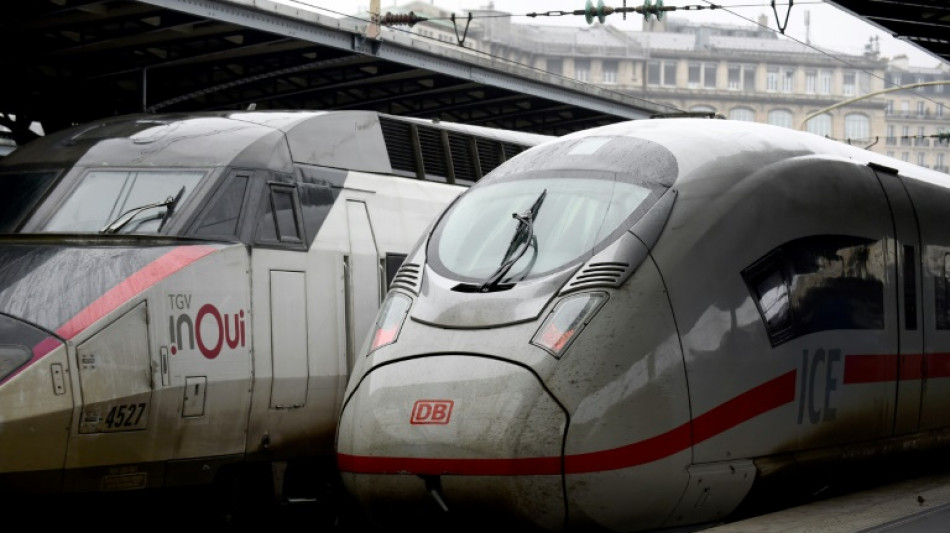
Paris-Berlin direct daytime highspeed rail link launched / Photo: ERIC PIERMONT - AFP/File

 Equitas Small Finance Bank rebounds after naming interim chief executive

 Titan quarterly profit seen rising as jewellery business drives growth

 Kuwait finance minister holds economic cooperation talks at COMCEC

 Abdul El-Sayed declares victory in Michigan Senate contest

 Democrats capture US Congress in sweeping midterm victory

 Manchester United rallies past Roma as PSG dominates in Champions League

 Qatar sees tentative opening for renewed regional diplomacy

 Qatar Tourism joins Pacific Asia Travel Association at London travel market

 Abdul El-Sayed Wins Michigan Senate Seat in Historic Election

 Qatar media bodies discuss support for humanitarian initiatives

French and German rail operators launched the first direct high-speed rail link between Paris and Berlin on Monday, in response to growing European demand for train travel.
The inaugural service, a German ICE train, left the French capital's Gare de l'Est station at 9:55 am (0855 GMT) and was due at Berlin Hauptbahnhof at 6:03 pm.
The service shaves only minutes off the fastest one-change connection between both capitals.
The trains run at up to 320 kilometres (199 miles) per hour while in France, but that speed drops to a maximum 250 km/h in Germany -- only just meeting the definition of high-speed rail travel.
A one-way ticket for the 1,100- kilometre journey costs upwards of 99 euros ($104), rising sharply on busy days.
Budget airlines, such as easyJet, charge around half that for a 1h45 nonstop flight between both capitals.
But French rail operator SNCF has reported an occupancy rate of over 80 percent for the new trains.
"Bookings are going very well," said SNCF boss Jean-Pierre Farandou. "People like to travel in comfort rather than negotiating the sometimes difficult access" to airports, he said.
Lea Bader, who travelled on Monday's train, said she did not hesitate to take the train because she would have had to buy an extra ticket for her cello on a plane.
She said the train was also more comfortable, and she welcomed the absence of a need to change trains which she said had been "horrible, because each time there was a problem or a delay".
A third of Germany's high-speed train services suffered delays in 2023, and line closures because of repairs or maintenance work are commonplace.
Kevin Kern, a 33-year-old Berliner, said his main motivation for rail travel is "the environment", with the trip generating an estimated 100 times less CO2 emissions per passenger than taking the plane.
SNCF and Deutsche Bahn together account for 30 million journeys between France and Germany.
SNCF's Farandou meanwhile said he was "perfectly confident" that the new daytime service will not see the same problems as a night service between Paris and Berlin relaunched a year ago after a near-10-year pause.
The night service has been dogged with delays, and was even halted completely between August and October of last year because of railway work done on the German side.
A.Motta--PC



