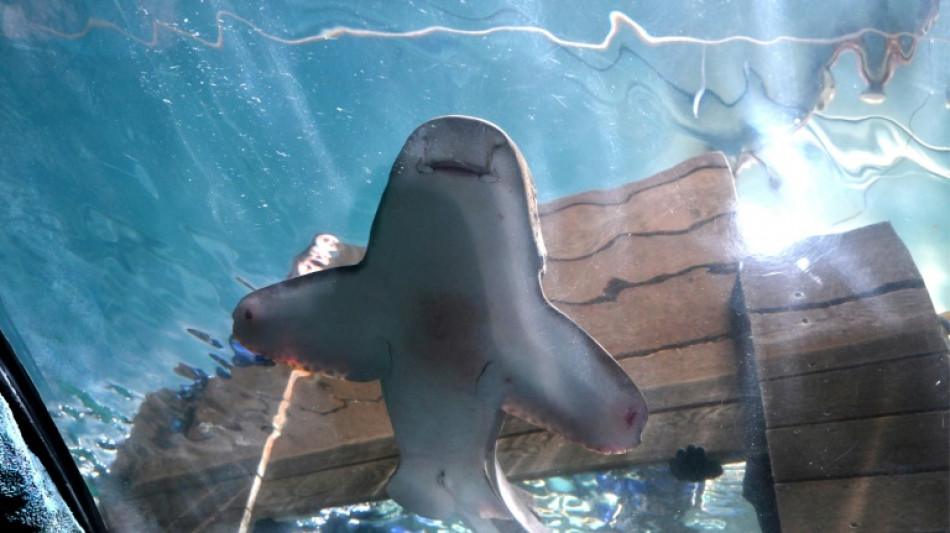
Scientists artificially inseminate leopard sharks to boost diversity / Photo: Saeed KHAN - AFP

 Indians living in Japan on stand-by to house Asian Games athletes

 Trump signs bill authorizing sweeping Russia sanctions

 Protesters form human chain at Kennedy Center after Trump threat

 Death toll from attack at police HQ in Pakistan rises to 31

 Trump says Denmark to give US 'permanent control' over Greenland security

 Kennedy Center: future unclear for iconic Washington arts hub

 Trump claims 'infinite' Greenland security deal with Denmark

 Helicopters battle wildfire threatening Ecuador's capital

 Brentford batter Chelsea to undo Alonso's promising start

 Kane hits Bundesliga century as Bayern rout Union

 Trump says CNN, MS NOW, Politico banned from White House

 Hushing and hedging: US companies retreat on climate

 Springboks to face Fiji before 2027 Rugby World Cup

 Nigeria miners struggled to breathe in cell before 37 died: survivors

 McIlroy on the charge at PGA Championship as Reed withdraws

 McIlroy on the charge at PGA Championship

 Crisis-wracked Volkswagen warns of 10-bn-euro hit to profits

 Costa Rica's Grynspan tops third informal poll for UN chief: diplomat

 Stock markets retreat after central bank rate hikes

 Russia labels director of Cannes Grand Prix winner a 'foreign agent'

 Macron warns of Russian 'hybrid' threat after meeting presidential hopefuls

 UN holds third informal poll for new chief

 Kulusevski return can spark Spurs: De Zerbi

 Shakira to cap off world tour with Madrid 12-gig run

 Isolated Syrian-Druze city blames Damascus for shortages

A black-and-cream leopard shark enters a hypnotic-like state of relaxation as scientists at Sydney Aquarium carefully roll her onto her back in a small pool.
The shark, named Zimba, is one of the first captive leopard sharks in the world to be artificially inseminated with the sperm of wild sharks in an attempt to build populations around the world.
If the process is successful, Zimba's shark pups will be sent to the Raja Ampat region in Indonesia, where the local population is on the brink of extinction due to unsustainable fishing practices and habitat destruction.
Artificial insemination allows sharks that would never normally interact to breed and increase genetic diversity, said SEA LIFE Australia and New Zealand regional coordinator Laura Simmons.
Simmons hopes that eventually the leopard shark population will be "genetically viable and capable of maintaining a self-sustaining population in the wild".
That could take years, she told AFP, but "this is one step closer to where we need to be".
The procedure is one part of a larger worldwide leopard shark breeding programme, known as StAR, that involves more than 60 conservation groups, aquariums and government agencies.
Globally, about 37 percent of oceanic shark and ray species, including the leopard shark, are now listed as either endangered or critically endangered by the International Union for Conservation of Nature, a global database for threatened species.
- 'Species belongs outside' -
Australia's leopard shark populations remain plentiful and of least concern, and scientists hope they can help bolster the numbers in other regions.
Back at the Sydney Aquarium pool, Ocean Park Hong Kong's chief veterinarian Paolo Martelli inserts a metal tube filled with the sperm of wild leopard sharks into Zimba's underside.
The shark is still in a natural state called tonic immobility -- a relaxed condition that allows scientists to work without getting injured.
The whole process takes a matter of minutes and everyone claps and cheers once it is over. Zimba is flipped back onto her stomach and swims around the pool as if nothing happened.
Martelli is using a technique he developed and has successfully used on other species, but this is the first time it has been used on leopard sharks.
"It's not straightforward," he said.
Martelli and his team collected the sperm of wild leopard sharks off the coast of Queensland -- which has a large shark population -- and brought the precious cargo to Sydney.
Only three of four samples taken survived the journey.
"This species belongs in outside habitats, not in a museum," Martelli said.
But as the shark's habitat declines, scientists must give a "helping hand" in protecting and conserving this valuable species, he added.
"It is safe to say that sharks have suffered a lot in the last century."
L.Mesquita--PC



