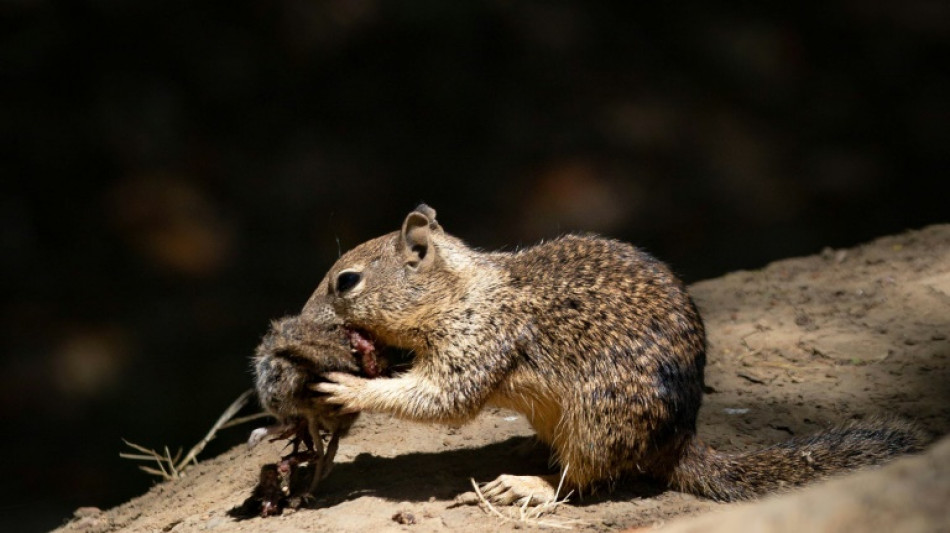
Cute carnivores: Bloodthirsty California squirrels go nuts for vole meat / Photo: Sonja Wild - University of California, Davis/AFP

 Equitas Small Finance Bank rebounds after naming interim chief executive

 Titan quarterly profit seen rising as jewellery business drives growth

 Kuwait finance minister holds economic cooperation talks at COMCEC

 Abdul El-Sayed declares victory in Michigan Senate contest

 Democrats capture US Congress in sweeping midterm victory

 Manchester United rallies past Roma as PSG dominates in Champions League

 Qatar sees tentative opening for renewed regional diplomacy

 Qatar Tourism joins Pacific Asia Travel Association at London travel market

 Abdul El-Sayed Wins Michigan Senate Seat in Historic Election

 Qatar media bodies discuss support for humanitarian initiatives

Squirrels might look like adorable, nut-hoarding furballs, but some are ruthless predators that hunt, tear apart, and devour voles.
That's the startling finding of a new study published Wednesday in the Journal of Ethology -- the first to document widespread carnivorous behavior in these seemingly innocent creatures.
"This was shocking," said lead author Jennifer E. Smith, an associate professor of biology at the University of Wisconsin-Eau Claire.
"We had never seen this behavior before. Squirrels are one of the most familiar animals to people. We see them right outside our windows; we interact with them regularly.
"Yet here's this never-before-encountered-in-science behavior that sheds light on the fact that there's so much more to learn about the natural history of the world around us."
The observations were made this summer, during the 12th year of a long-term study conducted at Briones Regional Park in Contra Costa County, California.
Between June and July, researchers recorded 74 interactions involving California ground squirrels and voles, with 42 percent of them involving active hunting of their fellow rodents.
Co-author Sonja Wild, a postdoctoral researcher at the University of California, Davis, admitted she was initially skeptical of the reports brought to her by undergraduate students who first witnessed the behavior.
"I could barely believe my eyes," said Wild. But "once we started looking, we saw it everywhere."
It was previously known that as many as 30 species of squirrels opportunistically consume meat, ranging from small fish to birds. However, it was unclear whether this behavior stemmed from scavenging or active predation.
The new study is the first to confirm that hunting is, in fact, a common behavior.
Researchers observed squirrels crouching low to the ground before ambushing their prey, though more often, they chased voles, pounced, and delivered a neck bite followed by vigorous shaking.
The study also found that the squirrels' carnivorous behavior peaked during the first two weeks of July, coinciding with a surge in vole populations reported by citizen scientists on the iNaturalist app.
"This shows the squirrels are behaviorally flexible and can respond to changes in food availability," said Wild.
Other species, such as raccoons, coyotes, and spotted hyenas, have been known to adapt their hunting strategies in response to human-induced changes in their environments.
Several questions still remain unanswered.
Researchers hope to investigate how widespread hunting behavior is among squirrel species, whether it is passed down from parents to pups, and how it affects their broader ecosystems.
H.Portela--PC



