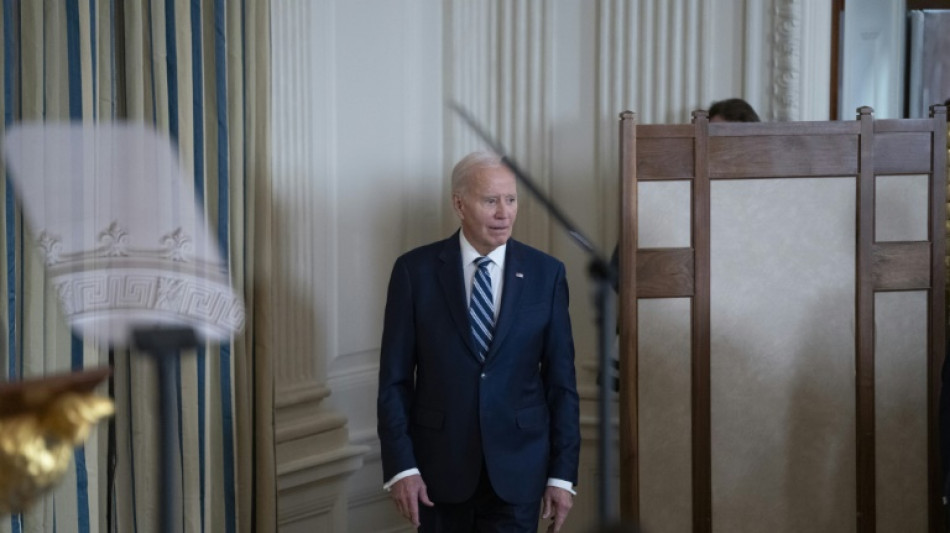
Biden issues major coastal protection before Trump handover / Photo: Chris Kleponis - AFP

 Equitas Small Finance Bank rebounds after naming interim chief executive

 Titan quarterly profit seen rising as jewellery business drives growth

 Kuwait finance minister holds economic cooperation talks at COMCEC

 Abdul El-Sayed declares victory in Michigan Senate contest

 Democrats capture US Congress in sweeping midterm victory

 Manchester United rallies past Roma as PSG dominates in Champions League

 Qatar sees tentative opening for renewed regional diplomacy

 Qatar Tourism joins Pacific Asia Travel Association at London travel market

 Abdul El-Sayed Wins Michigan Senate Seat in Historic Election

 Qatar media bodies discuss support for humanitarian initiatives

US President Joe Biden on Monday banned offshore drilling across an immense area of coastal waters, weeks before Donald Trump takes office pledging to massively increase fossil fuel production.
The ban encompasses the entire Atlantic coast and eastern Gulf of Mexico, as well as the Pacific coast off California, Oregon and Washington, and a section of the Bering Sea off Alaska.
A White House statement said the declaration protected more than 625 million acres (253 million hectares) of waters.
"As the climate crisis continues to threaten communities across the country and we are transitioning to a clean energy economy, now is the time to protect these coasts for our children and grandchildren," Biden said in a statement.
"In balancing the many uses and benefits of America's ocean, it is clear to me that the relatively minimal fossil fuel potential in the areas I am withdrawing do not justify the environmental, public health, and economic risks that would come from new leasing and drilling," he added.
The ban does not have an end date and could be legally -- and politically -- tricky for Trump to overturn.
"It's ridiculous. I'll unban it immediately... I have the right to unban it immediately," Trump said shortly after the announcement in a radio interview with a conservative radio host.
Biden is taking the action under the Outer Continental Shelf Lands Act of 1953, which gives the federal government authority over the exploitation of offshore resources.
The law however does not expressly provide for presidents to unilaterally reverse a drilling ban without going through Congress.
During his campaign, Trump pledged to "unleash" domestic fossil fuel production in a bid to lower gas costs, despite the country already seeing record high extraction rates.
After US media reported late last week that Biden would issue such a ban, Karoline Leavitt, Trump's incoming press secretary, called the move "a disgraceful decision designed to exact political revenge on the American people who gave President Trump a mandate to increase drilling and lower gas prices."
Environmental NGOs, on the other hand, welcomed the decision.
"This is an epic ocean victory!" said Joseph Gordon, Oceana's Climate and Energy Director.
"Our treasured coastal communities are now safeguarded for future generations," he said.
"With today's withdrawals, President Biden has now conserved more than 670 million acres of US lands, waters, and ocean -- more than any president in history," the White House said.
The move is the latest in a string of last minute climate policy actions by the Biden administration ahead of Trump's return to the White House.
In mid-December, the outgoing administration issued an ambitious new climate target under the landmark Paris accord, committing the United States to reducing economy-wide greenhouse gas emissions by 61-66 percent below 2005 levels by 2035, on the path to achieving net zero by 2050.
E.Borba--PC



