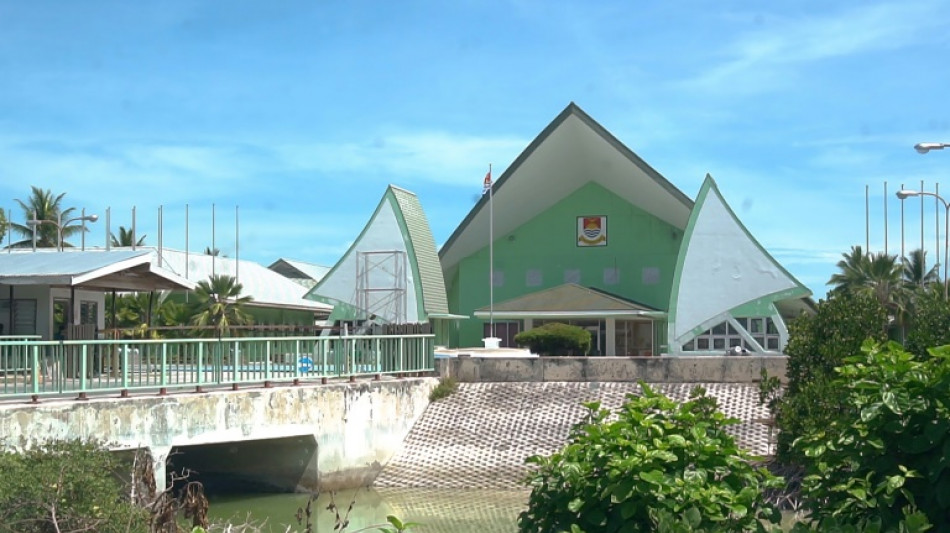
Kiribati eyes deep-sea mining deal with China / Photo: Raimon Kataotao - AFP/File

 Indians living in Japan on stand-by to house Asian Games athletes
 Trump signs bill authorizing sweeping Russia sanctions

 Protesters form human chain at Kennedy Center after Trump threat

 Death toll from attack at police HQ in Pakistan rises to 31

 Trump says Denmark to give US 'permanent control' over Greenland security

 Kennedy Center: future unclear for iconic Washington arts hub

 Trump claims 'infinite' Greenland security deal with Denmark

 Helicopters battle wildfire threatening Ecuador's capital

 Brentford batter Chelsea to undo Alonso's promising start

 Kane hits Bundesliga century as Bayern rout Union

 Trump says CNN, MS NOW, Politico banned from White House

 Hushing and hedging: US companies retreat on climate

 Springboks to face Fiji before 2027 Rugby World Cup

 Nigeria miners struggled to breathe in cell before 37 died: survivors

 McIlroy on the charge at PGA Championship as Reed withdraws

 McIlroy on the charge at PGA Championship

 Crisis-wracked Volkswagen warns of 10-bn-euro hit to profits

 Costa Rica's Grynspan tops third informal poll for UN chief: diplomat

 Stock markets retreat after central bank rate hikes

 Russia labels director of Cannes Grand Prix winner a 'foreign agent'

 Macron warns of Russian 'hybrid' threat after meeting presidential hopefuls

 UN holds third informal poll for new chief

 Kulusevski return can spark Spurs: De Zerbi

 Shakira to cap off world tour with Madrid 12-gig run

 Isolated Syrian-Druze city blames Damascus for shortages

Pacific nation Kiribati says it is exploring a deep-sea mining partnership with China, dangling access to a vast patch of Pacific Ocean harbouring coveted metals and minerals.
Beijing has been ramping up efforts to court Pacific nations sitting on lucrative seafloor deposits of cobalt, nickel and copper -- recently inking a cooperation deal with Cook Islands.
Kiribati opened discussions with Chinese ambassador Zhou Limin after a longstanding agreement with leading deep-sea mining outfit The Metals Company fell through.
"The talk provides an exciting opportunity to explore potential collaboration for the sustainable exploration of the deep-ocean resources in Kiribati," the government said Monday evening in a statement.
Pacific nations Kiribati, Cook Islands and Nauru sit at the forefront of a highly contentious push to mine the depths of the ocean.
Kiribati holds rights for deep-sea mining exploration across a 75,000-square-kilometre swathe of the Pacific, in a region known as the Clarion Clipperton Zone.
Through state-backed subsidiary Marawa Research, Kiribati had been working with Canada-based The Metals Company to explore the mineral deposits.
But that agreement was terminated "mutually" at the end of 2024, The Metals Company told AFP.
A Kiribati fisheries official said the nation was now exploring opportunities with other foreign partners.
The Metals Company said Kiribati's mining rights were "less commercially favourable" than other projects with Pacific nations Nauru and Tonga.
Kiribati's announcement comes as international regulators begin a series of crunch meetings that could decide the fate of the nascent industry.
The Metals Company and other industry players are pushing the International Seabed Authority to set rules allowing large-scale exploitation.
- 'Bending over backwards' -
Kiribati, a climate-threatened archipelago home to some 130,000 people, lays claim to an ocean expanse that forms one of the largest exclusive economic zones in the world.
Under incumbent President Taneti Maamau it severed diplomatic links with Taiwan in 2019, forming deeper ties to China.
Chinese companies have in recent years been granted rights to harvest Kiribati's profitable fisheries -- one of the nation's few natural resources besides minerals.
A visiting cadre of Beijing police have also visited the capital Tarawa to help train local Kiribati forces.
Tessie Lambourne, a leading member of Kiribati's opposition, said China seemed to be seeking access to "our maritime space for its own interest".
"I always say that our government is bending over backwards to please China," she told AFP.
China and Cook Islands struck a five-year cooperation agreement in February to study the Pacific nation's seabed mineral riches.
The deal did not include any exploration or mining licence.
Companies hope to earn billions by scraping the ocean floor for polymetallic rocks, or nodules, that are loaded with manganese, cobalt, copper and nickel -- metals used to build batteries for electric vehicles.
Pacific nations such as Nauru and Kiribati believe the industry holds the key to economic prosperity in a region where scarce land is already under threat from rising seas.
But neighbours Palau, Fiji and Samoa are staunchly opposed, pushing for lingering environmental questions to be cleared up before anyone takes the plunge.
P.Serra--PC



