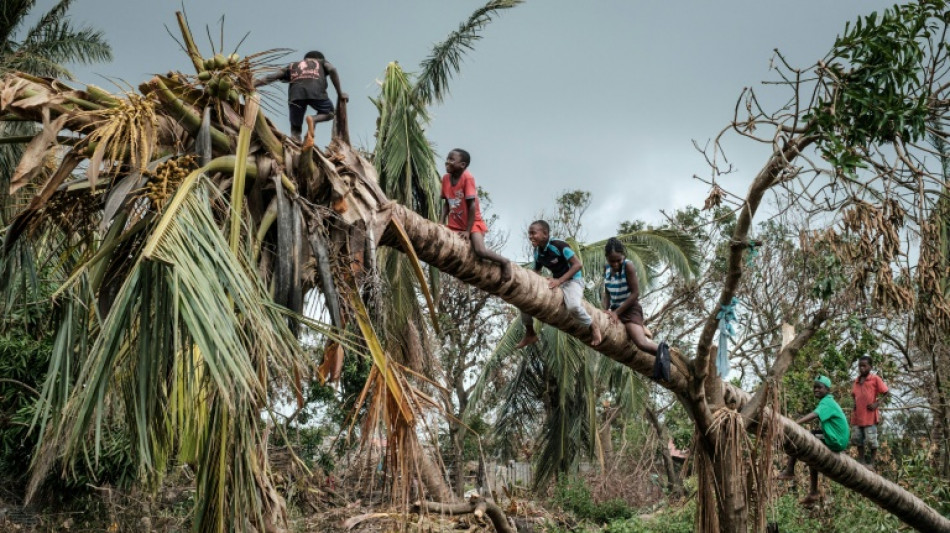
Mozambique cyclone cluster raises fears of new norm / Photo: Yasuyoshi CHIBA - AFP

 Indians living in Japan on stand-by to house Asian Games athletes

 Trump signs bill authorizing sweeping Russia sanctions

 Protesters form human chain at Kennedy Center after Trump threat

 Death toll from attack at police HQ in Pakistan rises to 31

 Trump says Denmark to give US 'permanent control' over Greenland security

 Kennedy Center: future unclear for iconic Washington arts hub

 Trump claims 'infinite' Greenland security deal with Denmark

 Helicopters battle wildfire threatening Ecuador's capital

 Brentford batter Chelsea to undo Alonso's promising start

 Kane hits Bundesliga century as Bayern rout Union

 Trump says CNN, MS NOW, Politico banned from White House

 Hushing and hedging: US companies retreat on climate

 Springboks to face Fiji before 2027 Rugby World Cup

 Nigeria miners struggled to breathe in cell before 37 died: survivors

 McIlroy on the charge at PGA Championship as Reed withdraws

 McIlroy on the charge at PGA Championship

 Crisis-wracked Volkswagen warns of 10-bn-euro hit to profits

 Costa Rica's Grynspan tops third informal poll for UN chief: diplomat

 Stock markets retreat after central bank rate hikes

 Russia labels director of Cannes Grand Prix winner a 'foreign agent'

 Macron warns of Russian 'hybrid' threat after meeting presidential hopefuls

 UN holds third informal poll for new chief

 Kulusevski return can spark Spurs: De Zerbi

 Shakira to cap off world tour with Madrid 12-gig run

 Isolated Syrian-Druze city blames Damascus for shortages

Three cyclones have battered Mozambique in three months, pounding one of the world's most impoverished regions, pushing thousands of people into distress and leaving experts wondering whether more frequent storms will become the norm.
The unusually clustered series of cyclones has also piled pressure on aid groups assisting people in the area, where the repeated disasters have destroyed tens of thousands of homes.
"Mozambique is experiencing a truly bad series of cyclonic impacts," said Sebastien Langlade, chief cyclone forecaster at the Regional Specialized Meteorological Centre based on Reunion island in the Indian Ocean.
The first of this cyclone season -- which typically runs from November to after April -- was Chido which struck in mid-December, killing at least 120 people after tearing through the French territory of Mayotte.
Dikeledi made landfall in January, claiming at least five lives.
And then came Jude, which last week brought winds of up to 195 kilometres (120 miles) an hour, according to Mozambican authorities. It killed at least 16 people in the country and destroyed more than 40,000 homes.
It affected around 420,000 people across Madagascar, Malawi and Mozambique, the UN has said.
Jude and Dikeledi made landfall at almost the same location in the province of Nampula, about 1,400 kilometres (870 miles) north of the capital Maputo. Chido hit about 200 kilometres further north.
- Repeat disasters -
"It's double tragedy. These are communities that did not have an opportunity to recover from the first cyclone," the head of the Red Cross and Red Crescent delegation in Maputo, Naemi Heita, told AFP.
The impoverished and remote area is home to some of the most vulnerable people in the world, "who are just not well set-up to withstand these kind of impacts," UNICEF's Mozambique spokesperson Guy Taylor said.
By the time Jude arrived, "all river basins and dams in Nampula province were already almost full," said Taylor.
The recurring disasters are also putting strain on the capacity of international aid organisations to respond.
"Supplies become depleted -- after one cyclone, two cyclones, three cyclones, you start to run out," said Taylor.
While the extreme weather is leaving these regions increasingly vulnerable, there is no matching rise in resources available to help them, said Heita.
"We are definitely concerned about the increase of the disasters, the intensity as well as the frequency. And that has made us realise that we need to invest more into preparedness," she said.
- Increased frequency -
This part of central Mozambique has experienced some terrifying storms, including Idai which claimed more than 600 lives in 2019.
Even if the number of people killed in this season's cyclones was lower than some previous ones, experts are seeing an increase in frequency.
Mozambique has been struck by eight cyclones since 2019, said Langlade. "This is unprecedented in the cyclonic history of the country," said the meteorologist who has catalogued all weather systems that affected the area since satellites were first used in 1969.
Previously there were between six and seven such events -- cyclones as well as tropical storms -- a decade, he said. But in the previous six seasons, there had already been 10, he added.
A factor may be the warming of the waters in the Mozambique channel between Madagascar and Africa, with warmer seas among the elements that fuel cyclones, he said.
For the whole of the southwestern Indian Ocean area, eight of the 11 recorded tropical storms this season reached cyclone intensity, the expert said.
"This ratio is above normal. Typically, it is 50 percent, but so far it has exceeded 70 percent," he said.
"Is this simply a natural long-term fluctuation or is it a response to climate change? It's still too early to tell."
"Adaptation is necessary," said Taylor. UNICEF has, for example, built more than 1,000 classrooms in Mozambique that can stand up to cyclones.
Preparedness also saves lives, he said. "It really makes the case for investing in resilience, because if you don't, it's almost like not having infrastructure in some of these places, because it just gets knocked down time and time again."
P.L.Madureira--PC



