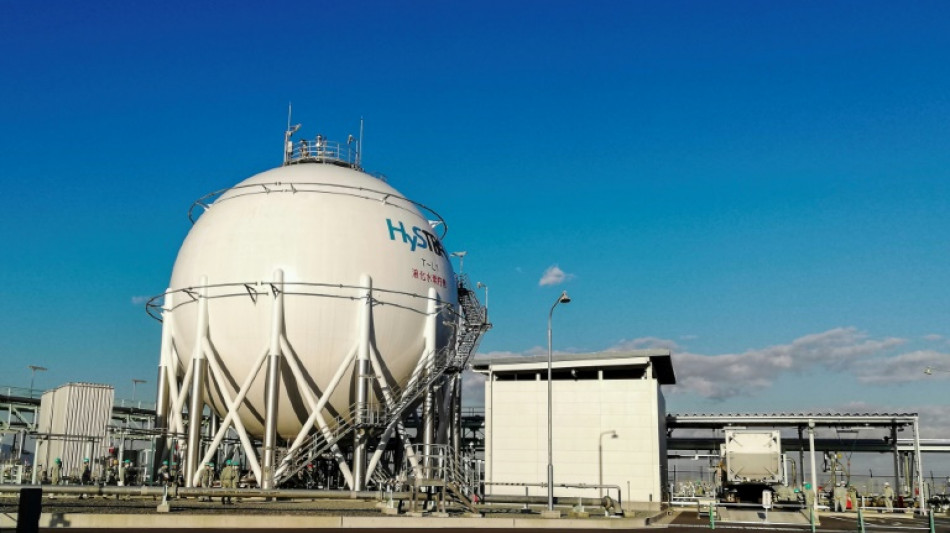
Japan-Australia flagship hydrogen project stumbles / Photo: Etienne BALMER - AFP

 Indians living in Japan on stand-by to house Asian Games athletes
 Trump signs bill authorizing sweeping Russia sanctions

 Protesters form human chain at Kennedy Center after Trump threat

 Death toll from attack at police HQ in Pakistan rises to 31

 Trump says Denmark to give US 'permanent control' over Greenland security

 Kennedy Center: future unclear for iconic Washington arts hub

 Trump claims 'infinite' Greenland security deal with Denmark

 Helicopters battle wildfire threatening Ecuador's capital

 Brentford batter Chelsea to undo Alonso's promising start

 Kane hits Bundesliga century as Bayern rout Union

 Trump says CNN, MS NOW, Politico banned from White House

 Hushing and hedging: US companies retreat on climate

 Springboks to face Fiji before 2027 Rugby World Cup

 Nigeria miners struggled to breathe in cell before 37 died: survivors

 McIlroy on the charge at PGA Championship as Reed withdraws

 McIlroy on the charge at PGA Championship

 Crisis-wracked Volkswagen warns of 10-bn-euro hit to profits

 Costa Rica's Grynspan tops third informal poll for UN chief: diplomat

 Stock markets retreat after central bank rate hikes

 Russia labels director of Cannes Grand Prix winner a 'foreign agent'

 Macron warns of Russian 'hybrid' threat after meeting presidential hopefuls

 UN holds third informal poll for new chief

 Kulusevski return can spark Spurs: De Zerbi

 Shakira to cap off world tour with Madrid 12-gig run

 Isolated Syrian-Druze city blames Damascus for shortages

Japan wants to become a hydrogen fuel leader to meet its net-zero goals, but one blockbuster project is hanging in the balance over questions about its climate credentials.
The Hydrogen Energy Supply Chain (HESC) is billed as a billion-dollar attempt to ship liquid hydrogen from Australia to Japan.
However, cold feet about the project in Australia means HESC will source hydrogen from Japan to meet a 2030 deadline for its demonstration phase.
Hydrogen sounds promising on paper: while fossil fuels emit planet-warming greenhouse gases, burning hydrogen creates only water vapour.
But it has not yet lived up to its promise, with several much-hyped projects globally struggling to overcome high costs and engineering challenges.
Hydrogen's climate credentials also depend on how it is produced.
"Green hydrogen" uses renewable energy, while "blue hydrogen" relies on fossil fuels such as coal and gas, with carbon-capture technology to reduce emissions.
"Brown hydrogen" is produced by fossil fuels without any carbon capture.
The HESC project aims to produce blue hydrogen in the Australian state of Victoria, harnessing abundant local supplies of lignite coal.
With the world's first liquid hydrogen tanker and an imposing storage site near Kobe in Japan, HESC had been touted as a flagship experiment showcasing Japan's ambitions for the fuel.
HESC says it aims to eventually produce enough hydrogen to "reduce about 1.8 million tonnes per annum of CO2 from being released into the atmosphere".
Japan's energy sector emitted 974 million tonnes of CO2 from fuel combustion in 2022, according to the International Energy Agency (IEA).
- 'Strong opposition' -
Japan's government pledged 220 billion yen (now $1.4 billion) to HESC's current "commercial demonstration" phase, which has a completion deadline of 2030.
But to meet this deadline, the project will now source hydrogen in Japan.
That has been blamed on cold feet among Australian officials concerned about the project's environmental payoff.
A spokesman for Japan's Kawasaki Heavy Industries, one of the companies behind HESC, said the decision to shift production to Japan was taken "chiefly because of delay in procedures on the Australian side".
The Victoria government did not respond to repeated requests for comment, though Australian officials have told local media that the move was a Japanese "commercial decision".
Australia's cooling interest in the project is due to "strong opposition" from environmental activists and energy experts opposed to carbon capture and storage, said Daisuke Akimoto of Tokyo University of Information Sciences.
"The main problem the project faces is the lack of approval of the blue hydrogen project by the Victorian government," Akimoto said.
Kawasaki said it has not yet decided what type of hydrogen it will procure in Japan and downplayed the project's challenges.
"We are very positive" about HESC and "there is no change" to the goal of building a new supply chain, the spokesman said, declining to be named.
- 'Evidence gap' -
However, sourcing the hydrogen locally leaves "a critical evidence gap at the middle of the project" -- proving carbon capture and storage work -- explained David Cebon, an engineering professor at the University of Cambridge.
That is "difficult and challenging and not being done successfully anywhere", Cebon said.
Kawasaki has said it will continue "feasibility studies" for the HESC project, but Cebon believes it will "quietly die", partly because of the cost of shipping hydrogen to Japan.
To be transported by sea as a liquid, hydrogen needs to be cooled to -253 degrees Celsius (-423.4 Fahrenheit) -- an expensive, energy-intensive process.
"I think wiser heads in the government just realised how crazy it is," said Mark Ogge from the Australia Institute think-tank.
Japanese energy company Kansai Electric has separately withdrawn from a different project to produce "green" hydrogen in Australia.
A company spokesman declined to comment on reports that the decision was due to ballooning costs.
- 'It will take decades' -
Resource-poor Japan is the world's fifth largest single-country emitter of carbon dioxide.
It already produces some hydrogen domestically, mostly using natural gas and oil or nuclear power, although this is limited and expensive.
Some experts are sanguine about HESC's challenges.
Noe van Hulst, a hydrogen advisor to the IEA, said it was important to take the long view.
"Pilot projects are undertaken to test innovations in practice: learning-by-doing," he told AFP.
"Yes, it is hard to develop a low-carbon hydrogen market and it will take decades," as with wind and solar energy, van Hulst said.
Solar in particular has seen costs plummet and uptake soar far beyond initial expectations and at greater speed.
And for now, "there isn't really an alternative (to) decarbonise these hard-to-electrify sectors like steel, cement, ships and planes", van Hulst added.
X.Matos--PC



