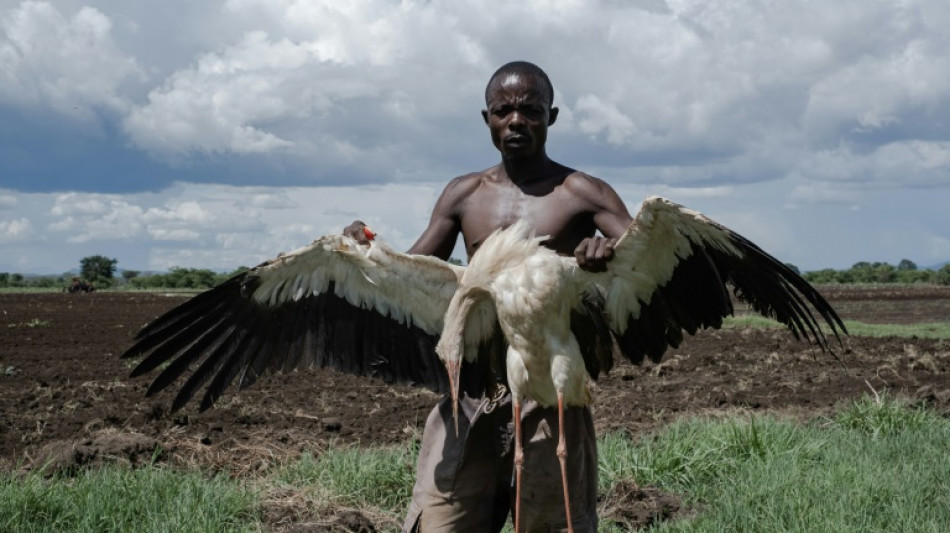
Ugandans kill migrating storks in desperation for food / Photo: Badru Katumba - AFP

 Greenland parliament approves security agreement with United States

 Qatar envoy meets incoming UN General Assembly president

 Trump Signals Willingness to Work With Democrats After Midterm Defeat

 Galloway accuser could not foresee publishing-sector fallout, lawyer argues

 New York City Center revives In the Heights as a timely community story

 Godzilla Minus Zero shifts focus toward postwar human drama

 Mehbooba Mufti urges dialogue and renewed Central Asia links for Kashmir

 Seacliff Healthcare Seeks Specialist GP in Thirroul

 US stocks fall before midterm Election Day as technology shares weaken

 BLS Polymers makes strong market debut at ₹248 per share

 Petrol and diesel prices remain broadly steady across major Indian cities

 Reliance shares remain in focus after near-12% surge

 2026 Arizona Midterms: Key Races, Ballot Measures, and Voter Deadlines

 Coal India prepares possible $1 billion Mahanadi Coalfields listing

Desperate Ugandans are using poison to kill thousands of migrating white storks and other protected birds because they have so few sources of food.
In Ayoreri, a village on the Kenyan border, Sam Chekwoi, 42, said unpredictable rains and droughts have made it increasingly hard to feed his two wives and 11 children.
"I used to farm but the sun would destroy my food crops. That is when I decided to start catching those birds to provide food for my children and myself," he said.
He showed AFP how locals hunt their prey.
First they catch a mouse and kill it, then pour a mixture of alcohol and rat poison into its mouth and leave it in the field for a bird to spot.
The birds swoop down and quickly feel the impact of the poison. They try to fly away but cannot get very far and the villagers chase them down to finish the kill.
"When the birds eat the trap, they get weak, we catch them, kill them, and then eat them," said Chekwoi.
He estimates he has eaten upwards of 300 storks since moving to the area in 2016.
"If there was an alternative, I would do it," said Chekwoi.
The activity risks heavy fines but locals feel they have no choice.
- 'Only source of protein' -
Joel Cherop, 45, a farmer and conservationist, grew up in the area and is trying to discourage the practice.
He estimates that some 3,000 white storks have been eaten by villagers since the start of the year when the migrating season began.
Cherop described the birds as the "only source of protein" for many in the area. They can sell a stork for around 2,000 shillings or less than a dollar, he said.
He has monitored the birds over the years and knows from tagging that some came from Poland, Czech Republic and Hungary.
Although the nomadic communities in the region have degraded the land by cutting down too many trees for charcoal, Cherop empathises with their difficulties, especially the worsening droughts.
"There is no doubt that crop failure tops the agenda in this community for the last 10 years," he told AFP.
It feels particularly unfair, he said, to think that climate change is the result of industrial practices elsewhere in the world -- "the Americas, the Russias and the Chinas who are emitting billions of (tonnes of) carbon."
Cherop has started planting thousands of fruit trees around his farm in a bid to regenerate the land and is employing as many locals as he can with his limited means.
He says the local villagers are simply trying to survive.
"These are hungry young people who have no food, so they found an alternative in the migratory birds," he said.
O.Gaspar--PC



