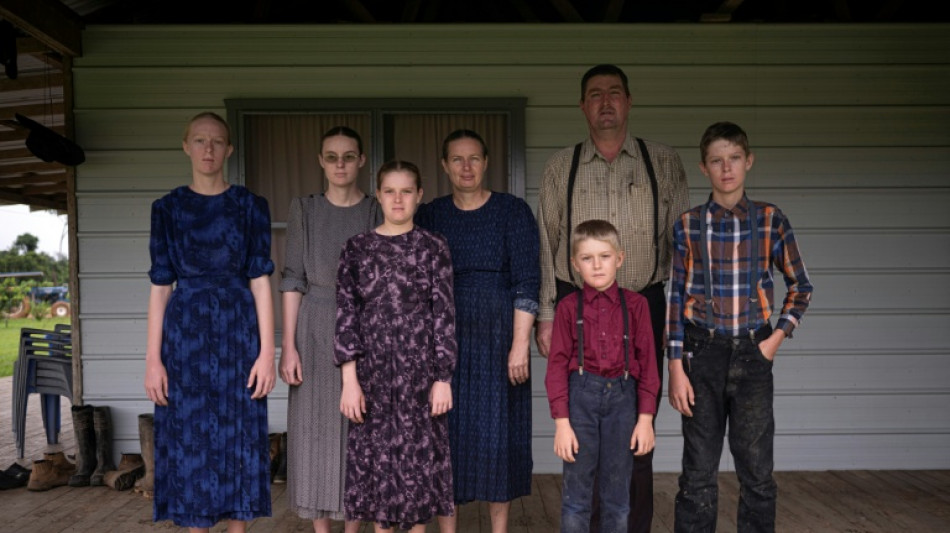
Mennonite communities raise hackles in Peruvian Amazon / Photo: ERNESTO BENAVIDES - AFP

 Ed Sheeran returns to stage after Palestinian controversy

 Asian Games to open in Japan after troubled build-up

 Drone owners rush to offload devices ahead of Beijing ban

 Trump's beef policies irk Texas ranchers, testing their loyalty

 Nvidia, OpenAI CEOs to attend Xi dinner at White House

 Anthropic picks Accenture for in-house AI safety evaluation

 Balogun returns as Monaco beat Lens to continue strong Ligue 1 start

 'Pause' on overt repression in Venezuela, but reforms still needed: HRW

 Global stocks mixed as yen falls despite Bank of Japan rate hike

 Cuba hit with seventh major blackout of the year

 Murray out with concussion so Wentz will start for Vikings

 UN chief 'deeply regrets' US visa refusal to Abbas for annual meeting

 England quick Carse to face no charges over alleged nightclub assault

 Mancini brings nine newcomers into the first squad of his Italy comeback

 Czechs level Davis Cup tie against USA as South Korea eye Finals

 New France boss Zidane confirms Mbappe as captain after naming first squad

 California governor signs order to explore AI 'kill switch'

 Head leads run spree as Australia win Zimbabwe ODI series

 In-form Raphinha wants to finish career at Barcelona

 Warren Buffett steps down as Berkshire Hathaway chairman

 Carrick confident Man Utd can 'work through' tough time

 Mbappe ends Nike partnership to join Swiss brand On

 Liverpool boss Iraola puts Bournemouth love affair on hold

 'A disaster' if Man City do not win says Maresca after flawless start

 Kerry James Marshall: American 'blackness' painter celebrated in Europe

When they saw men with arrows and machetes bearing down on them, Daniel Braun and other Mennonites living in the Peruvian Amazon fled across rice paddies, some of their barns ablaze behind them.
In Masisea, a remote settlement near Peru's border with Brazil accessible only by boat along a tributary of the Amazon or over dirt paths, members of the austere Protestant sect are under siege.
Here, as in several other South American countries, the reclusive Christians, who have roots in 16th-century Europe and who eschew modernity, are accused of destroying forests as they expand their agricultural imprint on the continent.
In 2024, Peruvian prosecutors charged 44 men from the Masisea Mennonite colony with destroying 894 hectares (2,209 acres) of virgin forest and requested that each be sentenced to between eight and 10 years in prison.
The trial would be the first of a Mennonite colony in Latin America for environmental crimes.
The men's lawyer, Carlos Sifuentes, argues that the land was "already cleared" when the community bought it.
- Rich versus poor -
A 2021 study carried out by researchers at Canada's McGill University counted 214 Mennonite colonies in Latin America occupying some 3.9 million hectares, an area bigger than the Netherlands.
In Peru, Mennonites have established five thriving colonies in the Amazon in the past decade.
Their presence is a thorn in the side of the 780-strong Shipibo-Konibo Indigenous community, which lives on the shores of Lake Imiria about 10 miles (16 kilometers) from Masisea.
The Shipibo-Konibo live in wooden huts of palm or zinc roofs with no electricity or running water, surviving off fishing and subsistence farming.
They accuse the wealthier Mennonites, whom they call "forest termites," of illegally occupying around 600 hectares of their 5,000-hectare territory.
"The Mennonites build ranches on communal land... They engage in deforestation. What they are doing is a crime against the environment," Indigenous leader Abner Ancon, 54, told AFP.
- Horse-drawn carriages -
The Mennonites arrived in Peru from neighboring Bolivia.
David Klassen, a 45-year-old father of five children ranging in age from seven to 20, said they were driven to emigrate because of a shortage of farmland and because of Bolivia's "radical left" policies.
Today, the self-sufficient enclave is comprised of some 63 families who raise cattle and pigs and grow rice and soybeans on 3,200 hectares while using diesel generators for power.
The men and boys wear checked shirts, suspenders and hats or caps, The women and girls wear long dresses, with their hair pulled back in tight braids or buns.
The community, which speaks a German dialect but whose leaders speak passable Spanish, has little contact with the outside world, relying on tractors and horse-drawn carriages as its main modes of transport.
After 10 years of peaceful coexistence with their Indigenous neighbors, the settlement came under attack last July.
Braun said he was sitting with other men outside a barn when a group of Shipibo-Konibo appeared out of nowhere.
"They came with arrows and machetes. They said you have one or two hours to leave," the 39-year-old recalled, adding that they set fire to property.
No one was injured in the standoff but the charred remains of a shed and a barn and zinc roofs were visible through the long grass.
Ancon admitted that his community's Indigenous guard had chased the Mennonites but "without resorting to violence."
- A fraction of the damage -
A lawyer for the Shipibo-Konibo, Linda Vigo, accused the settlers of hiring contractors to clear forest, "and when it's all cleared, the Mennonites come in with their tractors, flatten everything, and then you go in afterwards and find it all cultivated."
Pedro Favaron, a specialist on Indigenous peoples at the Pontifical Catholic University of Peru, acknowledged that the Mennonite farming model failed to meet "environmental expectations."
But he argued that the land they bought from mixed-race settlers in Masisea "was already degraded."
The independent Monitoring of the Andes Amazon Program, which tracks deforestation and fires, estimates the area cleared by Mennonites in Peru since 2017 at 8,660 hectares.
It's a tiny fraction of the 3 million hectares of forest lost over the past three decades in the Andean country, mainly due to fires, illegal mining and deforestation by other groups.
Standing in the middle of a verdant rice field, Klassen assured: "We love the countryside... We don't want to destroy everything."
F.Cardoso--PC



