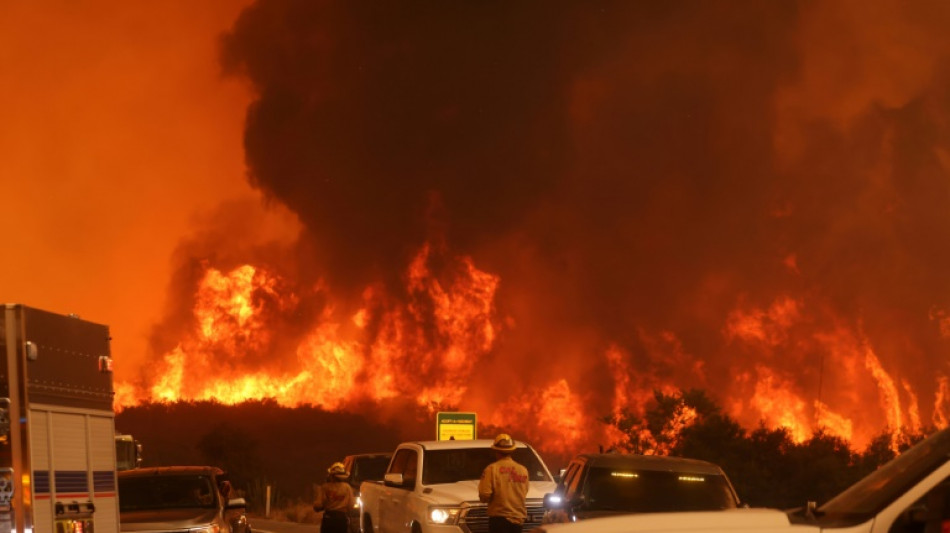
Warning signs on climate flashing bright red: top scientists / Photo: David SWANSON - AFP/File

 Ed Sheeran returns to stage after Palestinian controversy

 Asian Games to open in Japan after troubled build-up

 Drone owners rush to offload devices ahead of Beijing ban

 Trump's beef policies irk Texas ranchers, testing their loyalty

 Nvidia, OpenAI CEOs to attend Xi dinner at White House

 Anthropic picks Accenture for in-house AI safety evaluation

 Balogun returns as Monaco beat Lens to continue strong Ligue 1 start

 'Pause' on overt repression in Venezuela, but reforms still needed: HRW

 Global stocks mixed as yen falls despite Bank of Japan rate hike

 Cuba hit with seventh major blackout of the year

 Murray out with concussion so Wentz will start for Vikings

 UN chief 'deeply regrets' US visa refusal to Abbas for annual meeting

 England quick Carse to face no charges over alleged nightclub assault

 Mancini brings nine newcomers into the first squad of his Italy comeback

 Czechs level Davis Cup tie against USA as South Korea eye Finals

 New France boss Zidane confirms Mbappe as captain after naming first squad

 California governor signs order to explore AI 'kill switch'

 Head leads run spree as Australia win Zimbabwe ODI series

 In-form Raphinha wants to finish career at Barcelona

 Warren Buffett steps down as Berkshire Hathaway chairman

 Carrick confident Man Utd can 'work through' tough time

 Mbappe ends Nike partnership to join Swiss brand On

 Liverpool boss Iraola puts Bournemouth love affair on hold

 'A disaster' if Man City do not win says Maresca after flawless start

 Kerry James Marshall: American 'blackness' painter celebrated in Europe

From carbon pollution to sea-level rise to global heating, the pace and level of key climate change indicators are all in unchartered territory, more than 60 top scientists warned Thursday.
Greenhouse gas emissions from burning fossil fuels and deforestation hit a new high in 2024 and averaged, over the last decade, a record 53.6 billion tonnes per year -- that is 100,000 tonnes per minute -- of CO2 or its equivalent in other gases, they reported in a peer-reviewed update.
Earth's surface temperature last year breached 1.5 degrees Celsius for the first time, and the additional CO2 humanity can emit with a two-thirds chance of staying under that threshold long-term -- our 1.5C "carbon budget" -- will be exhausted in a couple of years, they calculated.
Investment in clean energy outpaced investment in oil, gas and coal last year two-to-one, but fossil fuels account for more than 80 percent of global energy consumption, and growth in renewables still lags behind new demand.
Included in the 2015 Paris climate treaty as an aspirational goal, the 1.5C limit has since been validated by science as necessary for avoiding a catastrophically climate-addled world.
The hard cap on warming to which nearly 200 nations agreed was "well below" two degrees, commonly interpreted to mean 1.7C to 1.8C.
"We are already in crunch time for these higher levels of warming," co-author Joeri Rogelj, a professor of climate science and policy at Imperial College London, told journalists in a briefing.
"The next three or four decades is pretty much the timeline over which we expect a peak in warming to happen."
- 'The wrong direction' -
No less alarming than record heat and carbon emissions is the gathering pace at which these and other climate indicators are shifting, according to the study, published in Earth System Science Data.
Human-induced warming increased over the last decade at a rate "unprecedented in the instrumental record", and well above the 2010-2019 average registered in the UN's most recent Intergovernmental Panel on Climate Change (IPCC) report, in 2021.
The new findings -- led by the same scientists using essentially the same methods -- are intended as an authoritative albeit unofficial update of the benchmark IPCC reports underpinning global climate diplomacy.
They should be taken as a reality check by policymakers, the authors suggested.
"I tend to be an optimistic person," said lead author Piers Forster, head of the University of Leed's Priestley Centre for Climate Futures.
"But if you look at this year's update, things are all moving in the wrong direction."
The rate at which sea levels have shot up in recent years is also alarming, the scientists said.
After creeping up, on average, well under two millimetres per year from 1901 to 2018, global oceans have risen 4.3 mm annually since 2019.
- What happens next? -
An increase in the ocean watermark of 23 centimetres -- the width of a letter-sized sheet of paper -- over the last 125 years has been enough to imperil many small island states and hugely amplify the destructive power of storm surges worldwide.
An additional 20 centimetres of sea level rise by 2050 would cause one trillion dollars in flood damage annually in the world's 136 largest coastal cities, earlier research has shown.
Another indicator underlying all the changes in the climate system is Earth's so-called energy imbalance, the difference between the amount of solar energy entering the atmosphere and the smaller amount leaving it.
So far, 91 percent of human-caused warming has been absorbed by oceans, sparing life on land.
But the planet's energy imbalance has nearly doubled in the last 20 years, and scientists do not know how long oceans will continue to massively soak up this excess heat.
Dire future climate impacts worse than what the world has already experienced are already baked in over the next decade or two.
But beyond that, the future is in our hands, the scientists made clear.
"We will rapidly reach a level of global warming of 1.5C, but what happens next depends on the choices which will be made," said co-author and former IPCC co-chair Valerie Masson-Delmotte.
The Paris Agreement's 1.5C target allows for the possibility of ratcheting down global temperatures below that threshold before century's end.
Ahead of a critical year-end climate summit in Brazil, international cooperation has been weakened by the US withdrawal from the Paris Agreement.
President Donald Trump's dismantling of domestic climate policies means the United States is likely to fall short on its emissions reduction targets, and could sap the resolve of other countries to deepen their own pledges, experts say.
L.Mesquita--PC