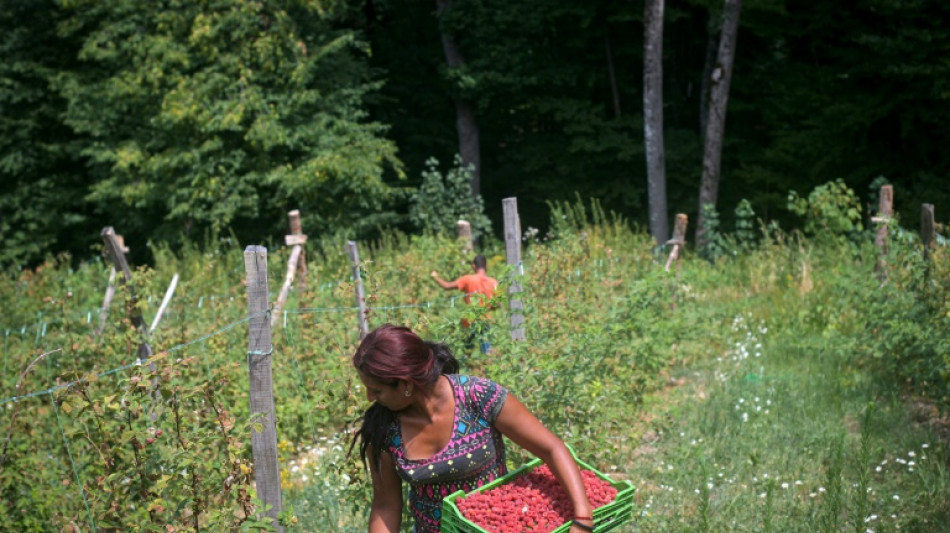
Drought-hit Serbian raspberry farmers fear 'catastrophic' future / Photo: OLIVER BUNIC - AFP

 Ed Sheeran returns to stage after Palestinian controversy

 Asian Games to open in Japan after troubled build-up

 Drone owners rush to offload devices ahead of Beijing ban

 Trump's beef policies irk Texas ranchers, testing their loyalty

 Nvidia, OpenAI CEOs to attend Xi dinner at White House

 Anthropic picks Accenture for in-house AI safety evaluation

 Balogun returns as Monaco beat Lens to continue strong Ligue 1 start

 'Pause' on overt repression in Venezuela, but reforms still needed: HRW

 Global stocks mixed as yen falls despite Bank of Japan rate hike

 Cuba hit with seventh major blackout of the year

 Murray out with concussion so Wentz will start for Vikings

 UN chief 'deeply regrets' US visa refusal to Abbas for annual meeting

 England quick Carse to face no charges over alleged nightclub assault

 Mancini brings nine newcomers into the first squad of his Italy comeback

 Czechs level Davis Cup tie against USA as South Korea eye Finals

 New France boss Zidane confirms Mbappe as captain after naming first squad

 California governor signs order to explore AI 'kill switch'

 Head leads run spree as Australia win Zimbabwe ODI series

 In-form Raphinha wants to finish career at Barcelona

 Warren Buffett steps down as Berkshire Hathaway chairman

 Carrick confident Man Utd can 'work through' tough time

 Mbappe ends Nike partnership to join Swiss brand On

 Liverpool boss Iraola puts Bournemouth love affair on hold

 'A disaster' if Man City do not win says Maresca after flawless start

 Kerry James Marshall: American 'blackness' painter celebrated in Europe

Facing drought and record heat, raspberry farmers in western Serbia are warning of the worst season in decades for one of the world's largest exporters of the fruit.
Under the scorching sun, pickers move through parched raspberry fields in search of the few fruits that have not shrivelled to a pea.
The dry spell started six weeks early in the region of Arilje, around 120 kilometres (75 miles) southwest of Belgrade, hitting a harvest already weakened by a late frost which struck while the berries were in bloom.
"I used to be the best picker here, getting 100, even 120 kilos a day. Now I can barely manage 20 or 25," Ivan Mitic told AFP, as he plucked berries from the occasional healthy branch.
Even after he has sorted through several rows in the intense summer heat, the richest raspberries are in short supply, and his fluorescent green tray is left half-filled.
"You just can't pick enough. From five or six rows, you can't even fill one crate," the 27-year-old picker said.
Data published by the World Bank show Serbia was the top global exporter of several frozen berries, including raspberries, in 2023.
In 2024 it shipped around 80,000 tonnes of rasperries, mostly frozen, to major markets including France and Germany last year, according to the Serbian Chamber of Commerce.
But it has not rained for almost two months, and with no irrigation systems, Ivan's employer, Mileta Pilcevic, said farmers are experiencing the worst season in 50 years.
"We expected a state of natural disaster to be declared. The heat has been extreme. We thought someone would reach out, but no one has," Pilcevic said.
The third-generation raspberry farmer said his fruits had withered to a fraction of even a poor harvest, where he could expect at least 22 tonnes.
"This year, after all this drought, I'll be lucky to get five."
Across his three hectares, dead fruit and pale green, unripe berries hang from leaves.
- 'Red gold'-
June was Serbia's driest month on record, according to meteorologists, with no rain in what is usually the Balkan nation's wettest weeks.
"Due to climate change, climate variability has increased," University of Belgrade meteorologist Ana Vukovic Vimic said.
"The warm, dry season is getting longer, while peak rainfall has moved from June to May, with the trend continuing toward earlier months," Vukovic Vimic said.
Alongside declining rainfall, the region has warmed dramatically in the last 10 to 20 years -- now two degrees Celsius (3.6 degrees Fahrenheit) warmer on average, she said.
This summer is predicted to be record-breaking, with its average temperature already 2.5C (4.5F) hotter, the professor said.
Serbia's "red gold" is one of the country's most important export products and is among the many crops stricken by the drier, hotter climate, agricultural economist Milan Prostran said.
The berry makes up a third of all fruit exported from the country and was worth around $290 million in 2024, according to the chamber of commerce.
This year, drought is likely to drag those figures down.
"Reports from the field suggest this will be one of the worst seasons we have seen, both in yield and fruit quality," the chamber warned.
Prostran said investment in irrigation had been "completely neglected" in a country with abundant rivers.
"I hope it will receive more attention in the coming years," he said.
- 'Catastrophic' consequences -
The state company in charge of irrigation projects said it is aware of the challenges, noting that irrigated land in Serbia has increased significantly over the past five years.
But just over two percent of the land suitable for irrigation had systems in place, the company Srbijavode said in a written statement.
Further development is "crucial to mitigating drought and ensuring stable agricultural production", the company said.
But raspberry farmers in the hills of Arilje, already weighed down by three bad seasons, do not have the funds to install the systems themselves.
"Maybe there will be drought next year, maybe not, we don't know," said Ljube Jakovljevic, who runs a farm neighbouring Pilcevic's.
On dry days, he hauls water in large canisters by tractor to maintain his two hectares of raspberries.
Both Mitic and Pilcevic agree that without help to build irrigation systems, the future of the region's raspberry production, and the 20,000 residents who rely on it, is uncertain.
"The consequences will be catastrophic. We will not be able to survive from this, let alone invest in the next season," Pilcevic said.
S.Pimentel--PC



