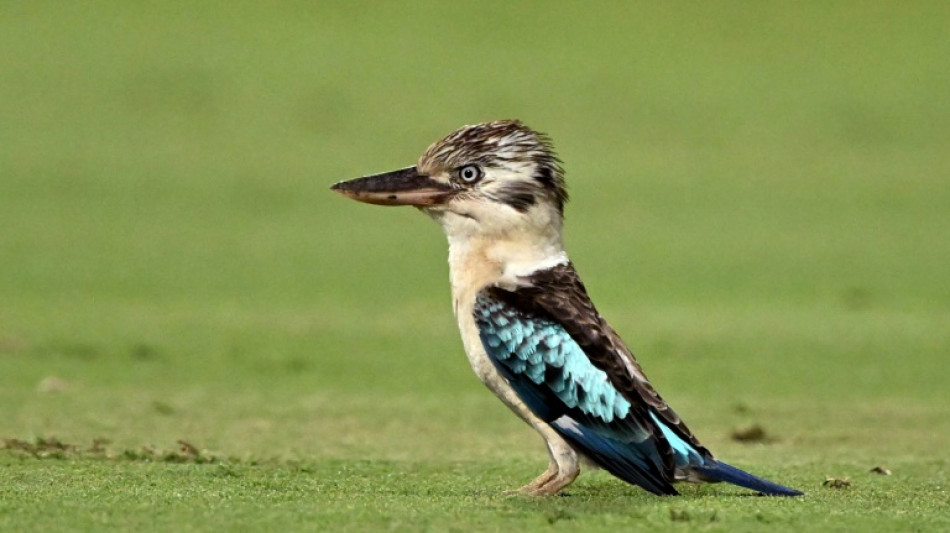
Scientists find surprising sex reversal in Australian birds / Photo: William WEST - AFP

 Ed Sheeran returns to stage after Palestinian controversy

 Asian Games to open in Japan after troubled build-up

 Drone owners rush to offload devices ahead of Beijing ban

 Trump's beef policies irk Texas ranchers, testing their loyalty

 Nvidia, OpenAI CEOs to attend Xi dinner at White House

 Anthropic picks Accenture for in-house AI safety evaluation

 Balogun returns as Monaco beat Lens to continue strong Ligue 1 start

 'Pause' on overt repression in Venezuela, but reforms still needed: HRW

 Global stocks mixed as yen falls despite Bank of Japan rate hike

 Cuba hit with seventh major blackout of the year

 Murray out with concussion so Wentz will start for Vikings

 UN chief 'deeply regrets' US visa refusal to Abbas for annual meeting

 England quick Carse to face no charges over alleged nightclub assault

 Mancini brings nine newcomers into the first squad of his Italy comeback

 Czechs level Davis Cup tie against USA as South Korea eye Finals

 New France boss Zidane confirms Mbappe as captain after naming first squad

 California governor signs order to explore AI 'kill switch'

 Head leads run spree as Australia win Zimbabwe ODI series

 In-form Raphinha wants to finish career at Barcelona

 Warren Buffett steps down as Berkshire Hathaway chairman

 Carrick confident Man Utd can 'work through' tough time

 Mbappe ends Nike partnership to join Swiss brand On

 Liverpool boss Iraola puts Bournemouth love affair on hold

 'A disaster' if Man City do not win says Maresca after flawless start

 Kerry James Marshall: American 'blackness' painter celebrated in Europe

Scientists have documented a surprising rate of sex reversal in wild Australian birds, a phenomenon that could be explained by rising pollution or other environmental triggers.
A study of five common Australian species, including kookaburras, magpies and lorikeets, found around six percent of birds had the chromosomes of one sex but the reproductive organs of another.
The findings indicated a surprisingly high number of birds had reversed their sex after birth, said researchers from the University of the Sunshine Coast.
"This indicates that sex determination in wild birds is more fluid than we thought, and can persist into adulthood," said study co-author Dominique Potvin.
The study performed DNA tests on almost 500 birds.
The overwhelming majority of sex reversals involved genetically female birds growing male gonads.
"We also discovered a genetically male kookaburra who was reproductively active with large follicles and a distended oviduct, indicating recent egg production," said Potvin.
Sex reversal is well known in certain species of reptile and fish but is thought to be rare in wild birds and mammals.
Scientists have documented how pollutants and even warm temperatures can trigger sex reversal in frogs.
The cause of sex reversal in wild birds was not clear, the University of the Sunshine Coast study said.
But it could be due to environmental factors, such as hormone-disrupting chemicals building up in wild areas.
"Understanding how and why sex reversal occurs is vital for conservation and for improving the accuracy of bird research," added Potvin.
The study was published this week in peer-reviewed journal Biology Letters.
V.Dantas--PC



