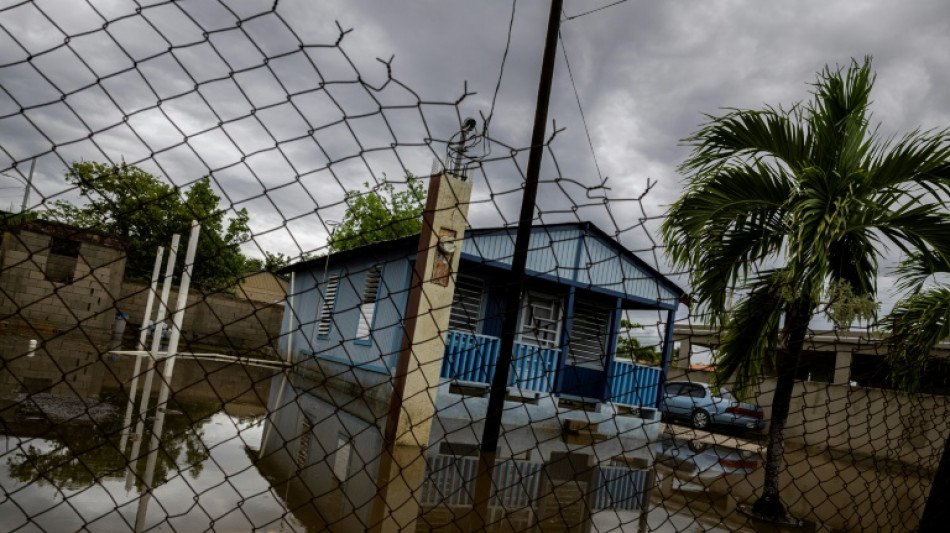
Hurricane Erin douses Caribbean, menaces US coast / Photo: Ricardo ARDUENGO - AFP

 Ed Sheeran returns to stage after Palestinian controversy

 Asian Games to open in Japan after troubled build-up

 Drone owners rush to offload devices ahead of Beijing ban

 Trump's beef policies irk Texas ranchers, testing their loyalty

 Nvidia, OpenAI CEOs to attend Xi dinner at White House

 Anthropic picks Accenture for in-house AI safety evaluation

 Balogun returns as Monaco beat Lens to continue strong Ligue 1 start

 'Pause' on overt repression in Venezuela, but reforms still needed: HRW

 Global stocks mixed as yen falls despite Bank of Japan rate hike

 Cuba hit with seventh major blackout of the year

 Murray out with concussion so Wentz will start for Vikings

 UN chief 'deeply regrets' US visa refusal to Abbas for annual meeting

 England quick Carse to face no charges over alleged nightclub assault

 Mancini brings nine newcomers into the first squad of his Italy comeback

 Czechs level Davis Cup tie against USA as South Korea eye Finals

 New France boss Zidane confirms Mbappe as captain after naming first squad

 California governor signs order to explore AI 'kill switch'

 Head leads run spree as Australia win Zimbabwe ODI series

 In-form Raphinha wants to finish career at Barcelona

 Warren Buffett steps down as Berkshire Hathaway chairman

 Carrick confident Man Utd can 'work through' tough time

 Mbappe ends Nike partnership to join Swiss brand On

 Liverpool boss Iraola puts Bournemouth love affair on hold

 'A disaster' if Man City do not win says Maresca after flawless start

 Kerry James Marshall: American 'blackness' painter celebrated in Europe

Hurricane Erin's massive footprint battered Caribbean islands with heavy gusts and downpours Monday, as it threatened rip currents and flooding along the US East Coast later this week even without a predicted landfall.
The Category 4 storm strengthened dramatically over the weekend in a historic burst of intensification scientists said was fueled by human-caused climate change. It briefly peaked as a Category 5 hurricane before weakening slightly.
In its latest advisory the US National Hurricane Center said the Atlantic season's first hurricane was packing maximum sustained winds of 140 miles (220 kilometers) per hour while moving northwest at 10 mph.
Erin is "unusually large," with hurricane force winds extending 80 miles and tropical storm winds extending 230 miles, the NHC said.
The storm's outer bands were forecast to dump rain across Cuba and the Dominican Republic through Monday as well as the Turks and Caicos and the Bahamas -- where a tropical storm warning is in place -- into Tuesday.
These regions could receive localized totals of up to six inches (15 centimeters) of rain, according to the NHC.
The agency's deputy director, Jamie Rhome, warned Americans not to assume the hurricane won't impact them simply because its track keeps it offshore.
"Nothing could be further from the truth for portions of the Mid-Atlantic, especially the Outer Banks of North Carolina," he said. On Wednesday and Thursday, waves of up to 20 feet (six meters), coastal flooding and storm surge "could overwash dunes and flood homes, flood roads and make some communities impassable," he said.
Evacuations have been ordered for two North Carolina islands, Ocracoke and Hatteras.
From Tuesday, much of the East Coast will face a high risk of life-threatening surf and rip currents, which occur when channels of water surge away from the shore.
In Puerto Rico, a US territory of more than three million people, weekend flooding swamped homes and roads in the island's east, and widespread power outages left residents in the dark, though nearly all service has since been restored.
- Climate link -
"Erin is one of the fastest, most intensifying storms in the modern record," Daniel Gilford, a climate scientist at the nonprofit Climate Central, told AFP.
"We see that it has intensified over these warm surface temperatures -- and this makes a lot of sense, because we know that hurricanes act like heat engines taking up energy from the ocean surface, converting that energy into winds."
According to Climate Central, Erin traveled over waters whose extreme warmth was made up to 100 times more likely through climate change.
The Atlantic hurricane season, which runs from June 1 to November 30, has now entered its historical peak.
Despite a relatively quiet start with just four named storms so far, the National Oceanic and Atmospheric Administration (NOAA) continues to forecast an "above-normal" season.
A typical season produces 14 named storms, of which seven become hurricanes and three strengthen into major hurricanes.
This year, tropical activity is expected to be elevated by a combination of warmer-than-average sea-surface temperatures in the tropical Atlantic and Caribbean, along with an active West African monsoon, NOAA said.
Scientists broadly agree that climate change is supercharging tropical cyclones: warmer oceans fuel stronger winds, a warmer atmosphere intensifies rainfall, and higher sea levels magnify storm surge.
Climate change may also be making hurricanes more frequent.
J.Pereira--PC



