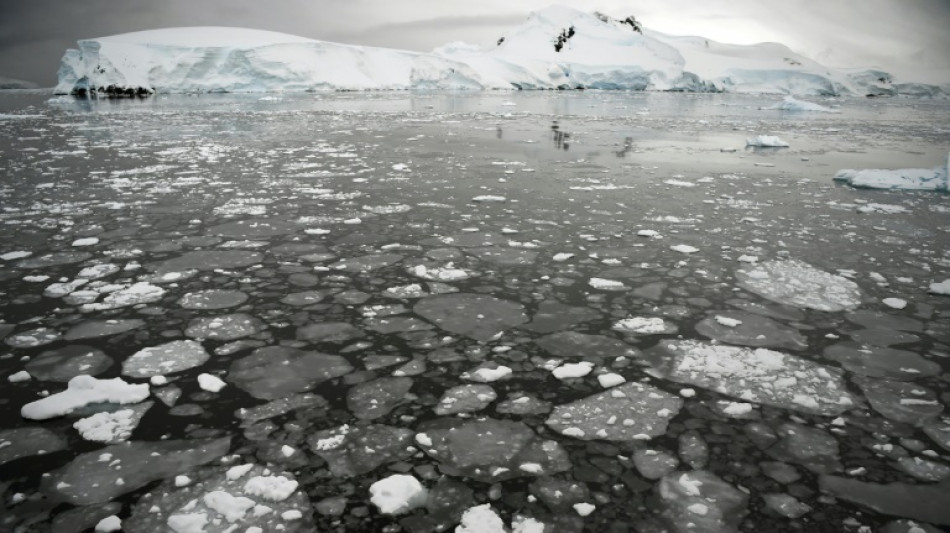
Antarctic sea ice hits its third-lowest winter peak on record / Photo: EITAN ABRAMOVICH - AFP/File

 Drone owners rush to offload devices ahead of Beijing ban

 Trump's beef policies irk Texas ranchers, testing their loyalty

 Nvidia, OpenAI CEOs to attend Xi dinner at White House

 Anthropic picks Accenture for in-house AI safety evaluation

 Balogun returns as Monaco beat Lens to continue strong Ligue 1 start

 'Pause' on overt repression in Venezuela, but reforms still needed: HRW

 Global stocks mixed as yen falls despite Bank of Japan rate hike

 Cuba hit with seventh major blackout of the year

 Murray out with concussion so Wentz will start for Vikings

 UN chief 'deeply regrets' US visa refusal to Abbas for annual meeting

 England quick Carse to face no charges over alleged nightclub assault

 Mancini brings nine newcomers into the first squad of his Italy comeback

 Czechs level Davis Cup tie against USA as South Korea eye Finals

 New France boss Zidane confirms Mbappe as captain after naming first squad

 California governor signs order to explore AI 'kill switch'

 Head leads run spree as Australia win Zimbabwe ODI series

 In-form Raphinha wants to finish career at Barcelona

 Warren Buffett steps down as Berkshire Hathaway chairman

 Carrick confident Man Utd can 'work through' tough time

 Mbappe ends Nike partnership to join Swiss brand On

 Liverpool boss Iraola puts Bournemouth love affair on hold

 'A disaster' if Man City do not win says Maresca after flawless start

 Kerry James Marshall: American 'blackness' painter celebrated in Europe

 Spain coach De la Fuente offers 'full support' to people of Ceuta

 Russia seizes assets of Nestle, French firms over West's Ukraine support

Antarctica's winter sea ice has hit its third-lowest peak in nearly half a century of satellite monitoring, researchers said Tuesday, highlighting the growing influence of climate change on the planet's southern pole.
Each year during the Southern Hemisphere's winter, the ocean around Antarctica freezes hundreds of miles beyond the continent, with the maximum reach usually observed in September or October, before the thawing cycle begins.
This year, the ice appeared to peak on September 17 at 17.81 million square kilometers (6.88 million square miles), according to preliminary figures by the US National Snow and Ice Data Center at the University of Colorado Boulder.
The 2025 maximum ranks as the third lowest in the 47-year record, behind the all-time low in 2023 and the second-lowest in 2024 -- but still well below the historic normal.
Senior research scientist Ted Scambos at CU Boulder told AFP that until 2016, measurements of Antarctic sea ice showed "an erratic but slight increase over time."
But "what seems to be happening is that warmth from the global ocean is now mixing into the water that's closest to Antarctica" -- meaning that climate change finally caught up with the southern continent's frozen seas.
Floating sea ice does not add to sea level when it melts.
But its retreat does replace white surfaces that reflect almost all of the Sun's energy back into space with deep blue water, which absorbs the same amount instead.
The sea ice also acts as a stabilizing buffer -- protecting the Antarctic Ice Sheet from entering the ocean and amplifying sea level rise by reducing the impact of waves before they reach the coast and lessening the effect of winds over the ocean.
On the other hand, it also triggers a competing effect.
"We may see more snowfall in Antarctica, because the humid air over the ocean would be closer to the coast... storms that arrive over the ice sheet would carry more moisture and therefore produce more snowfall over the continent, and that offsets sea level rise," said Stamos.
He added, however, that while increased snowfall could offset destabilization effects for decades, over longer timescales past records show that when the climate stays warmer, the ice sheet shrinks.
The Antarctic Ice Sheet holds enough land ice to raise seas high enough to inundate low-lying coastlines around the world, though such a catastrophic impact would likely unfold over centuries.
Ninety percent of the heat generated by human-caused global warming is soaked up by oceans.
M.Gameiro--PC



