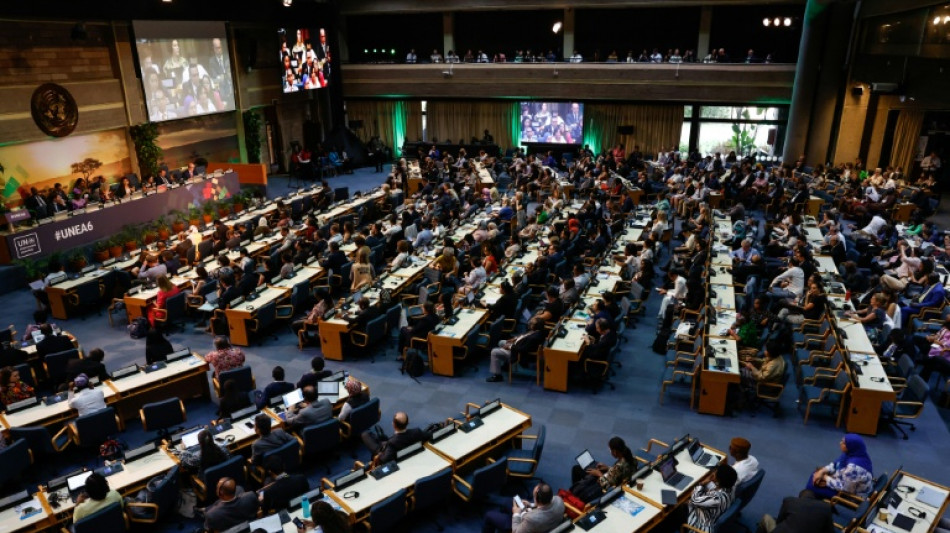
Fight over fossil fuels nixes key text of UN environment report / Photo: SIMON MAINA - AFP

 Drone owners rush to offload devices ahead of Beijing ban

 Trump's beef policies irk Texas ranchers, testing their loyalty

 Nvidia, OpenAI CEOs to attend Xi dinner at White House

 Anthropic picks Accenture for in-house AI safety evaluation

 Balogun returns as Monaco beat Lens to continue strong Ligue 1 start

 'Pause' on overt repression in Venezuela, but reforms still needed: HRW

 Global stocks mixed as yen falls despite Bank of Japan rate hike

 Cuba hit with seventh major blackout of the year

 Murray out with concussion so Wentz will start for Vikings

 UN chief 'deeply regrets' US visa refusal to Abbas for annual meeting

 England quick Carse to face no charges over alleged nightclub assault

 Mancini brings nine newcomers into the first squad of his Italy comeback

 Czechs level Davis Cup tie against USA as South Korea eye Finals

 New France boss Zidane confirms Mbappe as captain after naming first squad

 California governor signs order to explore AI 'kill switch'

 Head leads run spree as Australia win Zimbabwe ODI series

 In-form Raphinha wants to finish career at Barcelona

 Warren Buffett steps down as Berkshire Hathaway chairman

 Carrick confident Man Utd can 'work through' tough time

 Mbappe ends Nike partnership to join Swiss brand On

 Liverpool boss Iraola puts Bournemouth love affair on hold

 'A disaster' if Man City do not win says Maresca after flawless start

 Kerry James Marshall: American 'blackness' painter celebrated in Europe

 Spain coach De la Fuente offers 'full support' to people of Ceuta

 Russia seizes assets of Nestle, French firms over West's Ukraine support

The UN on Tuesday unveiled its largest-ever scientific assessment on the dire state of the environment, but a crucial summary of its findings was torpedoed as nations feuded over fossil fuels.
The dispute over the Global Environment Outlook echoes a growing trend in consensus-based negotiations where oil-producing countries in particular are frustrating efforts to address pollution from fossil fuels and plastic.
The UN Environment Programme (UNEP) said it was the first time that countries had failed to produce a politically-negotiated summary of the mammoth report, which is published roughly every five years and involves hundreds of scientists.
"It's regrettable," UNEP executive director Inger Andersen told AFP but added "the integrity of the report" remained above question.
Since first being published in 1997, UNEP's flagship outlook reports have been accompanied by a summary for policymakers: a political statement, negotiated line by line, that distils the science into plain language for governments.
Under United Nations rules, this can only be approved by consensus as it serves as a collective understanding of the latest science in a way policy leaders can act upon.
But at a five-day meeting in late October to approve the summary, sharp divisions over the text made consensus impossible.
Major oil producers Saudi Arabia and the United States opposed references to phasing out fossil fuels, which are used to make plastic, and when burned are the primary driver of climate change, according to minutes of the meeting seen by AFP.
Other countries disagreed with language on gender, conflict and environmentally harmful subsidies, among other flashpoint issues, according to the minutes.
- 'Same story' -
In a joint statement read as the negotiations closed, the European Union, UK and several other nations criticised "diversion attempts" during the talks but did not name any country by name.
"It's always the same story," a French diplomat said of the "difficult discussions" that took place at UNEP headquarters in Nairobi.
Andersen said several countries "had significant disagreements" but defended their right to dissent. The US "actually was quite quiet and only spoke at the very end" to indicate their opposition, she added.
"That is what makes the United Nations the United Nations, and so we arrived where we did. But we certainly would like to hope that that doesn't set a precedence for other processes," she said.
The report, "A Future We Choose", spans more than 1,200 pages and makes the case that investing in a cleaner planet could deliver trillions of dollars each year in additional economic growth.
Key to this would be "a total transformation of our energy system", said report co-chair Robert Watson, who has helmed the UN's expert scientific panels on climate change and biodiversity.
"We clearly have to eliminate the use of fossil fuels over the coming decades," the British scientist told reporters.
- Flashpoint -
But this issue has stalled politically since countries agreed at the UN climate summit in Dubai in 2023 to move away from coal, gas and oil.
In October, pressure from the US helped delay a vote on an emissions price on global shipping, while negotiations for a world-first plastic treaty collapsed in August under opposition from oil-producing nations.
Last month's UN COP30 climate summit ended with a watered-down deal after dozens of countries, including Saudi Arabia and coal producer India, opposed calls to advance a fossil fuel phaseout.
Watson said the world was "not moving fast enough by any stretch of the imagination to become sustainable" and progressive governments would need to take the lead.
"As our report says, the cost of action is less than the cost of inaction. But I have to say at this moment in time, multilateralism does seem to be in trouble," he said.
A.Motta--PC



