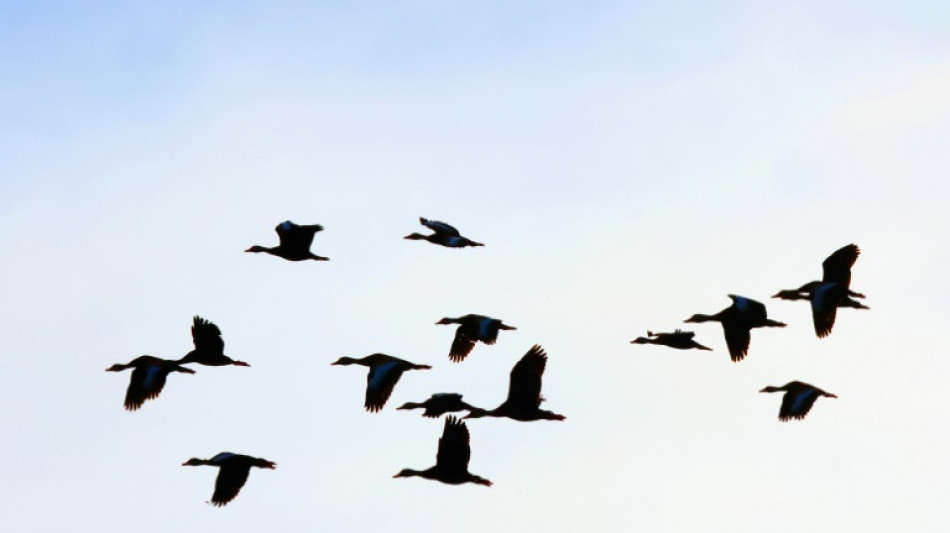
Mercury pollution makes ducks more likely to get bird flu: study / Photo: BRUCE BENNETT - GETTY IMAGES NORTH AMERICA/AFP/File

 Trump's beef policies irk Texas ranchers, testing their loyalty

 Nvidia, OpenAI CEOs to attend Xi dinner at White House

 Anthropic picks Accenture for in-house AI safety evaluation

 Balogun returns as Monaco beat Lens to continue strong Ligue 1 start

 'Pause' on overt repression in Venezuela, but reforms still needed: HRW

 Global stocks mixed as yen falls despite Bank of Japan rate hike

 Cuba hit with seventh major blackout of the year

 Murray out with concussion so Wentz will start for Vikings

 UN chief 'deeply regrets' US visa refusal to Abbas for annual meeting

 England quick Carse to face no charges over alleged nightclub assault

 Mancini brings nine newcomers into the first squad of his Italy comeback

 Czechs level Davis Cup tie against USA as South Korea eye Finals

 New France boss Zidane confirms Mbappe as captain after naming first squad

 California governor signs order to explore AI 'kill switch'

 Head leads run spree as Australia win Zimbabwe ODI series

 In-form Raphinha wants to finish career at Barcelona

 Warren Buffett steps down as Berkshire Hathaway chairman

 Carrick confident Man Utd can 'work through' tough time

 Mbappe ends Nike partnership to join Swiss brand On

 Liverpool boss Iraola puts Bournemouth love affair on hold

 'A disaster' if Man City do not win says Maresca after flawless start

 Kerry James Marshall: American 'blackness' painter celebrated in Europe

 Spain coach De la Fuente offers 'full support' to people of Ceuta

 Russia seizes assets of Nestle, French firms over West's Ukraine support

 England can build on World Cup 'spirit', says Tuchel

Ducks contaminated by mercury pollution are significantly more likely to get bird flu, a study found Wednesday, pointing towards another way that human-driven changes to the natural world increase the risk of viruses spreading.
Bird flu rarely infects humans but persistent outbreaks in the US and UK among other countries have led to millions of poultry being culled so far this year.
Wild waterfowl such as ducks are believed to be superspreaders of the virus in part because they travel so far as they migrate, potentially infecting other birds along the way.
For the new study, scientists shot down nearly 750 wild ducks from 11 different species in California's San Francisco Bay, which is in a migratory path that stretches from Alaska to Patagonia.
They then tested the ducks for mercury contamination and whether they were infected with bird flu -- or had antibodies for the virus in their system.
The results, published in the journal Proceedings of the Royal Society B, showed that ducks contaminated with mercury were up to 3.5 times more likely to have had bird flu at some point over the last year or so.
The study's lead author, Claire Teitelbaum, a quantitative ecologist at the USGS Eastern Ecological Science Center, said mercury contamination "can suppress the immune system, and that might make infection with anything -- including influenza -- more likely".
The San Francisco Bay is also a "significant hotspot for mercury contamination in North America... largely from historical gold mining, where mercury was part of that process," she told AFP.
The ducks however tested negative to the highly pathogenic H5N1 bird flu strain that has been detected in many parts of the world.
- More bird flu likely -
Teitelbaum said that bird flu outbreaks in the United States had slowed down during the summer "because many of the wild birds are up on their breeding grounds" farther north.
But "as they're starting to come back down, we're probably going to see a lot more activity", she warned.
The spread comes as researchers increasingly sound the alarm that climate change, deforestation, livestock farming and other human-induced factors raise the likelihood of viruses crossing over from animals to humans.
Teitelbaum said that "there are just so many ways in which humans have historically altered and are continuing to alter the natural environment."
How pollution and contamination affect the risk of diseases spreading is "just another link that we need to add in to our more holistic view of what's going on in the world," she said.
Daniel Becker, a biologist at the University of Oklahoma not involved in the research, hailed the "impressive" study.
"There is surprisingly little work looking at contaminant concentrations in wildlife and their relationship to infectious disease," especially for viruses that can cross over to humans like bird flu, he said.
T.Resende--PC



