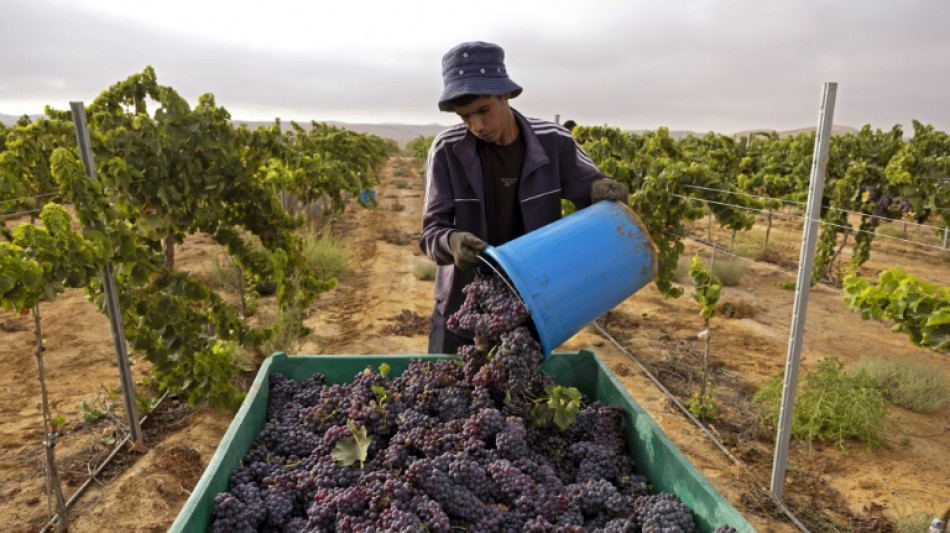
Negev desert winemakers show way ahead in Israel's hot climate / Photo: MENAHEM KAHANA - AFP

 Trump's beef policies irk Texas ranchers, testing their loyalty

 Nvidia, OpenAI CEOs to attend Xi dinner at White House

 Anthropic picks Accenture for in-house AI safety evaluation

 Balogun returns as Monaco beat Lens to continue strong Ligue 1 start

 'Pause' on overt repression in Venezuela, but reforms still needed: HRW

 Global stocks mixed as yen falls despite Bank of Japan rate hike

 Cuba hit with seventh major blackout of the year

 Murray out with concussion so Wentz will start for Vikings

 UN chief 'deeply regrets' US visa refusal to Abbas for annual meeting

 England quick Carse to face no charges over alleged nightclub assault

 Mancini brings nine newcomers into the first squad of his Italy comeback

 Czechs level Davis Cup tie against USA as South Korea eye Finals

 New France boss Zidane confirms Mbappe as captain after naming first squad

 California governor signs order to explore AI 'kill switch'

 Head leads run spree as Australia win Zimbabwe ODI series

 In-form Raphinha wants to finish career at Barcelona

 Warren Buffett steps down as Berkshire Hathaway chairman

 Carrick confident Man Utd can 'work through' tough time

 Mbappe ends Nike partnership to join Swiss brand On

 Liverpool boss Iraola puts Bournemouth love affair on hold

 'A disaster' if Man City do not win says Maresca after flawless start

 Kerry James Marshall: American 'blackness' painter celebrated in Europe

 Spain coach De la Fuente offers 'full support' to people of Ceuta

 Russia seizes assets of Nestle, French firms over West's Ukraine support

 England can build on World Cup 'spirit', says Tuchel

In Israel's Negev desert, winemakers are sharing their knowledge of growing vines in the blistering heat with European producers also facing fierce temperatures this summer.
Walking between rows of ripe grapes growing from the scorched land, David Pinto enthuses about how his vineyard has come of age in the past three years.
"We're masters of the conditions, without depending on the whims of the weather," said Pinto, whose estate near the town of Yeruham carries his name.
With nearly year-round sunshine and little rain in the barren Negev, Pinto has adopted a micro-irrigation system to conserve resources and drip water slowly onto the vines.
Such techniques may soon need to be used across the Mediterranean region, with winemakers in France forced to start picking earlier than usual due to an exceptionally dry and hot summer.
"Winemakers from Bordeaux came to visit us following the heatwave in France," said Pinto, who advised his guests on ways to adapt to climate changes.
"Now we share the same challenges, with the extreme climate and the dryness that harms the grapes," he added, while workers plucked grapes in the early morning light.
Israel's greener north has long been the centre of its viniculture, but more pioneering winemakers are discovering its sun-baked south.
Pinto, whose wines sell for 89 shekels ($26), is one of more than 25 wineries now dotted across the desert landscape.
They include Ramat Negev, adjacent to the Egyptian border, and Nana, located near the vast crater-like formation of Makhtesh Ramon.
- Enduring extreme heat -
Ilan Abitbol, who advises various Israeli winemakers, is busy creating a variety of blends on a small plot of land.
"The temperature of the Negev gives a particular identity to the region's wines: more dry, stronger in alcohol," he said.
Pinto's Malbec, for example, brings a weighty 14.5 percent alcohol volume to the table.
"We're used to extreme temperatures, whereas in Europe, the climatic changes have an impact on the vines, because they're not used to these temperatures," said Abitbol.
For Yaakov Oriya, Pinto's winemaker, there are unique opportunities in a desert region, where wine has been produced for centuries since Byzantine times.
"When you're faced with a different land like this, you can create different wines," he said, including dessert and sparkling varieties.
"We're not the first to make wine in this region but making the desert bloom remains a wonderful objective," said Oriya.
On the Pinto estate, where sturdy olive and argan trees also grow, the family is expecting to produce 55,000 bottles this season.
Beyond their own commercial gains, Jimmy Pinto, David's father, said the wine industry can boost the wider economy in the sparsely-populated desert.
"Creating a winery here in Yeruham contributes to our efforts to develop the region," he said.
Jimmy Pinto likened the years-long work in the fields to an educational network he has developed for children in remote areas.
"It's a great challenge, but in the same way that we think that the children of this region can be better, we want to produce a wine that will be the best," he said.
"And in these two areas, it takes time before you see the fruits of your investment."
G.Teles--PC



