EU ministers seek ways to face energy shock / Photo: Patricio ARANA - AFP

 Drone owners rush to offload devices ahead of Beijing ban

 Trump's beef policies irk Texas ranchers, testing their loyalty

 Nvidia, OpenAI CEOs to attend Xi dinner at White House

 Anthropic picks Accenture for in-house AI safety evaluation

 Balogun returns as Monaco beat Lens to continue strong Ligue 1 start

 'Pause' on overt repression in Venezuela, but reforms still needed: HRW

 Global stocks mixed as yen falls despite Bank of Japan rate hike

 Cuba hit with seventh major blackout of the year

 Murray out with concussion so Wentz will start for Vikings

 UN chief 'deeply regrets' US visa refusal to Abbas for annual meeting

 England quick Carse to face no charges over alleged nightclub assault

 Mancini brings nine newcomers into the first squad of his Italy comeback

 Czechs level Davis Cup tie against USA as South Korea eye Finals

 New France boss Zidane confirms Mbappe as captain after naming first squad

 California governor signs order to explore AI 'kill switch'

 Head leads run spree as Australia win Zimbabwe ODI series

 In-form Raphinha wants to finish career at Barcelona

 Warren Buffett steps down as Berkshire Hathaway chairman

 Carrick confident Man Utd can 'work through' tough time

 Mbappe ends Nike partnership to join Swiss brand On

 Liverpool boss Iraola puts Bournemouth love affair on hold

 'A disaster' if Man City do not win says Maresca after flawless start

 Kerry James Marshall: American 'blackness' painter celebrated in Europe

 Spain coach De la Fuente offers 'full support' to people of Ceuta

 Russia seizes assets of Nestle, French firms over West's Ukraine support

EU energy ministers on Friday will attempt to forge a united response to the energy shock from Russia's war on Ukraine that has sent prices for electricity and heating skyrocketing.
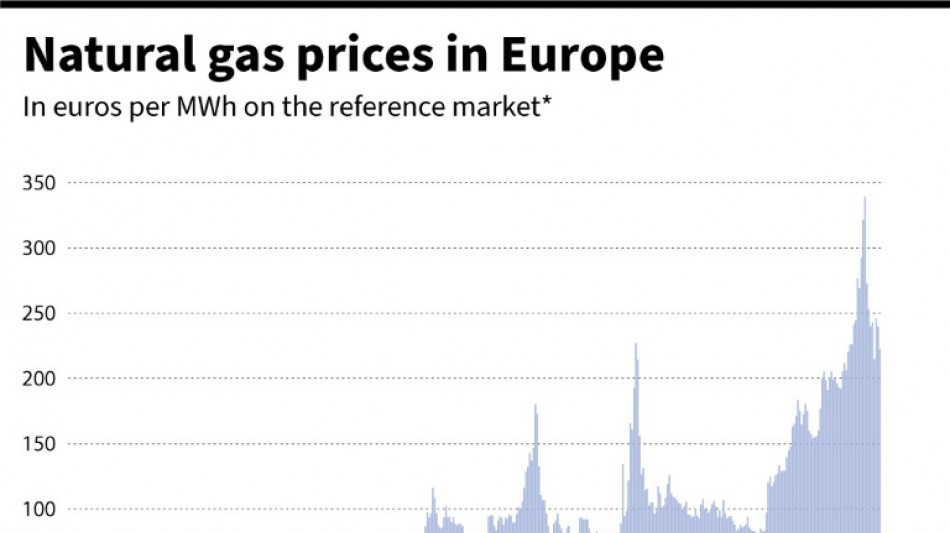
Moscow's invasion has seen the price of natural gas hit record levels, throwing the EU economy into deep uncertainty with all eyes on whether Russian President Vladimir Putin will cut off the energy flow entirely.
Before the war, 40 percent of the EU's gas imports came from Russia, with most of the supply going to Germany, the bloc's economic powerhouse that is now scrambling to come up with new ways to heat homes and power factories.
The European Commission, the EU's executive, will ask the ministers meeting in Brussels to consider a series of highly complex proposals designed to ease the burden.
The main drive will be to find ways to compensate households and businesses that are struggling to pay their bills and keep activity going.
The EU executive will propose a mechanism that would see non-gas electricity companies, such as nuclear, solar or renewable firms, share windfall revenues won on the back of high prices for electric power.
The market price of electricity in Europe is closely linked to the gas price, meaning non-gas utilities are enjoying a revenue bonanza while companies stuck paying for gas struggle.
Fossil fuel companies would also be levied on their mega profits from the inflated energy prices.
There needs to be a "discussion without qualms" about a potential solidarity levy on "energy companies that make windfall profits in times of war", said Austrian Energy Minister Leonore Gewessler ahead of the talks.
- Price cap push stalled -
Another proposal that has broad backing is an idea to rescue electricity companies that are struggling to hedge their spending on the financial markets.
This would be done by relaxing EU rules on state rescues of companies that are suddenly facing more onerous terms for cash as fears of a crisis spread.
The commission will also ask member states to agree on a united way to cut back on energy demand, with mandatory cuts on usage still considered an option, diplomats said.
"These are proposals where I feel there is quite a large convergence of views among the member states," said a key EU diplomat.
An idea to cap Russian gas prices however is stalled, diplomats warned, with fears rife that the retribution from Russia would throw the European economy into even further chaos.
EU chief Ursula von der Leyen on Wednesday urged member states to agree a price cap on Russian gas, a measure that Putin has warned would be "an absolutely stupid decision".
But an EU diplomat aware of the state of negotiations warned that there was no majority among the member states in favour of the idea.
The EU's energy ministers are set to debate the commission's ideas, with many countries expected to come to the table with their own proposals.
The commission, which draws up laws that are then ratified by member states and the European Parliament, would then formalise the proposal next week.
G.M.Castelo--PC



