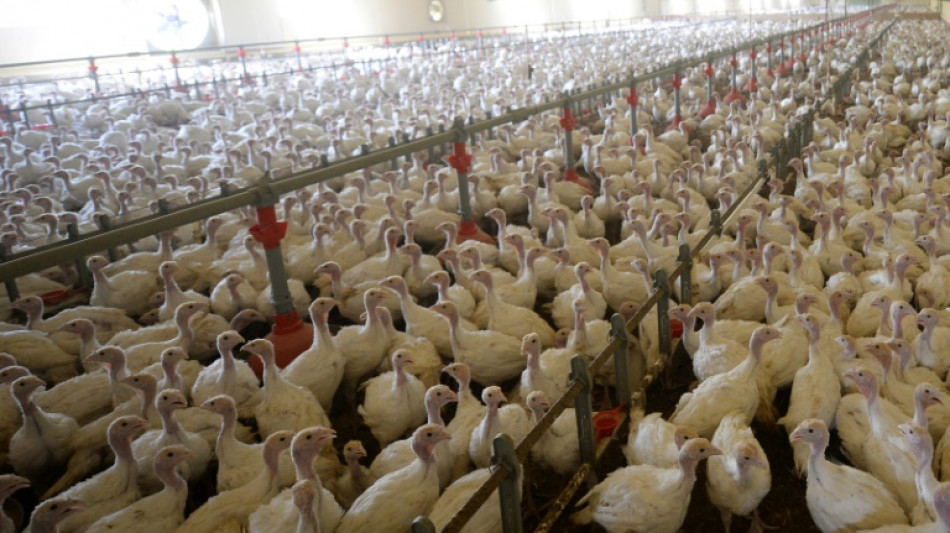
Change in livestock food could feed a billion people: study / Photo: JEAN-FRANCOIS MONIER - AFP/File

 Drone owners rush to offload devices ahead of Beijing ban

 Trump's beef policies irk Texas ranchers, testing their loyalty

 Nvidia, OpenAI CEOs to attend Xi dinner at White House

 Anthropic picks Accenture for in-house AI safety evaluation

 Balogun returns as Monaco beat Lens to continue strong Ligue 1 start

 'Pause' on overt repression in Venezuela, but reforms still needed: HRW

 Global stocks mixed as yen falls despite Bank of Japan rate hike

 Cuba hit with seventh major blackout of the year

 Murray out with concussion so Wentz will start for Vikings

 UN chief 'deeply regrets' US visa refusal to Abbas for annual meeting

 England quick Carse to face no charges over alleged nightclub assault

 Mancini brings nine newcomers into the first squad of his Italy comeback

 Czechs level Davis Cup tie against USA as South Korea eye Finals

 New France boss Zidane confirms Mbappe as captain after naming first squad

 California governor signs order to explore AI 'kill switch'

 Head leads run spree as Australia win Zimbabwe ODI series

 In-form Raphinha wants to finish career at Barcelona

 Warren Buffett steps down as Berkshire Hathaway chairman

 Carrick confident Man Utd can 'work through' tough time

 Mbappe ends Nike partnership to join Swiss brand On

 Liverpool boss Iraola puts Bournemouth love affair on hold

 'A disaster' if Man City do not win says Maresca after flawless start

 Kerry James Marshall: American 'blackness' painter celebrated in Europe

 Spain coach De la Fuente offers 'full support' to people of Ceuta

 Russia seizes assets of Nestle, French firms over West's Ukraine support

Diverting grain and other feed for livestock to human consumption could boost food supply sufficiently to feed an additional billion people, according to research released on Monday.
Many livestock animals and farmed fish are fed on foods such as cereals, fish and pulses that are edible for humans.
As the world struggles to feed hundreds of millions of people enough calories and nutrients to maintain their health, researchers in Finland examined what would happen if more food grown for animal consumption went to humans.
They analysed global food system data for crop, livestock and aquaculture production, focusing on feed use and the availability of other potential food sources for animals, such as by-products and residues of other farming processes that already exist.
Given the calorific needs of the world's animals and fish stocks, they calculated that switching out otherwise edible feed could increase global human food supply by 13 percent in terms of calories and by 15 percent in terms of protein.
"That's about one billion people," lead study author Vilma Sandstrom, from Finland's Aalto University, told AFP.
Around 15 percent of the more than six billion tonnes of animal feed consumed each year consists of products that could directly be used as human food.
Globally, 49 percent of feed use in aquaculture, 68 percent in poultry and 38 percent in pork meat production consists of food that is edible for humans, the paper showed.
The researchers identified readily available alternatives that are only edible for animals.
These included crop production by-products such as straw, leaves, distiller's grains, sugar beet, rapeseed and cottonseed, as well as animal by-products such as meat and bone meal.
"A lot of these are just left in the field or are wasted," said Sandstrom. "They are not necessarily ready to feed to animals immediately but this is one potential we have."
United Nations Secretary-General Antonio Guterres warned in July that Russia's invasion of Ukraine had combined with the lingering trade impacts of Covid-19 to create an "unprecedented global hunger crisis".
As well as diverting vital calories away from hungry people, growing crops to feed to livestock has an outsized impact on the environment and climate.
Meat production alone accounts for over 14 percent of all greenhouse gas emissions and farming now uses more than three quarters of Earth's available freshwater.
"We are looking at different ways to help supply food for humanity within planetary boundaries," said Sandstrom.
"A lot of the feed that is fed now to livestock and aquaculture is something that we could consume. This is one of the leverage points we were looking for."
The study was published in the journal Nature Food.
R.J.Fidalgo--PC



