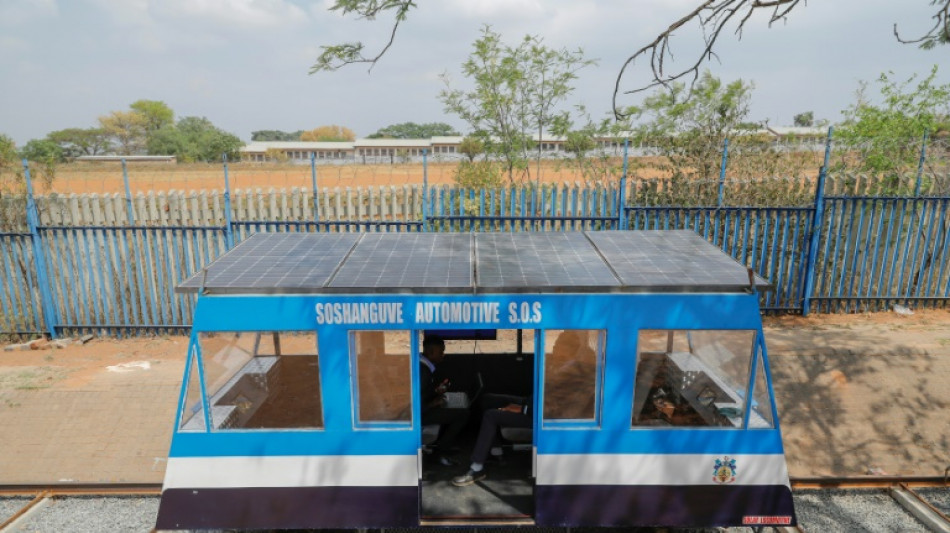
S.Africa teens build solar train as power cuts haunt commuters / Photo: Phill Magakoe - AFP

 Drone owners rush to offload devices ahead of Beijing ban

 Trump's beef policies irk Texas ranchers, testing their loyalty

 Nvidia, OpenAI CEOs to attend Xi dinner at White House

 Anthropic picks Accenture for in-house AI safety evaluation

 Balogun returns as Monaco beat Lens to continue strong Ligue 1 start

 'Pause' on overt repression in Venezuela, but reforms still needed: HRW

 Global stocks mixed as yen falls despite Bank of Japan rate hike

 Cuba hit with seventh major blackout of the year

 Murray out with concussion so Wentz will start for Vikings

 UN chief 'deeply regrets' US visa refusal to Abbas for annual meeting

 England quick Carse to face no charges over alleged nightclub assault

 Mancini brings nine newcomers into the first squad of his Italy comeback

 Czechs level Davis Cup tie against USA as South Korea eye Finals

 New France boss Zidane confirms Mbappe as captain after naming first squad

 California governor signs order to explore AI 'kill switch'

 Head leads run spree as Australia win Zimbabwe ODI series

 In-form Raphinha wants to finish career at Barcelona

 Warren Buffett steps down as Berkshire Hathaway chairman

 Carrick confident Man Utd can 'work through' tough time

 Mbappe ends Nike partnership to join Swiss brand On

 Liverpool boss Iraola puts Bournemouth love affair on hold

 'A disaster' if Man City do not win says Maresca after flawless start

 Kerry James Marshall: American 'blackness' painter celebrated in Europe

 Spain coach De la Fuente offers 'full support' to people of Ceuta

 Russia seizes assets of Nestle, French firms over West's Ukraine support

For years, students in a South African township have seen their parents struggle to use trains for daily commutes, the railways frequently hobbled by power outages and cable thefts.
To respond to the crisis, a group of 20 teenagers invented South Africa's first fully solar-powered train.
Photovoltaic panels fitted to the roof, the angular blue-and-white test train moves on an 18-metre-long (60 feet) test track in Soshanguve township north of the capital Pretoria.
Trains are the cheapest mode of transport in South Africa, used mostly by the poor and working class.
"Our parents... no longer use trains (because of) cable theft... and load shedding," said Ronnie Masindi, 18, referring to rolling blackouts caused by failures at old and poorly maintained coal-powered plants.
The state power company Eskom started imposing on-and-off power rationing 15 years ago to prevent a total national blackout.
The power outages, known locally as load-shedding, have worsened over the years disrupting commerce and industry, including rail services.
Infrastructure operator Transnet has struggled to keep rail traffic flowing smoothly since the economic challenges of the pandemic fuelled a surge in cable theft.
By 2020, rail use among public transport users was down almost two-thirds compared to 2013, according to the National Households Travel Survey with many commuters turning to more expensive minibus taxis.
Masindi said they decided to "create and build a solar-powered train that uses solar to move instead of (mains) electricity".
The journey has not been without its challenges.
A lack of funding delayed production of the prototype locomotive, and the government later chipped in.
"It was not a straight line," said another student, Lethabo Nkadimeng, 17. "It was like taking a hike to the highest peak of the mountain."
The train, which can run at 30 kilometres (20 miles) per hour, was showcased at a recent universities innovation event.
For now, the prototype can run for 10 return trips on the track installed on the grounds of a school.
It will be used for further research, and eventually presented as a model the government could adopt.
Fitted with car seats and a flat-screen TV to entertain passengers, it took the students two years to build.
"What we have realised is, if we you give township learners space, resources and a little mentorship they can do anything that any learner can do around the world," said Kgomotso Maimane, the project's supervising teacher.
P.Cavaco--PC



