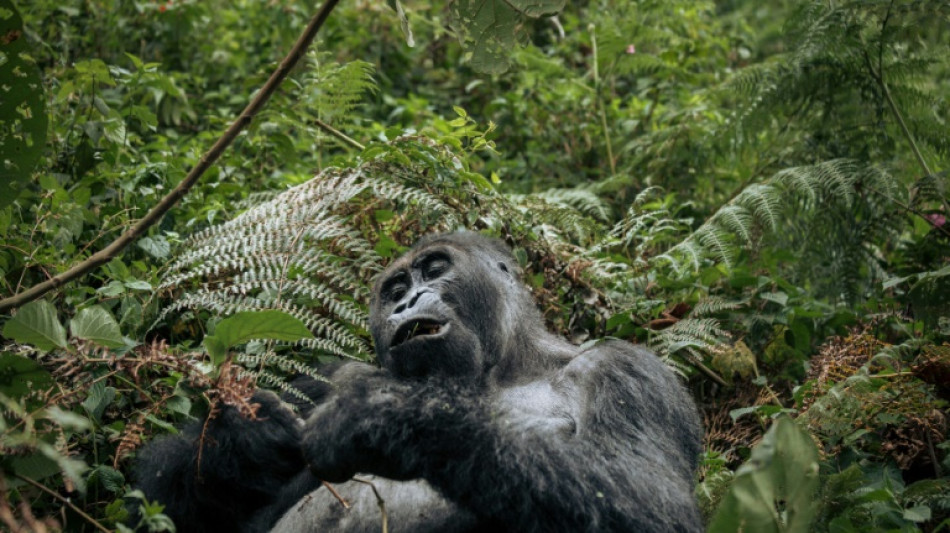
Wildlife populations plunge 69% since 1970: WWF / Photo: ALEXIS HUGUET - AFP/File

 Drone owners rush to offload devices ahead of Beijing ban

 Trump's beef policies irk Texas ranchers, testing their loyalty

 Nvidia, OpenAI CEOs to attend Xi dinner at White House

 Anthropic picks Accenture for in-house AI safety evaluation

 Balogun returns as Monaco beat Lens to continue strong Ligue 1 start

 'Pause' on overt repression in Venezuela, but reforms still needed: HRW

 Global stocks mixed as yen falls despite Bank of Japan rate hike

 Cuba hit with seventh major blackout of the year

 Murray out with concussion so Wentz will start for Vikings

 UN chief 'deeply regrets' US visa refusal to Abbas for annual meeting

 England quick Carse to face no charges over alleged nightclub assault

 Mancini brings nine newcomers into the first squad of his Italy comeback

 Czechs level Davis Cup tie against USA as South Korea eye Finals

 New France boss Zidane confirms Mbappe as captain after naming first squad

 California governor signs order to explore AI 'kill switch'

 Head leads run spree as Australia win Zimbabwe ODI series

 In-form Raphinha wants to finish career at Barcelona

 Warren Buffett steps down as Berkshire Hathaway chairman

 Carrick confident Man Utd can 'work through' tough time

 Mbappe ends Nike partnership to join Swiss brand On

 Liverpool boss Iraola puts Bournemouth love affair on hold

 'A disaster' if Man City do not win says Maresca after flawless start

 Kerry James Marshall: American 'blackness' painter celebrated in Europe

 Spain coach De la Fuente offers 'full support' to people of Ceuta

 Russia seizes assets of Nestle, French firms over West's Ukraine support

Wild populations of monitored animal species have plummeted nearly 70 percent in the last 50 years, according to a landmark assessment released Thursday that highlights "devastating" losses to nature due to human activity.
Featuring data from 32,000 populations of more than 5,000 species of mammals, birds, amphibians, reptiles and fish, the WWF Living Planet Index shows accelerating falls across the globe.
In biodiversity-rich regions such as Latin America and the Caribbean, the figure for animal population loss is as high as 94 percent.
Globally, the report found that monitored animal populations had fallen 69 percent since 1970.
Marco Lambertini, director general of WWF International, said his organisation was "extremely worried" by the new data.
"(It shows) a devastating fall in wildlife populations, in particular in tropical regions that are home to some of the most biodiverse landscapes in the world," he said.
Mark Wright, director of science at WWF, said the figures were "truly frightening", particularly for Latin America.
"Latin America is renowned for his biodiversity of course, it's really important for lots of other things as well," he said.
"It's super important for regulating the climate. We estimate currently there's something like 150 to 200 billion tonnes of carbon wrapped up in the forests of the Amazon."
That is equivalent to 550 to 740 billion tonnes of CO2, or 10 to 15 times more than annual greenhouse gas emissions at current rates.
The index found that freshwater species had declined more than those found in any other habitat, with an 83-percent population fall since 1970.
The report found that the main drivers of wildlife loss are habitat degradation due to development and farming, exploitation, the introduction of invasive species, pollution, climate change and disease.
Lambertini said the world needed to rethink its harmful and wasteful agricultural practices before the global food chain collapsed.
"Food systems today are responsible for over 80 percent of deforestation on land, and if you look at the ocean and freshwater they are also driving a collapse of fishery stocks and populations in those habitats," he said.
With world leaders due to convene in Montreal for the COP15 biodiversity summit in December, the report authors called for an international, binding commitment to protect nature, similar to the 2015 Paris Agreement on climate change.
- 'Need to act now' -
The Living Planet Report argues that increasing conservation and restoration efforts, producing and consuming food more sustainably, and rapidly and deeply decarbonising all sectors can alleviate the twin crises of climate change and biodiversity loss.
It also calls for governments to properly factor into policymaking the value of services rendered by nature, such as food, medicine and water supply.
"We need to stress the fact that nature loss is not just a moral issue of our duty to protect the rest of the world. It is actually an issue of material value, an issue of security for humanity as well," said Lambertini.
Some areas experienced more population loss than others -- Europe, for example, saw a wildlife population decline of 18 percent.
"But that also masks historic, very extreme losses of biodiversity," said Andrew Terry, director of conservation at the Zoological Society of London, which helped compile the data.
"We know that we're coming out of (a) low point in the state of biodiversity in the northern hemisphere."
In Africa, where 70 percent of livelihoods rely on nature in some form, the report showed a two-thirds fall in wildlife populations since 1970.
Alice Ruhweza, Africa regional director at WWF, said the assessment showed how there was a "huge human cost" when nature is lost.
She said young people in particular were concerned about wildlife preservation, and would push governments to implement greater protective measures.
"We have a young, entrepreneurial and increasingly educated population that is showing more awareness around issues of nature," said Ruhweza.
"So the potential for transformative change is really significant. But the time is running short, and we need to act now."
G.Machado--PC



