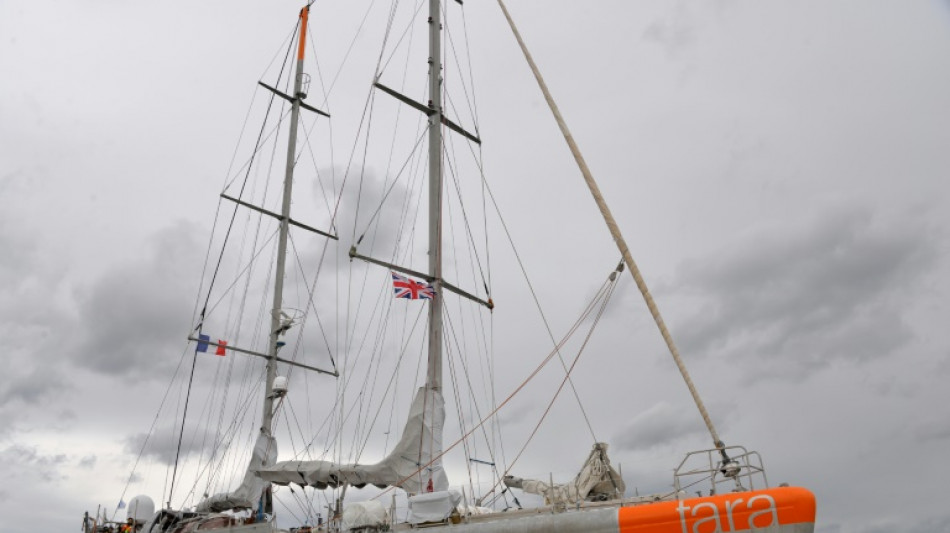
Scientists scour global waters testing ocean plankton and pollution / Photo: Amélie BOTTOLLIER-DEPOIS - AFP/File

 Drone owners rush to offload devices ahead of Beijing ban

 Trump's beef policies irk Texas ranchers, testing their loyalty

 Nvidia, OpenAI CEOs to attend Xi dinner at White House

 Anthropic picks Accenture for in-house AI safety evaluation

 Balogun returns as Monaco beat Lens to continue strong Ligue 1 start

 'Pause' on overt repression in Venezuela, but reforms still needed: HRW

 Global stocks mixed as yen falls despite Bank of Japan rate hike

 Cuba hit with seventh major blackout of the year

 Murray out with concussion so Wentz will start for Vikings

 UN chief 'deeply regrets' US visa refusal to Abbas for annual meeting

 England quick Carse to face no charges over alleged nightclub assault

 Mancini brings nine newcomers into the first squad of his Italy comeback

 Czechs level Davis Cup tie against USA as South Korea eye Finals

 New France boss Zidane confirms Mbappe as captain after naming first squad

 California governor signs order to explore AI 'kill switch'

 Head leads run spree as Australia win Zimbabwe ODI series

 In-form Raphinha wants to finish career at Barcelona

 Warren Buffett steps down as Berkshire Hathaway chairman

 Carrick confident Man Utd can 'work through' tough time

 Mbappe ends Nike partnership to join Swiss brand On

 Liverpool boss Iraola puts Bournemouth love affair on hold

 'A disaster' if Man City do not win says Maresca after flawless start

 Kerry James Marshall: American 'blackness' painter celebrated in Europe

 Spain coach De la Fuente offers 'full support' to people of Ceuta

 Russia seizes assets of Nestle, French firms over West's Ukraine support

After a near two-year "Microbiome" mission around the world, scientists said on Saturday they had gathered thousands of samples of marine micro-organisms in a bid to better understand ocean plankton and pollution.
The survey was carried out from the 33-year-old Tara research schooner, which returned to her home port of Lorient on France's western coast at the weekend.
From Chile to Africa, via the Amazon and the Antarctic, nearly 25,000 samples were collected over the 70,000-kilometre (43,000-mile) route.
"All this data will be analysed," Tara Ocean Foundation director Romain Trouble told a press conference.
"Within 18 months to two years we will start to have the first discoveries from the mission," he said.
At the base of the food chain, micro-organisms were the "invisible people of the sea", accounting for two-thirds of marine biomass, said Trouble.
"They capture atmospheric CO2 (carbon dioxide) and supply half of the oxygen we breathe."
Trouble said the mission sought to find out how it all works.
"How do all these marine viruses, bacteria, micro-algue manage to interact to produce oxygen?"
"And how will that change tomorrow with climate change and pollution?"
The Tara team paid particular attention to the impact on the oceans of the River Amazon, which has a water flow rate of 200 million litres (53 million gallons) per second.
They wanted to test a theory that deforestation and the spread of agriculture has increased nitrate fertiliser discharge, leading to an abundance of toxic algae along river banks and coasts, particularly in the Caribbean.
The 22-month odyssey also sought to trace the sources of plastic pollution at river mouths, to understand distribution and the types of material involved.
The mission was Tara's 12th global journey and involved 42 research institutions around the world.
Next spring, Tara sets off to research chemical pollution off European coasts.
Ferreira--PC



