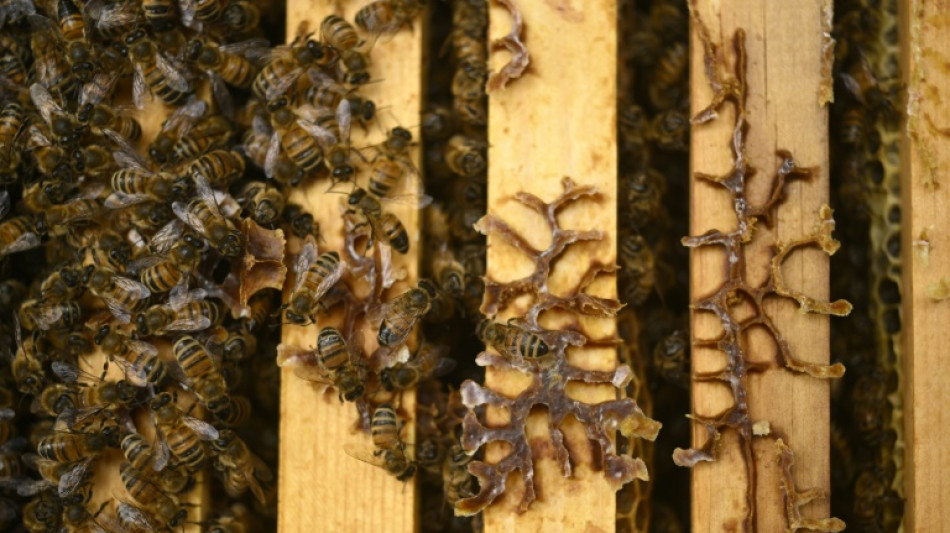
Europe's bees stung by climate, pesticides and parasites / Photo: Olivier MORIN - AFP/File

 Drone owners rush to offload devices ahead of Beijing ban

 Trump's beef policies irk Texas ranchers, testing their loyalty

 Nvidia, OpenAI CEOs to attend Xi dinner at White House

 Anthropic picks Accenture for in-house AI safety evaluation

 Balogun returns as Monaco beat Lens to continue strong Ligue 1 start

 'Pause' on overt repression in Venezuela, but reforms still needed: HRW

 Global stocks mixed as yen falls despite Bank of Japan rate hike

 Cuba hit with seventh major blackout of the year

 Murray out with concussion so Wentz will start for Vikings

 UN chief 'deeply regrets' US visa refusal to Abbas for annual meeting

 England quick Carse to face no charges over alleged nightclub assault

 Mancini brings nine newcomers into the first squad of his Italy comeback

 Czechs level Davis Cup tie against USA as South Korea eye Finals

 New France boss Zidane confirms Mbappe as captain after naming first squad

 California governor signs order to explore AI 'kill switch'

 Head leads run spree as Australia win Zimbabwe ODI series

 In-form Raphinha wants to finish career at Barcelona

 Warren Buffett steps down as Berkshire Hathaway chairman

 Carrick confident Man Utd can 'work through' tough time

 Mbappe ends Nike partnership to join Swiss brand On

 Liverpool boss Iraola puts Bournemouth love affair on hold

 'A disaster' if Man City do not win says Maresca after flawless start

 Kerry James Marshall: American 'blackness' painter celebrated in Europe

 Spain coach De la Fuente offers 'full support' to people of Ceuta

 Russia seizes assets of Nestle, French firms over West's Ukraine support

Bees pollinate 71 of the 100 crop species that provide 90 percent of food worldwide. They also pollinate wild plants, helping sustain biodiversity and the beauty of the natural world.
But climate change, pesticides and parasites are taking a terrible toll on bees and they need protecting, according to European beekeepers, who held their annual congress in Quimper, western France, this week.
The congress, which said some European beekeepers were suffering "significant mortalities and catastrophic harvests due to difficult climatic conditions", was an opportunity for beekeepers and scientists to try to respond to the major concerns.
The European Union, the world's second largest importer of honey, currently produces just 60 percent of what it consumes.
French beekeepers, for example, expect to harvest between 12,000 and 14,000 tonnes of honey this year, far lower than the 30,000 tonnes they harvested in the 1990s, according to the National Union of French Beekeepers (UNAF).
"I've been fighting for bees for 30 years but if I had to choose now, I don't know if I'd become a beekeeper," said UNAF spokesman Henri Clement, who has 200 hives in the unspoilt mountainous Cevennes region in southeastern France.
Clement is 62 and not far off retiring.
"But it's not much fun for young people who want to take up the profession," he said.
Many of the subjects buzzing around the congress were evidence of this -- Asian hornets, parasitic varroa mites and hive beetles (all invasive alien species in Europe), pesticides and climate change.
With climate change, "the bigger issue is just the erratic weather and rain patterns, drought and things like that", explained US entomologist Jeffery Pettis, president of Apimondia, an international federation of beekeeping associations in 110 countries.
"In certain places, the plants had been used to a certain temperature. And now it goes up, and you have a hot dry summer, and there are no flowers," Pettis told AFP.
No flowers means no pollen, which means bees dying of hunger.
Climate scientists say human-induced global heating is intensifying extreme weather events like flooding, and heatwaves that exacerbate wildfires.
"The fires seem to be a big issue," Pettis said. "They come sporadically and we lose hives directly from flooding and fires."
- Pollen quality -
Pettis, a former scientist at the US Department of Agriculture, published a study in 2016 on the quality of pollen produced by goldenrod -- a hardy perennial also known as solidago that produces a myriad of small, yellow, daisy-like flowers.
The study showed that the more carbon dioxide -- a greenhouse gas -- accumulates in the atmosphere, the lower the amount of protein in goldenrod pollen.
North America bees are dependent on nourishment from goldenrod pollen to get through the winter, Pettis explained.
"Getting inferior food ... should affect wintering. It could happen with other pollen sources. We don't know."
As in France, 30 to 40 percent of hives in the United States are dying every winter, Pettis said, decimated by varroa mites, pesticides and the destruction of wild spaces where wild plants grow.
"Today, there are even American startups that are developing drones to pollinise plants in the place of bees. It's utterly appalling," said Clement.
Toxic pesticides are another factor decimating bee colonies and other pollinating insects.
French molecular biophysics scientist Jean-Marc Bonmatin said parasites like varroa, were "boosted by the presence of neonicotinide pesticides, which directly poison pollinators".
Neonicotinides, chemically similar to nicotine, are systemic pesticides.
Unlike contact pesticides, which remain on the surface of the treated leaves, systemic pesticides are taken up by the plant and transported throughout the plant, to their leaves, flowers, roots and stems, as well as to their pollen and nectar.
These toxic substances can remain in the soil for between five and 30 years, Bonmatin said.
The EU restricted the use of three neonicotinides -- but not all -- in 2013 and banned them outright in 2018.
But since 2013, several EU states have repeatedly granted "emergency authorisations" to use the noxious insecticides on major crops.
- Limiting toxic chemicals -
He said open source software called Toxibee was being launched soon to help farmers protect bees by identifying the least toxic molecules to use on their crops.
"Before they spray the crops with pesticides, they can try to limit their noxious effect," he said.
"Because what kills bees will one day damage people's health too."
Pettis strove, however, to remain upbeat, pointing to some of the ways people can help bees.
"(We should) diversify agriculture and try not be driven by chemically-dependant agriculture, support organic and more sustainable farming."
He also stressed the incredible resistance of some bee species, helped by factors in the natural world.
He cited the example of a black bee found on the Ile de Groix island in Brittany, which has survived varroa attacks without beekeepers treating them for mites or giving them supplementary feeding.
"We think the bees are dependent on us but in reality they survive pretty well even without us," he said.
"And you still have the beauty of the bees. It's such a good thing to work with bees."
J.Pereira--PC



