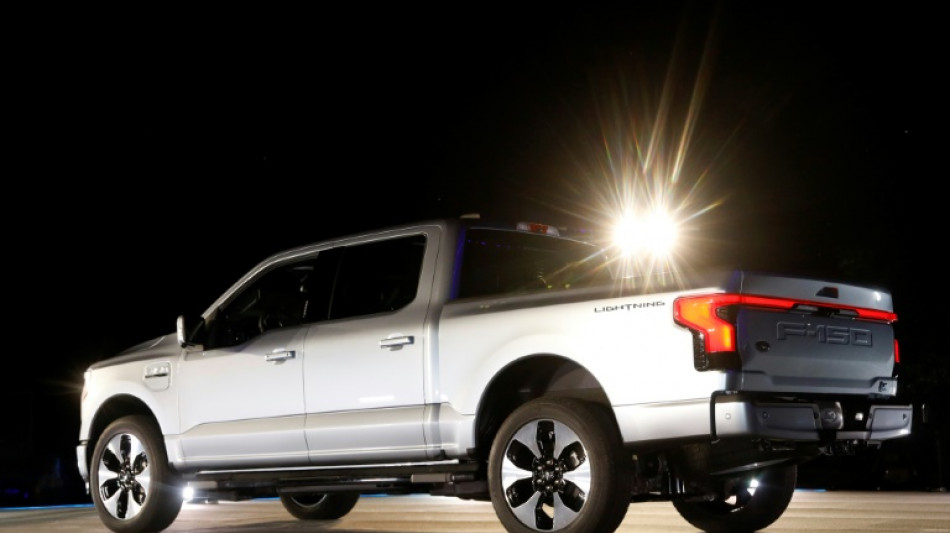
Will climate change doom US truck habit? Detroit says no / Photo: JEFF KOWALSKY - AFP/File

 Drone owners rush to offload devices ahead of Beijing ban

 Trump's beef policies irk Texas ranchers, testing their loyalty

 Nvidia, OpenAI CEOs to attend Xi dinner at White House

 Anthropic picks Accenture for in-house AI safety evaluation

 Balogun returns as Monaco beat Lens to continue strong Ligue 1 start

 'Pause' on overt repression in Venezuela, but reforms still needed: HRW

 Global stocks mixed as yen falls despite Bank of Japan rate hike

 Cuba hit with seventh major blackout of the year

 Murray out with concussion so Wentz will start for Vikings

 UN chief 'deeply regrets' US visa refusal to Abbas for annual meeting

 England quick Carse to face no charges over alleged nightclub assault

 Mancini brings nine newcomers into the first squad of his Italy comeback

 Czechs level Davis Cup tie against USA as South Korea eye Finals

 New France boss Zidane confirms Mbappe as captain after naming first squad

 California governor signs order to explore AI 'kill switch'

 Head leads run spree as Australia win Zimbabwe ODI series

 In-form Raphinha wants to finish career at Barcelona

 Warren Buffett steps down as Berkshire Hathaway chairman

 Carrick confident Man Utd can 'work through' tough time

 Mbappe ends Nike partnership to join Swiss brand On

 Liverpool boss Iraola puts Bournemouth love affair on hold

 'A disaster' if Man City do not win says Maresca after flawless start

 Kerry James Marshall: American 'blackness' painter celebrated in Europe

 Spain coach De la Fuente offers 'full support' to people of Ceuta

 Russia seizes assets of Nestle, French firms over West's Ukraine support

The US consumer's love for enormous vehicles has been seen by outsiders as a curiosity and sometimes a sign of profligacy.
Either way, rising concerns about climate change seemed to create a reckoning for the behemoth-sized pickup trucks and sport utility vehicles that recently have sustained US automaker profits.
Not so, according to Detroit auto giants, who have responded to the climate crisis by launching all-electric versions of the Ford F-150 pickup, the Chevrolet Blazer SUV and other best-selling giants that seemingly promise the possibility that consumers can have it all: address global warming without sacrificing the appeal of larger autos.
Leading US environmentalists, along with the Biden administration, have praised announcements of the electric vehicle (EV) rollouts as a way to reduce greenhouse gas emissions.
Absent has been any discussion of the environmental toll of large EV trucks, which require more energy to recharge and more critical materials than do smaller EVs.
In showcasing trucks, Detroit automakers are setting the groundwork for an EV era that mirrors the current profile of US roadways and distinct from Europe, where sedans dominate.
Industry insiders like Alan Amici, president of the Center for Automotive Research, see little appetite among American consumers to go small.
"People are still clamoring for big pickups and SUVs," Amici said. "I don't expect a return to sedans."
The trucks, often marketed in advertisements navigating rugged landscapes, provide lucrative profit margins to automakers and have become so ubiquitous on US roads that some consumers avoid smaller vehicles out of fear of how it would handle a crash with a much bigger auto.
Ford and General Motors, both of which report earnings this week, are positioning the vehicles as environmentally friendly based on how they contrast with gas-guzzling equivalents.
Luke Tonachel, who heads the clean vehicles program at environmental group NRDC, said electric pickups and SUVs represent a critical step in addressing climate change.
"It's incredibly important that we eliminate tailpipe pollution from all cars as soon as possible," Tonachel told AFP.
"We need broad acceptance and adoption of EVs across the market. And that's why it's encouraging to see automakers starting to make EVs on all types of car segments, including the most popular ones."
- Customer 'has spoken' -
The focus on large vehicles was apparent at last month's Detroit Auto Show, where Biden test drove the EV Cadillac Lyriq, an SUV made by the GM brand. In previous trips to Detroit, Biden cheered on production of GM's EV Hummer and the launch of Ford's F-150 EV.
While GM's display at the Detroit show included the Bolt, an EV sedan, greater prominence went to electric versions of three larger Chevies: the Silverado pickup, and the Blazer and Equinox SUVs.
"The customer has spoken. SUVs and trucks are what the customer wants," Chevrolet Vice President Steve Majoros told AFP at the show.
NRDC's Tonachel notes that some sedans still sell at substantial levels in the United States, but that they are made by companies like Japan's Toyota and South Korea's Hyundai.
"The different manufacturers are sort of carving out what they see as their specialty," he said. "The Detroit three automakers, they left the compact car and most of the sedan market years ago."
Bertrand Rakoto, global automotive practice leader at Ducker in Detroit, a consultancy, said it makes more sense to focus on trucks to fight climate change.
"You're removing the emissions for the large vehicles that are the most emitting," he said.
Rakoto, who is originally from France, said the contrast between the United States and Europe reflect different geographic qualities and transportation systems, with space in Europe more precious and public transit more integrated into regular life.
- Energy drain -
A December 2021 International Energy Agency report bemoaned the rise of SUVs, not only in the United States, but in India and Europe.
Most of the vehicles still run on gasoline, meaning that "if SUVs were an individual country, they would rank sixth in the world for absolute emissions in 2021, emitting over 900 million tons of CO2," the IEA said.
The analysis said SUV electrification helps, but noted larger vehicles require more critical materials for bigger batteries and consume around 20 percent more energy than a medium-sized car.
For Benjamin Stephan, of Greenpeace in Germany, limiting global warming remains critical, meaning "you sort of have to pull every lever available."
"Obviously an all-electric pickup truck will have a much better carbon footprint," he said. "But you could reduce that footprint even more by having no car at all, or a much smaller car."
P.Queiroz--PC



