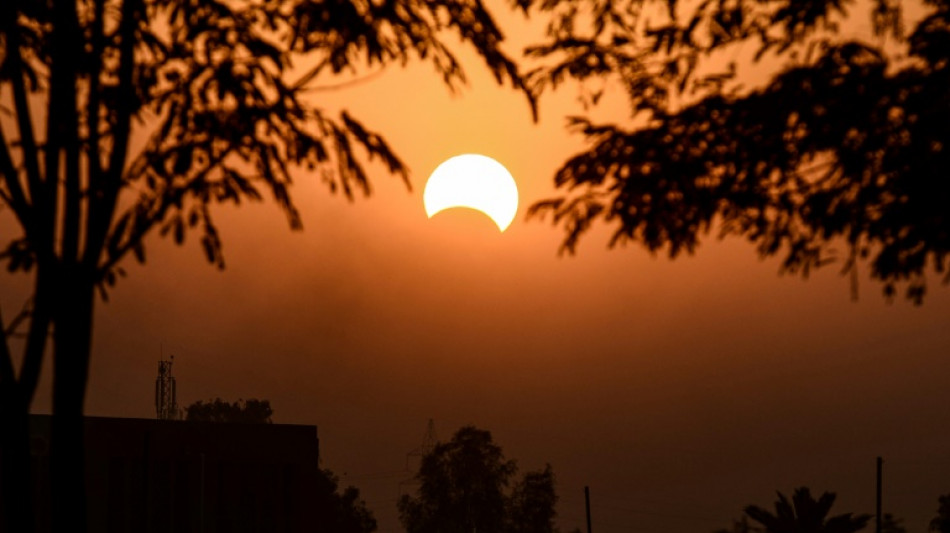
Partial solar eclipse begins in Iceland headed towards India / Photo: Haidar HAMDANI - AFP/File

 Drone owners rush to offload devices ahead of Beijing ban

 Trump's beef policies irk Texas ranchers, testing their loyalty

 Nvidia, OpenAI CEOs to attend Xi dinner at White House

 Anthropic picks Accenture for in-house AI safety evaluation

 Balogun returns as Monaco beat Lens to continue strong Ligue 1 start

 'Pause' on overt repression in Venezuela, but reforms still needed: HRW

 Global stocks mixed as yen falls despite Bank of Japan rate hike

 Cuba hit with seventh major blackout of the year

 Murray out with concussion so Wentz will start for Vikings

 UN chief 'deeply regrets' US visa refusal to Abbas for annual meeting

 England quick Carse to face no charges over alleged nightclub assault

 Mancini brings nine newcomers into the first squad of his Italy comeback

 Czechs level Davis Cup tie against USA as South Korea eye Finals

 New France boss Zidane confirms Mbappe as captain after naming first squad

 California governor signs order to explore AI 'kill switch'

 Head leads run spree as Australia win Zimbabwe ODI series

 In-form Raphinha wants to finish career at Barcelona

 Warren Buffett steps down as Berkshire Hathaway chairman

 Carrick confident Man Utd can 'work through' tough time

 Mbappe ends Nike partnership to join Swiss brand On

 Liverpool boss Iraola puts Bournemouth love affair on hold

 'A disaster' if Man City do not win says Maresca after flawless start

 Kerry James Marshall: American 'blackness' painter celebrated in Europe

 Spain coach De la Fuente offers 'full support' to people of Ceuta

 Russia seizes assets of Nestle, French firms over West's Ukraine support

A partial solar eclipse began over Iceland on Tuesday as the rare celestial spectacle started to make its way east across a swathe of the Northern Hemisphere.
The partial eclipse began at 0858 GMT and will end off the coast of India at 1302 GMT, crossing parts of Europe, North Africa and the Middle East on its way, according to the IMCCE institute of France's Paris Observatory.
Amateur astronomers must not stare directly at the eclipse, which will not darken the sky, and should instead wear protective glasses to avoid eye damage, experts said.
Solar eclipses occur when the Moon passes between the Sun and Earth, casting its shadow down onto our planet.
A total solar eclipse happens when the Moon completely blocks the Sun's disk, momentarily plunging a portion of the Earth into complete darkness.
However Tuesday's eclipse is only partial, and the "Moon's shadow will not touch the surface of the Earth at any point," the Paris Observatory said in a statement.
The Moon will cover a maximum of 82 percent of the Sun over Kazakhstan, but it will not be enough darken the daylight, Paris Observatory astronomer Florent Deleflie said.
At least 95 percent of the Sun needs to be obscured to get a "sense of darkness," Deleflie told AFP.
"It won't be spectacular, but it's always an event for amateur astronomers -- and it can make for beautiful photos."
- Chasing eclipses -
Ryan Milligan, an astrophysicist at Northern Ireland's Queen's University Belfast, is a self-described "solar eclipse chaser" who has travelled the world to witness the rare celestial events.
Though Tuesday's eclipse "will be a slight event", Milligan told AFP that as an eclipse chaser, it will be "exciting to get that buzz back again".
But even with "the brightest clear skies, you will be none the wiser of what's going on above your head" unless you have the correct glasses, he added.
It can also be observed by poking a small hole in one piece of paper and letting the sunshine stream through onto another piece.
The holes in kitchen colanders or even Ritz crackers can also be used, Milligan added.
Milligan has travelled to countries including Chile to Turkey to see a total of 10 eclipses.
This week he booked a camper van for a trip to Western Australia in April next year to see a total eclipse that will last 76 seconds.
He is also heading to Mexico in April 2024 for what he calls "the big one" -- a total eclipse that will pass over North America.
Closer to his home in Northern Ireland, a total eclipse will be visible in Spain in 2026.
To find out when eclipses can be seen in different countries, Milligan recommended the website timeanddate.com/eclipse.
Despite Tuesday not being the most exciting event, Milligan urged those interested to plan for the next total eclipse.
"People always talk about the northern lights being on their bucket list," Milligan said. "But a total solar eclipse is the most spectacular sight in nature."
H.Portela--PC



