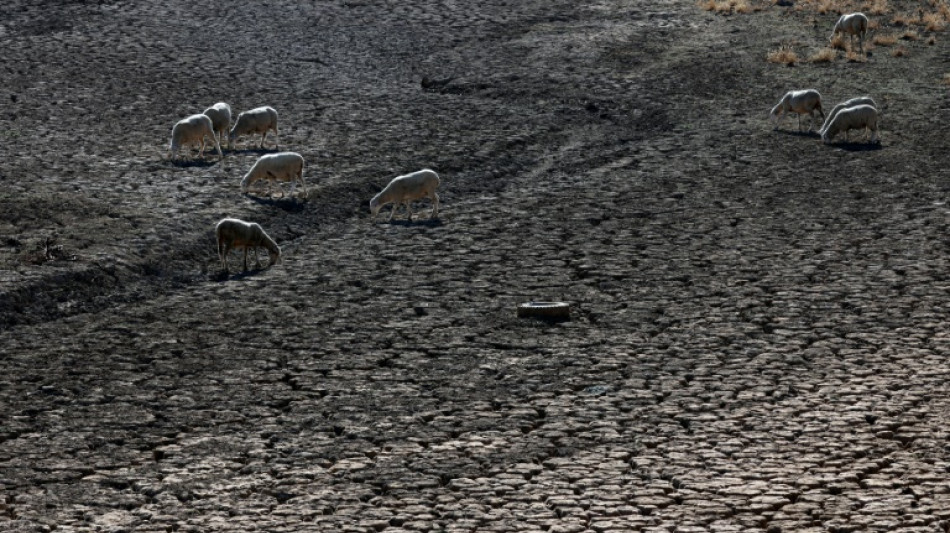
Heat waves cost poor countries the most, exacerbating inequality / Photo: THOMAS COEX - AFP/File

 Drone owners rush to offload devices ahead of Beijing ban

 Trump's beef policies irk Texas ranchers, testing their loyalty

 Nvidia, OpenAI CEOs to attend Xi dinner at White House

 Anthropic picks Accenture for in-house AI safety evaluation

 Balogun returns as Monaco beat Lens to continue strong Ligue 1 start

 'Pause' on overt repression in Venezuela, but reforms still needed: HRW

 Global stocks mixed as yen falls despite Bank of Japan rate hike

 Cuba hit with seventh major blackout of the year

 Murray out with concussion so Wentz will start for Vikings

 UN chief 'deeply regrets' US visa refusal to Abbas for annual meeting

 England quick Carse to face no charges over alleged nightclub assault

 Mancini brings nine newcomers into the first squad of his Italy comeback

 Czechs level Davis Cup tie against USA as South Korea eye Finals

 New France boss Zidane confirms Mbappe as captain after naming first squad

 California governor signs order to explore AI 'kill switch'

 Head leads run spree as Australia win Zimbabwe ODI series

 In-form Raphinha wants to finish career at Barcelona

 Warren Buffett steps down as Berkshire Hathaway chairman

 Carrick confident Man Utd can 'work through' tough time

 Mbappe ends Nike partnership to join Swiss brand On

 Liverpool boss Iraola puts Bournemouth love affair on hold

 'A disaster' if Man City do not win says Maresca after flawless start

 Kerry James Marshall: American 'blackness' painter celebrated in Europe

 Spain coach De la Fuente offers 'full support' to people of Ceuta

 Russia seizes assets of Nestle, French firms over West's Ukraine support

Heat waves, intensified by climate change, have cost the global economy trillions of dollars in the last 30 years, a study published Friday found, with poor countries paying the steepest price.
And those lopsided economic effects contribute to widening inequalities around the world, according to the research.
"The cost of extreme heat from climate change so far has been disproportionately borne by the countries and regions least culpable for global warming," Dartmouth College professor Justin Mankin, one of the authors of the study published in the journal Science Advances, told AFP. "And that's an insane tragedy."
"Climate change is playing out on a landscape of economic inequality, and it is acting to amplify that inequality," he said.
Periods of extreme heat cost the global economy about $16 trillion dollars between 1992 and 2013, the study calculated.
But while the richest countries have lost about 1.5 percent of their annual per capita GDPs dealing with heat waves, poorer countries have lost about 6.7 percent of their annual per capita GDPs.
The reason for that disparity is simple: poor countries are often situated closer to the tropics, where temperatures are warmer anyway. During heat waves, they become even hotter.
The study comes just days ahead of the start of the COP27 climate summit in Egypt, where the question of compensation for countries which are disproportionately vulnerable to but least responsible for climate change is expected to be one of the key topics.
The costs of heat waves come from several factors: effects on agriculture, strains on health systems, less productive workforces and physical damage to infrastructure, such as melting roads.
- 'Cost of inaction' -
Study researchers examined five days of weather considered extreme for a specific region each year.
"The general idea is to use variation in extreme heat, which is effectively randomly assigned to all these economic regions, and see the extent to which that accounts for variation in economic growth" in a given region, Mankin explained.
"Then the second part is to say, 'ok, how has human-caused warming influenced extreme heat?'" he added.
Despite these calculations, the study results almost certainly underestimate the true cost of extreme heat, according to the paper -- only studying five days per year does not reflect the increased frequency of such heat events, and not all potential costs were included.
Previous studies on the subject had focused on the costs of heat to specific sectors, though scientists say it is important to look at the price tag of climate change wholistically.
"You want to know what those costs are, so that you have a frame of reference against which to compare the cost of action," Mankin said, such as establishing cooling centers or installing air conditioners, versus "the cost of inaction."
"The dividends economically of responding to the five hottest days of the year could be quite great," he said.
But according to Mankin, the most important response is to reduce carbon emissions to slow down global warming at the source.
"We need to adapt to the climate we have now, and we also need to deeply invest in mitigation," he said.
T.Resende--PC



