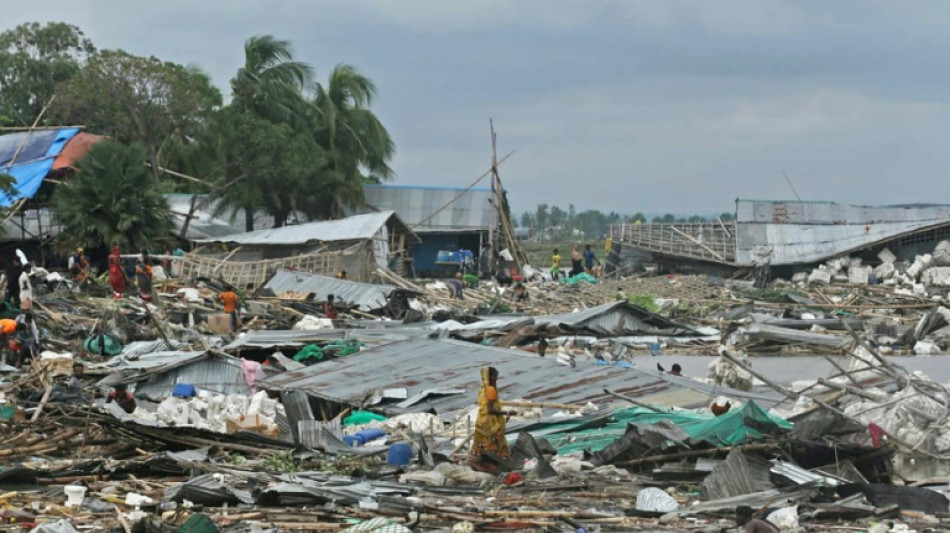
UN calls on nations to 'urgently' boost climate funds / Photo: Rabin Chowdhury - AFP/File

 Drone owners rush to offload devices ahead of Beijing ban

 Trump's beef policies irk Texas ranchers, testing their loyalty

 Nvidia, OpenAI CEOs to attend Xi dinner at White House

 Anthropic picks Accenture for in-house AI safety evaluation

 Balogun returns as Monaco beat Lens to continue strong Ligue 1 start

 'Pause' on overt repression in Venezuela, but reforms still needed: HRW

 Global stocks mixed as yen falls despite Bank of Japan rate hike

 Cuba hit with seventh major blackout of the year

 Murray out with concussion so Wentz will start for Vikings

 UN chief 'deeply regrets' US visa refusal to Abbas for annual meeting

 England quick Carse to face no charges over alleged nightclub assault

 Mancini brings nine newcomers into the first squad of his Italy comeback

 Czechs level Davis Cup tie against USA as South Korea eye Finals

 New France boss Zidane confirms Mbappe as captain after naming first squad

 California governor signs order to explore AI 'kill switch'

 Head leads run spree as Australia win Zimbabwe ODI series

 In-form Raphinha wants to finish career at Barcelona

 Warren Buffett steps down as Berkshire Hathaway chairman

 Carrick confident Man Utd can 'work through' tough time

 Mbappe ends Nike partnership to join Swiss brand On

 Liverpool boss Iraola puts Bournemouth love affair on hold

 'A disaster' if Man City do not win says Maresca after flawless start

 Kerry James Marshall: American 'blackness' painter celebrated in Europe

 Spain coach De la Fuente offers 'full support' to people of Ceuta

 Russia seizes assets of Nestle, French firms over West's Ukraine support

Climate change impacts battering vulnerable countries threaten to outstrip efforts to adapt to global warming, the UN warned Thursday, with a "significant" amount of international funding help recycled from other purposes.
Many emerging economies, which are least to blame for the fossil-fuel gases that stoke global warming, are among the most exposed to climate impacts, such as worsening drought, floods and cyclones.
Funding to help them adapt to accelerating impacts and curb emissions is one of the thorniest issues at UN climate negotiations, which begin their latest round in Egypt on Sunday.
Wealthy nations have failed to provide a pledged $100 billion a year to developing nations, reaching just $83 billion in 2020.
Only a part of that -- $29 billion -- was for adaptation.
That leaves a "yawning gap to be filled" said United Nations Environment Programme (UNEP) chief Inger Andersen, adding that the actual needs were around five to 10 times greater than finance provided in 2020.
While countries have committed to providing new funding for climate-vulnerable nations, richer nations have been accused of relabelling other types of funding, like humanitarian aid, as climate funding.
"Some of that money -- and we don't know how much, but certainly a significant proportion -- is not actually adaptation or mitigation, it's repurposed," Henry Neufeldt, author of the UNEP report, told a press conference on Thursday.
But as the world warms, climate change impacts increase and so too do the costs of preparing for them.
- 'Unacceptable' -
UNEP revised up its adaptation estimates from a year earlier, saying countries will now need $160 billion to $340 billion annually by 2030 to strengthen their resilience, rising to $315 billion and $565 billion by 2050.
Last week the UN warned the world was nowhere near the Paris Agreement target of capping warming at 1.5 degrees Celsius above pre-industrial levels.
"We must quickly reduce greenhouse gas emissions and strive for net-zero. But people, ecosystems and economies are already suffering," said Anderson, calling for the international community to "urgently increase efforts to adapt to climate change".
In February, in a report dubbed an "atlas of human suffering", the UN's climate experts warned that global warming is outpacing our preparations for a climate-addled world.
The poorest are often the hardest hit and the least able to protect themselves.
"This is unacceptable," said UN chief Antonio Guterres.
"We need a global surge in adaptation investment to save millions of lives from climate carnage," he added, announcing a new tool to try to help fill this gap.
At the last UN climate talks in Glasgow, countries agreed to double their adaptation finance from 2019 levels by 2025, reaching $40 billion.
But even that target is under question after the increase from 2019 to 2020 was just four percent, the UN said.
- 'Broken' -
"The current model for delivering adaptation support, quite frankly, is broken," a senior UN official told AFP.
While financing has always been a key sticking point in the UN climate negotiations, the issue is taking on greater urgency at this year's meeting.
A series of weather extremes across the planet have further intensified calls for funding to help with climate impacts already being felt, known as "loss and damage".
Pakistan, for example, is reeling from a crop-withering heatwave, followed within weeks by catastrophic inundations -- both intensified by climate change -- that killed over 1,700 people and swamped a third of its territory.
The floods caused over $30 billion in damages and economic losses, said Anderson.
But currently, the aftermath of this type of disaster is not covered by climate funds.
Harjeet Singh, head of global political strategy at the Climate Action Network, said that wealthy countries' willingness to put loss and damage funding on the agenda would be a "real test" of the UN climate meeting.
It will "either send a message of hope or despair to people already facing the climate crisis," he said, but added that as temperatures rise, finance for adaptation, loss and damage and curbing emissions are no longer in the billions: "We need trillions."
J.Oliveira--PC



