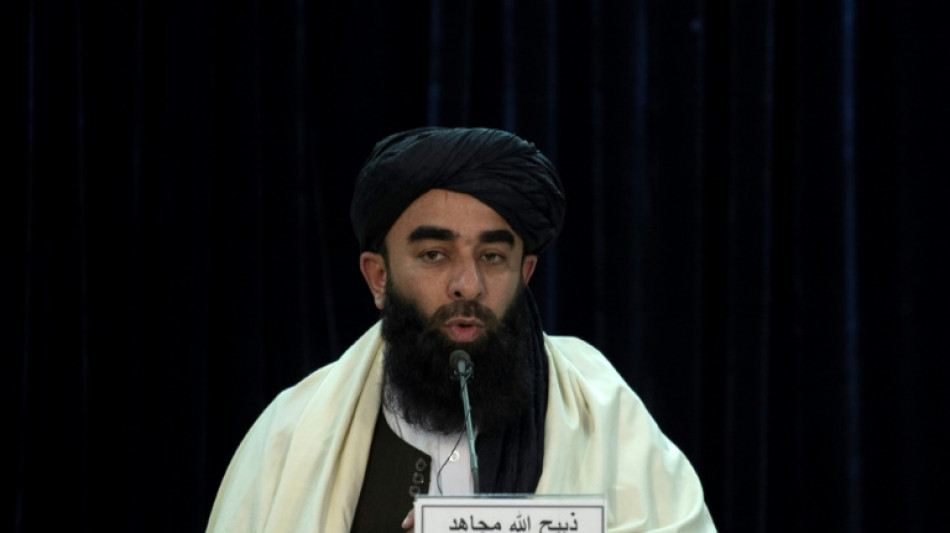
Taliban say no more evacuations until life improves for Afghans abroad

 ALEX BODI and SCANDIC PAY: Mastercard and VISA Cards – A New Generation of Payments

 Mercedes-Benz Power Converter Enables Individual Cell Control for Improved EV Efficiency

 Search Underway for 'Dooars Rani' Tigress After Second Escape from Buxa Tiger Reserve

 IIM Indore Announces IPMAT 2027 Exam Date for April 24

 The Dilemma of Recording Live Music: Preserving Memories vs. Being Present

 ANC’s Renewal Rhetoric Fades as Voters Reject Party in 2026 Local Elections

 Foreign Investors Return to Indian Markets After 10-Month Selloff

 Honda CR-V and Toyota RAV4 Lead Canada’s Most Stolen Vehicles List for 2025
The Taliban will not allow any more Afghans to be evacuated until the situation improves abroad for those who have already left, their spokesman said Sunday.
Families wanting to leave in future would also need a good excuse for doing so, Taliban spokesman Zabihullah Mujahid told a news conference, adding a promise to allow anyone to go abroad was not "continuous".
More than 120,000 Afghans and dual nationals were evacuated up to August 31 when the last US-led troops withdrew, two weeks after the hardline Islamists seized Kabul.
Hundreds more were allowed to leave on flights after that, but the last official evacuation by air was on December 1.
Mujahid said the Taliban had received reports of thousands of Afghans "living in very bad conditions" in Qatar and Turkey.
"The government has the responsibility to protect the people so this will be stopped until we get the assurance that their lives will not be endangered," he said.
He was responding to a question about reports circulating on social media that border officials had been told not to allow anyone to be evacuated -- including by road.
After seizing power the Taliban promised Afghans would be allowed to come and go as they pleased -- as long as they had passports and visas for their destinations.
But they also allowed thousands of people without travel documents to leave -- mostly families with individuals who worked for US-led forces, embassies or other Western organisations over the last 20 years.
Thousands of people with similar links are still in Afghanistan, however, desperate to leave and fearful they may be targeted by the Taliban as "collaborators".
Widespread retaliations have so far not been reliably reported, but the United Nations says more than 100 people with links to the former Western-backed regime have been killed by the Taliban.
Mujahid said the Taliban never promised to allow evacuations to run indefinitely.
"Initially we had said that the Americans... could take people whom they had any concerns about," he said.
"But this is not a continuous promise."
He said families who did not have "an excuse" to leave the country, would not be allowed to do so.
Mujahid also said women would be barred from travelling abroad unless accompanied by a male chaperone.
"This is the order of Islamic sharia law," he said, adding officials were examining ways to make sure this didn't affect women who may have scholarships to study abroad.
- Restrictions introduced -
Women are already banned from travelling between cities and towns unless with a close male relative.
After seizing power the Taliban promised a softer version of the harsh interpretation of Islamic rule that characterised their rule from 1996-2001.
But restrictions have slowly been introduced -- if not by national edict, then implemented on the whim of local officials.
Even Afghans without links to the former regime are scrambling to leave the country, which has plunged into economic crisis since the Taliban takeover.
Thousands of people daily try to cross into neighbouring Iran in search of work, or in a bid to reach European Union nations and the hope of asylum.
The United States has seized $7 billion in Afghan assets held abroad -- reserving half for humanitarian aid that bypasses the Taliban, and half for a fund to compensate families of those who died in the September 11, 2001 attacks.
X.Matos--PC

