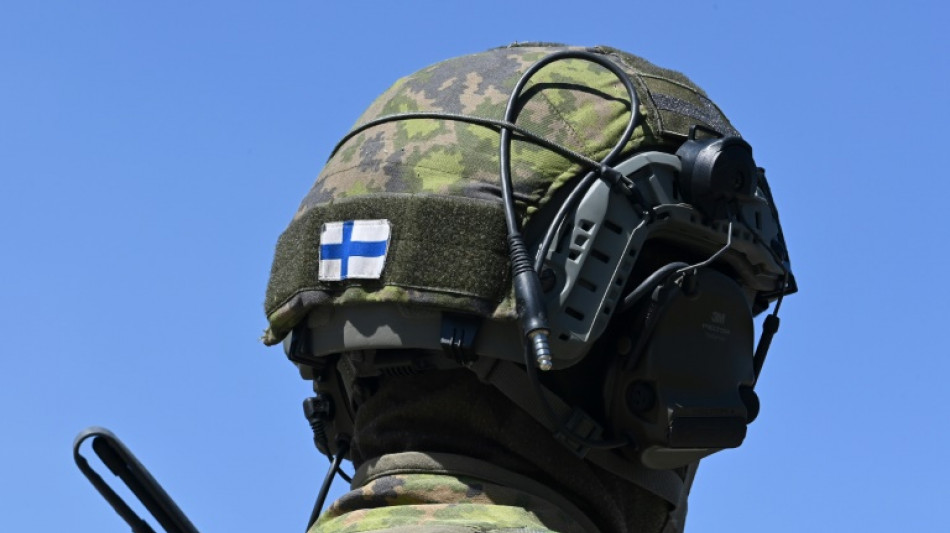
How Finland joining boosts NATO defences against Russia / Photo: Christof STACHE - AFP

 Manchester City's Premier League charges: What comes next?

 Brazil's cellphone crime: a security nightmare in every pocket
 Russia pummels Kyiv in latest deadly attack
 NFL Giants obtain QB McCarthy from Vikings

 Deal for evicted Spanish pensioner as PM seeks new housing law

 Clippers apologize, warn fans of 'challenges' after Leonard scandal

 Turkish comedian convicted for Erdogan 'insult' freed pending appeal

 Trump announces 'biggest' US steel plant in battleground Iowa

 Olise wonder strike gives Zidane's France win in Belgium
 US stocks fall, bond yields rise as Middle East war drags on
 Trump denies offering to sell arms to China's Xi

 Wemby ready for NBA Spurs to move rivals in climb to top

 Ukraine to postpone some spending amid delays in aid: PM

 Tuchel says Czech Republic game 'not yet a must-win'
 MaXhosa puts South Africa on the Paris fashion map
 Rose, Scott among 2027 World Golf Hall of Fame finalists

 Brunson says NBA champion Knicks can't get satisfaction

 France puts out largest wildfire since 1949
 Real Madrid's Perez summoned over Barcelona referee payments comments

 Oil takes off again, Wall Street dips after Trump rejects Iran truce offer

 AlgoQuant Asset Management Selects Liquid Mercury to Enhance Digital Asset Trading Infrastructure

 UK to reopen refugee resettlement scheme to push 'safe' migration
 Pope urges Europe to help combat 'lies and deceit' in world affairs

 Iranian lawyer Nasrin Sotoudeh wins Council of Europe's rights prize
 French far-right's Bardella denies alleged 2013 antisemitic comments
Finland's membership of NATO adds a potent military to the alliance and a strategic puzzle piece that can better help defend its vulnerable eastern flank from potential Russian attack, officials and analysts say.
When President Vladimir Putin launched his all-out war on Ukraine, part of Moscow's justification was the claim it needed to stop further NATO expansion in its backyard.
But 13 months on, Finland's choice to join means the US-led alliance is now doubling its border with Russia in a move that changes the military calculus from the Baltic region to the Arctic.
"Now Finland needs NATO, but NATO needs Finland as well in the face of an aggressive Russia," said Jamie Shea, a former senior NATO official who is an associate fellow at the Chatham House think tank.
"NATO will find collective defence against Russia easier now it has access to Finnish territory and the capabilities Finland brings to the table."
- Protecting the Baltics -
Alliance military planners have fretted for years over how to protect its three Baltic members -- Estonia, Latvia and Lithuania -- from a possible attack by Russia.
Concern focused on the Suwalki Gap, a 65-kilometre (40-mile) strip between the Russian enclave of Kaliningrad and Belarus, where a lightning strike could sever the Baltic allies from the rest of NATO.
Now Finland's membership could help NATO to dominate the Baltic Sea and, with Helsinki less than 70 kilometres across the water from Estonia's capital Tallinn, provide a new route for reinforcements.
"Finland's accession will strengthen NATO's forward defence and contribute to deterrence by denial," Estonia's Defence Minister Hanno Pevkur told AFP.
But he warned "the significance of the Suwalki gap for NATO remains, since Belarus has de facto become Russia's military district", and insisted the alliance still needs to push on with plans to reinforce the Baltics.
To the north, having Finland onboard will help the alliance defend the thin strip of Norwegian territory linking to Russia where Moscow could have staged a "fait accompli" assault, said analyst Jan Kallberg.
"Up to this point, NATO air forces have been dependent on a few Norwegian airfields that could be targeted early in a conflict, Finland adds more bases and air strips," said Kallberg, a senior fellow at the Center for European Policy Analysis.
And as jostling for control in the Artic region involving Russia, China and the West increases, stepping up NATO's footprint on its doorstep will be a major boost.
- Prepared for war -
Adding an extra 1,300 kilometres to the alliance's land border with Russia will also bring vulnerabilities, and working out how to defend it will pose a challenge for NATO strategists.
While its response to Finland's membership has been more muted than many expected, the Kremlin has pledged to bolster its forces close to the frontier in the coming years.
But with Russia's military bogged down in Ukraine, analysts say it will likely take years for Moscow to rebuild its capacity.
For the time being, Finland is expected to follow neighbour Norway's example and opt not to have forces from NATO allies stationed permanently on its territory.
The country already has a highly capable military.
"Finland is one of the very few European countries that never stopped preparing for a potential war," said Minna Alander, a research fellow at the Finnish Institute of International Affairs.
While other Western European militaries scaled back after the Cold War, Finland stuck to a conscription model fashioned from the bitter experience of the Soviet Union's invasion in 1939.
"That now gives Finland a wartime troop strength up to 280,000 and a total reserve of 870,000," Alander said.
"With 1,500 systems, Finland has one of the largest artilleries in Europe and has been and is continuously investing in air defence."
- A last gap -
Military officials from its future NATO counterparts point to Finland's winter warfare experience and planned upgrade to the latest US aircraft as key assets.
"On land, they are extremely capable, operating in the harshest of conditions and backed by considerable artillery," a senior Western official told AFP.
"In the air, Finland is buying the new F-35 fighter."
Finland's looming membership does highlight one gap left for NATO -- its neighbour Sweden.
Stockholm's application remains blocked by resistance from Turkey and Hungary, meaning that it still cannot be fully integrated into NATO's defence plans.
"The mere fact that Finland comes in will bolster Sweden because it will now be sandwiched between NATO members," said Shea.
"But the hope is still that they will be allowed in as soon as possible."
M.Carneiro--PC