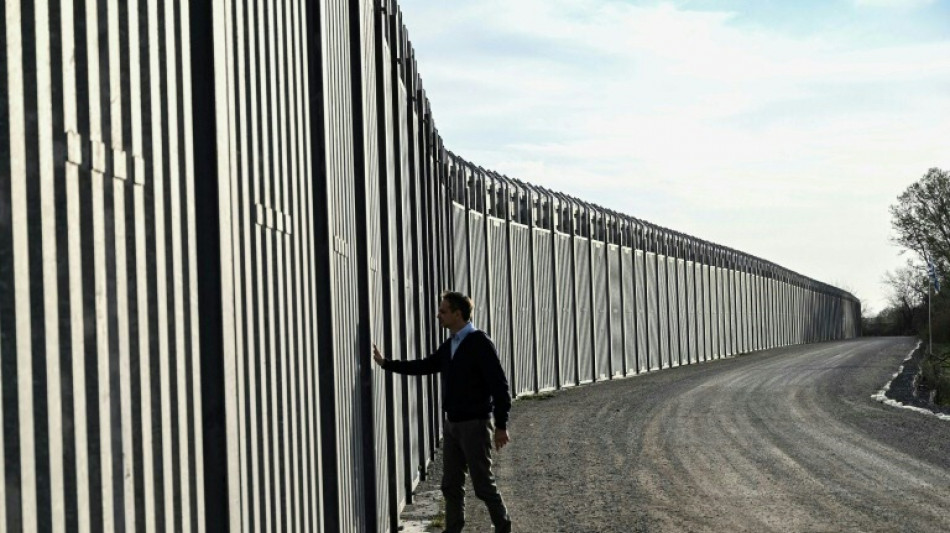
Greek PM wants EU aid for steel fence extension along Turkey border / Photo: Sakis MITROLIDIS - AFP

 IFFI Opening Film 'Fatherland' Addresses Global Divisions Through Post-War Lens

 Texas Sports Betting Status: No Legal Options Amid Legislative Push for 2027 Referendum

 Geri Halliwell-Horner Embraces Queen Camilla at Commonwealth Writing Competition
 Meta Quest 3 and 3S Gain Access to Over 150 3D Movies

 Sarah Bajada Shares Message on Pregnancy Loss

Greek Prime Minister Kyriakos Mitsotakis on Friday called on the European Union to "seriously consider" providing financial aid to help extend an anti-migrant steel fence along the border with Turkey.
"I think it's about time for the EU to seriously consider providing European funds for these types of projects," the head of government told AFP, on the sidelines of a visit announcing the project at Feres in northeastern Greece.
"After all, we're contributing towards European security and we are also contributing towards a more integrated and effective European asylum policy."
Athens has decided to extend by 35 kilometres (21.7 miles) a five-metre high steel fence which runs along the Evros river marking the border with Turkey.
The fence is currently 37.5km long, and Athens aims to carry out the extension within a year, adding a total of 100km by 2026.
Mitsotakis has insisted that, even without EU funds, the project, estimated at 100 million euros ($108 million), will go ahead.
"What you see here is an obstacle that the Greek government has built in order to protect the borders of a country which also happens to be the external borders of the European Union," he said.
"I've always been a firm believer that we cannot reach a new agreement on migration and asylum unless we protect our external borders.
"And what we're doing here, I think, is a significant contribution towards that end. What you see here has been funded exclusively by the Greek budget, by Greek taxpayers."
The debate on the financing of such fences resurfaced during an EU summit in February.
Several countries, including Austria and Greece, have called for EU funding to strengthen fences along the bloc's external borders to reduce the flow of asylum-seekers.
But in January, the European Commission insisted there was no money in the EU budget for this.
"If we were to spend money on walls or fences, there would be no money for other things," said EU Home Affairs Commissioner Ylva Johansson.
P.Cavaco--PC