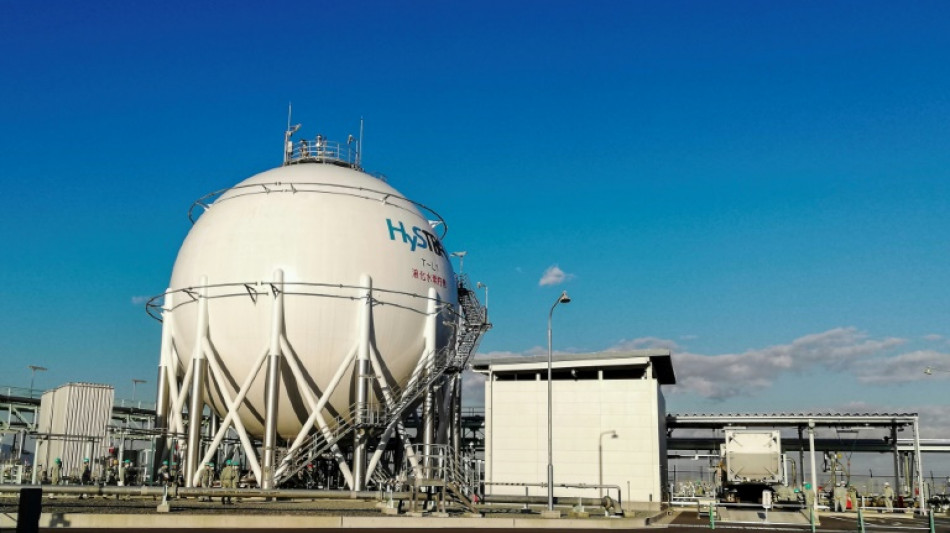
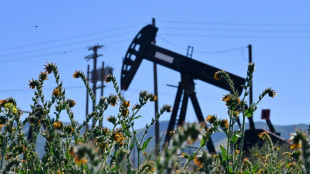
How Japan's big plans for a 'hydrogen society' fell flat / Photo: Etienne BALMER - AFP/File

 Ruthless An makes history to retain Asian Games badminton crown

 Australian central bank lifts key interest rate to 15-year high
 Polo makes landfall in Mexico as Category 3 hurricane
 South Korea team latest to be bussed to wrong Asian Games venue

 Bears thrash Eagles 27-7 as third-string QB Keenum shines

 All Blacks name veteran Taylor captain as Mo'unga seizes 10 jersey

 Race against time as Asian Games cricket quarter-finals washed out
 India turns to corals and seagrass to shield against rising seas
 Manchester City's Premier League charges: What comes next?

 Brazil's cellphone crime: a security nightmare in every pocket

 Russia pummels Kyiv in latest deadly attack
 Akkodis and Biolevate Partner to Accelerate AI-Powered Scientific, Regulatory and Technical Documentation in Highly Regulated Industries

 Dodgers eye three-peat, Red Sox face Yankees as MLB playoffs begin
 Certification of Boeing 737 MAX delayed by software bug

 Celine Dion wows Paris Fashion Week with surprise gig

 AMD buys firm founded by AI 'godmother' Fei-Fei Li

 Italy rebound in Turkey as France win late in Belgium

 Pope says concerns about AI 'should be taken seriously'

 Hurricanes to hoist title banner as NHL season begins
 Justice Alito steps aside from major US climate case

 Willis happy with England exile after retains Top 14 player award

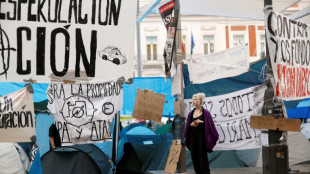 Spain housing protests keep heat on government as PM seeks new law

 Wissa spoils Zimbabwe homecoming as DR Congo win AFCON qualifier

 UK police release on bail five men held over airbase incident

 Ex-All Black Plummer 'sure' New Zealand will find Super Rugby solution

It was once touted as a miracle solution to Japan's energy problems: creating a "hydrogen society" by sharply ramping up use of the fuel for vehicles, industry and housing.
But the country's plan to expand its hydrogen market and slash greenhouse emissions has suffered delays and criticism over the fuel's green credentials.
As G7 climate ministers meet this weekend in the northern Japanese city of Sapporo, here are some key points about the strategy:
- Ambitious plans -
In 2017, Japan became the first country to devise a national strategy for hydrogen power, aiming to drastically scale up its use by 2030.
The colourless, odourless gas is an exciting prospect on paper.
It can be produced, stored and transported in large quantities, and does not emit carbon dioxide when burned.
These qualities are attractive to Japan, which is heavily reliant on fossil fuel imports.
Most of its nuclear reactors are still offline after the 2011 Fukushima disaster, and the nation set a goal two and a half years ago of reaching carbon neutrality by 2050.
- Fuel cell blues -
Hydrogen-powered fuel cell vehicles, which Japanese automakers helped pioneer, were a key part of the original plan.
The government had hoped for 40,000 of these cars to be on the road by 2020, and 800,000 by 2030.
But by the end of last year, just 7,700 units had been sold in the country since 2014.
Despite subsidies for buyers, they remain "very expensive", even compared to battery-powered electric cars, Kentaro Tamura, a Japan-based expert at the Institute for Global Environmental Strategies (IGES), told AFP.
Hydrogen refuelling stations have high installation and upkeep costs, and are rare in comparison to charging spots for electric vehicles, Tamura added.
- Hydrogen-powered homes -
The results have been better but still modest in housing -- the other major area initially earmarked for hydrogen expansion.
A residential fuel cell programme called "Enefarm" was meant to equip 5.3 million Japanese homes by 2030.
It uses gas to create hydrogen that reacts with oxygen from the air to generate electricity and heat water.
But by the end of 2022, just 465,000 systems had been installed, far short of the government's target of 1.4 million by 2020.
Price is a key factor here too, Tamura said, with installation costs "very high compared with alternative technologies like heat pumps".
- 'Grey' area -
Energy experts were sceptical of Japan's hydrogen strategy from the start, because it was launched without creating a reliable supply chain for environmentally friendly "green" hydrogen, produced from renewable energy sources.
Instead, Japan opted for so-called "grey" hydrogen, made using greenhouse gas-emitting coal, petrol or gas, and "blue" hydrogen, which also comes from fossil fuels but with the carbon emissions captured and stored.
In the meantime, countries such as China and some European nations have moved faster on green hydrogen, which remains rare and expensive but is key to decarbonisation, the Japanese Renewable Energy Institute think-tank says.
In March, Tokyo agreed to spend $1.6 billion on an ambitious but controversial venture in Australia to produce liquid hydrogen from lignite coal and export it to Japan.
But critics say the project's "blue" hydrogen claims are based on carbon capture technology that does not yet exist.
- Co-firing controversy -
Despite the setbacks, Japan will revise its hydrogen strategy by the end of May, with the Nikkei business daily reporting plans to increase its supply of the fuel to six times the current level by 2040.
It is also promoting another use for hydrogen and its derivative ammonia: burning it alongside gas and coal at existing power stations, to reduce carbon emissions.
An official from the Ministry of Economy, Trade and Industry told AFP that ammonia co-firing is "a realistic means of energy transition that is more CO2-reducing and economically efficient than the early phase-out of coal-fired power and its replacement with renewable energy".
But climate campaigners question the value of the expensive practice on the path to cleaner energy.
Japan is "the only G7 member" pushing for co-firing, Greenpeace's Hirotaka Koike said, describing it as a "national policy to keep the 'sunset' industry (of thermal power stations) alive".
X.M.Francisco--PC