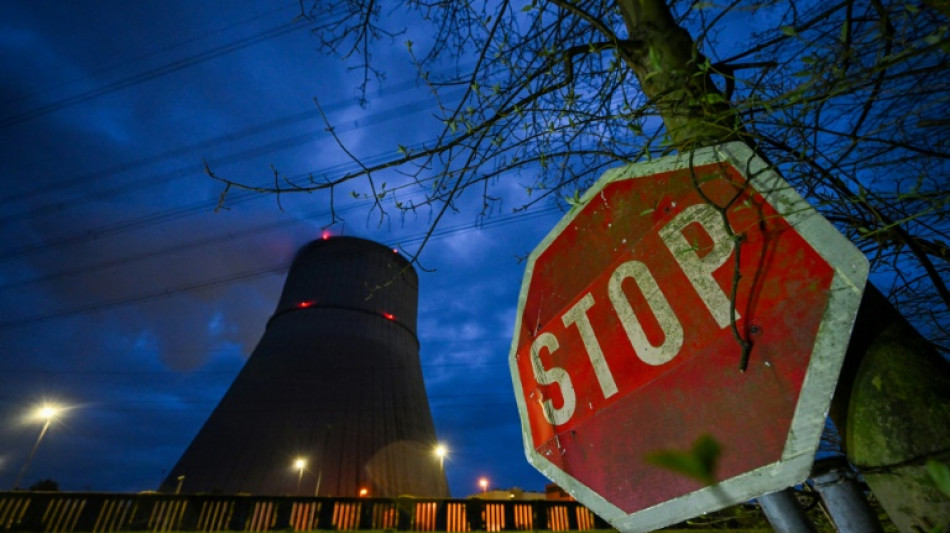
Germany ends nuclear era as last reactors power down / Photo: Ina FASSBENDER - AFP

 Slovenia sees surge in '.si' sites after Trump hypes 'super intelligence'

 'Like a dream' for An as Games organisers 'sorry' for latest mix-up
 Tokyo suffers longest streak of rainy days on record

 Indonesia charges train driver over crash that killed 16 women
 Ruthless An makes history to retain Asian Games badminton crown

 Australian central bank lifts key interest rate to 15-year high
 Polo makes landfall in Mexico as Category 3 hurricane
 South Korea team latest to be bussed to wrong Asian Games venue

 Bears thrash Eagles 27-7 as third-string QB Keenum shines
 All Blacks name veteran Taylor captain as Mo'unga seizes 10 jersey
 Race against time as Asian Games cricket quarter-finals washed out
 India turns to corals and seagrass to shield against rising seas

 Manchester City's Premier League charges: What comes next?

 Brazil's cellphone crime: a security nightmare in every pocket

 Russia pummels Kyiv in latest deadly attack
 Akkodis and Biolevate Partner to Accelerate AI-Powered Scientific, Regulatory and Technical Documentation in Highly Regulated Industries

 NFL Giants obtain QB McCarthy from Vikings

 Deal for evicted Spanish pensioner as PM seeks new housing law

 Clippers apologize, warn fans of 'challenges' after Leonard scandal

 Turkish comedian convicted for Erdogan 'insult' freed pending appeal

 Trump announces 'biggest' US steel plant in battleground Iowa

 Olise wonder strike gives Zidane's France win in Belgium
 US stocks fall, bond yields rise as Middle East war drags on

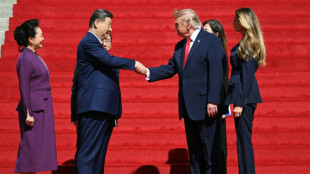 Trump denies offering to sell arms to China's Xi

 Wemby ready for NBA Spurs to move rivals in climb to top

Germany will switch off its last three nuclear reactors on Saturday, exiting atomic power even as it seeks to wean itself off fossil fuels and manage an energy crisis caused by the war in Ukraine.
While many Western countries are upping their investments in atomic energy to reduce their emissions, Germany is bringing an early end to its nuclear age.
Europe's largest economy has been looking to leave behind nuclear power since 2002, but the phase-out was accelerated by former chancellor Angela Merkel in 2011 after the Fukushima nuclear disaster in Japan.
The exit decision was popular in a country with a powerful anti-nuclear movement, stoked by lingering fears of Cold War conflict and atomic disasters such as Chernobyl in Ukraine.
"The risks of nuclear power are ultimately unmanageable," said Environment Minister Steffi Lemke, who this week made a pilgrimage to the ill-fated Japanese plant ahead of a G7 meeting in the country.
But the challenge caused by Russia's invasion of Ukraine, which put an end to cheap gas imports, and the need to quickly cut emissions has upped calls in Germany to delay the withdrawal from nuclear power.
- 'A mistake' -
Initially planned for the end of 2022, Germany's nuclear exit has already had to be pushed back once.
As Russian gas supplies dwindled last year, officials in Berlin were left scrambling to find a way to keep the lights on, with a short extension agreed until mid-April.
Germany, the largest emitter in the European Union, also powered up some of its mothballed coal-fuelled plants to cover the potential gap left by gas.
The perilous context has increased calls domestically to delay the nuclear exit.
Germany had to "expand the supply of energy and not restrict it any further" in light of potential shortages and high prices, the president of the German chambers of commerce Peter Adrian told the Rheinische Post daily.
The conservative leader of Bavaria Markus Soeder meanwhile told the Focus Online website that he wanted the plants to stay online and three more to be kept "in reserve".
Outside observers have been similarly irked by Germany's insistence on exiting nuclear while ramping up its coal usage, with climate activist Greta Thunberg in October slamming the move as "a mistake".
- 'Sooner or later' -
At the Isar 2 complex in Bavaria, technicians will progressively shut down the reactor from 10:00 pm (2000 GMT) on Saturday, severing it from the grid for good.
By the end of the day, operators at the other two facilities, in northern Emsland and southwestern Neckarwestheim, will have taken their facilities offline as well.
The three final plants provided just six percent of Germany's energy last year, compared with 30.8 percent from all nuclear plants in 1997.
"Sooner or later" the reactors will start being dismantled, Economy Minister Robert Habeck told the Funke group ahead of the scheduled decommissioning, brushing aside the idea of an extension.
The government has the energy situation "under control", Habeck assured, having filled gas stores and built new infrastructure for the import of liquefied natural gas to bridge the gap left by Russian supplies.
Instead, the minister from the Green party, which was founded on opposition to nuclear power, is focused on getting Germany to produce 80 percent of its energy from renewables by 2030.
To this end, Chancellor Olaf Scholz has called for the installation of "four to five wind turbines a day" over the next few years -- a tall order given that just 551 were installed last year.
But the current rate of progress on renewables could well be too slow for Germany to meet its climate protection goals.
Despite planning to exit nuclear, Germany has not "pushed ahead enough with the expansion of renewables in the last 10 years", Simon Mueller from the Agora Energiewende think tank told AFP.
To build enough onshore wind capacity, according to Mueller, Germany now has to "pull out all the stops".
E.Paulino--PC