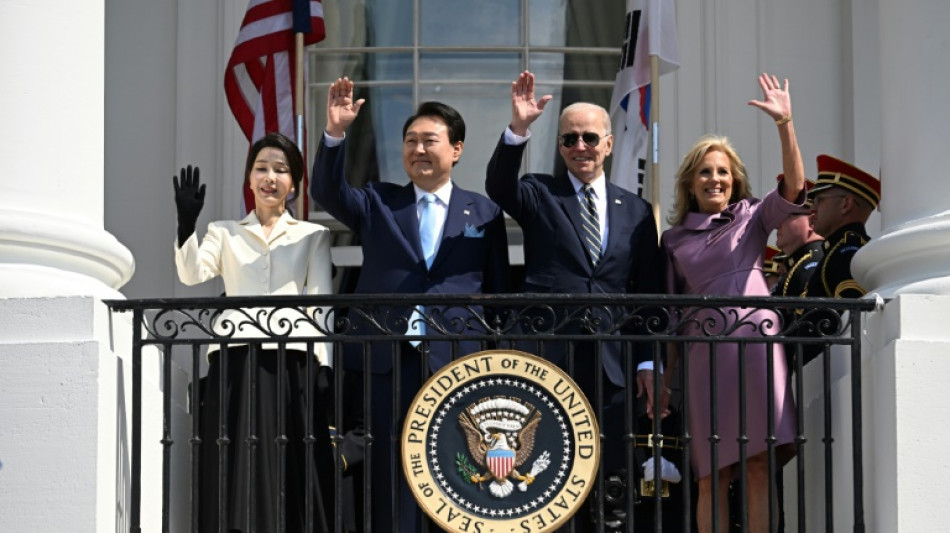
The 'end' of Kim Jong Un? What the 'Washington Declaration' means / Photo: Jim WATSON - AFP

 German far-right aims to lead Saxony-Anhalt govt in December

 Little damage as Hurricane Polo sweeps over Mexico's Pacific coast
 Manchester City guilty of breaking financial rules - Premier League

 FIFA boss Infantino blasted as would-be 'emperor' by UEFA's Ceferin

 Stocks move lower despite oil prices dropping

 AI driving up innovation investment: UN

 UN Security Council extends Haiti mission by 6 months

 Man Utd do not deserve medals if Man City stripped of titles: Rooney

 Vana Completes Expanded Staking as Part of the Vega Upgrade, Publishes Expanded VANA Token Economics
 Spain to cap gas price hikes, extend fuel discounts

 'We just need rain': Germany's Rhine river hits new low

 Yemen health system at 'breaking point': WHO

 Ireland undecided on second Israel match: coach

 France's Le Pen defiant after top ally hit by antisemitism claims

 Tom Cruise trades stunts for satire as toxic tycoon 'Digger'

 MEXC Unveils "WE SEE YOU" Brand Visual Refresh, Putting People Behind Every Trade in Focus

 Thai capital cleans up after deadly floods

 NATO, EU allies rally to Estonia after 'sabotage' blamed on Russia

 Families demand justice for Cameroon's 'nightmare' wave of murdered women

 Tebas says Man City should face 'most severe' sanctions if guilty of rule breaches

 Pochettino calls Man City success 'a period of deception'

 Settler attack on West Bank village injures Israeli forces, drawing rare rebuke

 Mystery over UK airbase scare after reports no explosives found

 Spanish govt races to adopt housing law under protest pressure

 Estonia slams Russian 'sabotage' after arson attack on defence company
If North Korea uses its nuclear weapons against the United States or its ally South Korea, it would be "the end" of Kim Jong Un's regime, Seoul and Washington announced this week.
The stern threat comes as President Yoon Suk Yeol is on a six-day state visit to the United States, where he and his counterpart Joe Biden discussed ramping up the US security shield for South Korea in the face of the nuclear-armed North's increased missile tests.
But how significant is the tough-sounding statement? AFP takes a look at what we know:
- What is it? -
The Washington Declaration boosts the US nuclear umbrella over South Korea.
It includes the regular deployment of a US nuclear submarine to South Korea -- something that has not happened since the 1980s -- and other measures, including more information sharing in the event of a North Korean attack.
But there are no plans to station US nuclear weapons in South Korea, and some analysts doubt the declaration's practical value.
"It is questionable whether the North would be afraid of a strategic nuclear submarine equipped with an SLBM with a range of more than 7,400 kilometres (4,600 miles)," Cheong Seong-chang of the Center for North Korea Studies at the Sejong Institute told AFP.
The "too long" range of the submarine's missiles mean it may not be able to hit North Korea if it were in South Korean waters, he said.
- Is it significant? -
The state visit undoubtedly "represents a new high-water mark for US-South Korea relations, with the breadth and depth of security, economic, and cultural cooperation on full display", Leif-Eric Easley, a professor at Ewha University in Seoul, told AFP.
US officials described the new arrangement as akin to moves last witnessed when Washington oversaw the defence of Europe against the Soviet Union.
Yoon has been trying to reassure the South's increasingly nervous public about the US commitment to so-called "extended deterrence", where US assets -- including nuclear weapons -- serve to prevent attacks on allies.
A majority of South Koreans now believe the country should develop its own nuclear weapons, surveys show. Yoon has previously hinted Seoul could pursue this option.
- Will Seoul get nuclear weapons? -
Absolutely not. And this could cause problems, experts said.
"One thing was clear: there was an implied agreement that Seoul would not go nuclear," said Soo Kim, Policy Practice Area Lead at LMI Consulting and a former CIA analyst.
"Seoul's nuclear ambitions have been capped."
Gi-Wook Shin, a Korea expert and sociology professor at Stanford University, told AFP that the declaration was "a step forward".
"I don't think this will be enough to appease a South Korean public that has increasingly demanded that Seoul develop nuclear weapons of its own," Shin said.
- What will North Korea do? -
Closer cooperation between its self-declared arch enemies, Washington and Seoul, is bound to concern Kim Jong Un's regime and there could be more missile launches to demonstrate this, experts say.
In public, "North Korea will downplay the message of reassurance by the US regarding nuclear deterrence", Chun In-bum, a retired South Korean army general, told AFP.
But behind closed doors "they will get the message: if they use nuclear weapons it will be the end of the regime", he said.
Having spent decades -- and a huge chunk of the impoverished country's GDP -- on developing his banned nuclear weapons programmes, Kim is not going to change track, experts said.
"It is unlikely that North Korea will give up its nuclear weapons by giving in to these threats," Yang Moo-jin, president of the University of North Korean Studies in Seoul, told AFP.
- What about Trump? -
The major problem with the Washington Declaration is not the agreement itself, but US political dysfunction, which means it could be worthless after the next presidential election there, Karl Friedhoff at the Chicago Council on Global Affairs told AFP.
The potential return to power of former US president Donald Trump is likely to trigger "very serious discussions" in Seoul, he said.
For the US-South Korea relationship "the biggest challenge is something that the alliance doesn't really have any control over: US domestic politics", he said.
"There is serious concern in Seoul about a return of the GOP -- especially Trump -- to the White House. If he wins the election in 2024, that could spark a very unpredictable turn of events in the relationship."
H.Silva--PC