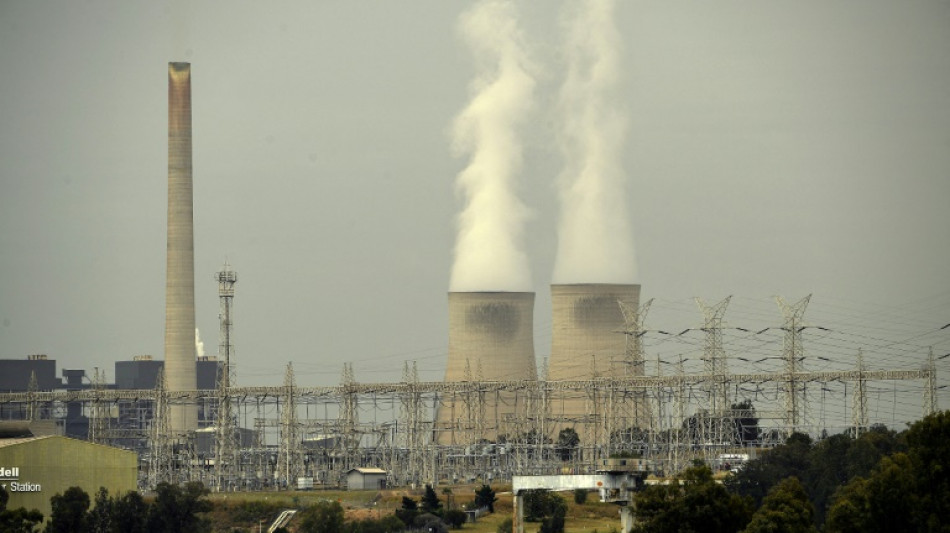
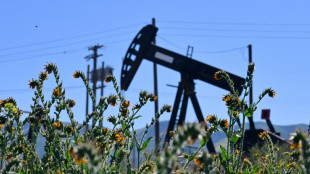
Australia closes oldest coal plant, pivots to renewables / Photo: Saeed KHAN - AFP

 German far-right aims to lead Saxony-Anhalt govt in December

 Little damage as Hurricane Polo sweeps over Mexico's Pacific coast

 Manchester City guilty of breaking financial rules - Premier League

 FIFA boss Infantino blasted as would-be 'emperor' by UEFA's Ceferin

 Stocks move lower despite oil prices dropping

 AI driving up innovation investment: UN

 UN Security Council extends Haiti mission by 6 months

 Man Utd do not deserve medals if Man City stripped of titles: Rooney

 Vana Completes Expanded Staking as Part of the Vega Upgrade, Publishes Expanded VANA Token Economics

 Spain to cap gas price hikes, extend fuel discounts
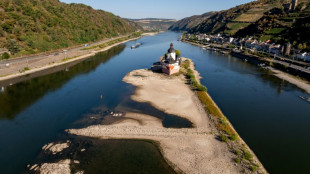 'We just need rain': Germany's Rhine river hits new low

 Yemen health system at 'breaking point': WHO

 Ireland undecided on second Israel match: coach

 France's Le Pen defiant after top ally hit by antisemitism claims

 Tom Cruise trades stunts for satire as toxic tycoon 'Digger'

 MEXC Unveils "WE SEE YOU" Brand Visual Refresh, Putting People Behind Every Trade in Focus

 Thai capital cleans up after deadly floods

 NATO, EU allies rally to Estonia after 'sabotage' blamed on Russia

 Families demand justice for Cameroon's 'nightmare' wave of murdered women
 Tebas says Man City should face 'most severe' sanctions if guilty of rule breaches

 Pochettino calls Man City success 'a period of deception'

 Settler attack on West Bank village injures Israeli forces, drawing rare rebuke

 Mystery over UK airbase scare after reports no explosives found

 Spanish govt races to adopt housing law under protest pressure

 Estonia slams Russian 'sabotage' after arson attack on defence company

Australia's oldest coal-fired power plant will shut down Friday as the country, a once-notorious climate straggler, prepares for a seismic shift towards renewable energy.
The Liddell power station, about three hours' drive north of Sydney, is one in a series of ageing coal-fired plants slated to close in coming years.
Built in 1971, Liddell provides about 10 percent of the electricity used in New South Wales, Australia's most populous state.
For decades, coal has provided the bulk of Australia's electricity, but University of New South Wales renewable energy expert Mark Diesendorf told AFP that stations such as Liddell were fast becoming unreliable "clunkers".
Besides being inefficient, highly polluting and expensive to repair, the continued widespread use of coal-fired power plants would make Australia's climate targets almost impossible to meet.
Australia has long been one of the world's largest coal producers and exporters, and under a series of governments of all stripes it has resisted pressure to scale back the industry.
But the centre-left government elected last year on the promise of climate action has pledged that 82 percent of the country's electricity will come from renewable sources by 2030.
This demands a drastic overhaul -- while world leaders such as Norway produce more than 90 percent of their power through renewables, Australia currently sits around 30 percent.
"The plans are for a fairly rapid phase-out," Diesendorf told AFP.
"These stations are overdue for retirement and there's no economic argument for replacing them with new coal."
- 'Right direction' -
Under growing public pressure to address the climate crisis, many Australian fossil fuel companies increasingly prefer to shutter old coal plants than keep them online.
Utility company AGL said it originally planned to close Liddell in 2022, but kept it running until April to "support system reliability".
Australia's largest coal-fired power station, the Eraring facility in New South Wales, is scheduled to close in 2025 and a handful more will follow over the next decade.
These closures will test whether renewables are ready to fill the gap, climate finance expert Tim Buckley told AFP.
"If everything lines up it's fine. The momentum is good, and the policy heads in the right direction."
Drenched in sunshine and blessed with sparsely-populated windswept coasts, Australia has the natural ingredients to be a renewable energy superpower, Buckley said.
"Every bloody week there's a new battery announced, or a new wind farm, or other major projects proceeding," he added.
The tricky part, he said, would be figuring out how to store this energy and pump it across the vast distances between Australian towns and cities.
"We are talking about projects that haven't been attempted in Australia for decades, where labour shortages are real and engineering problems are to be expected.
"The chance of everything going smoothly between now and 2030 is close to zero."
Even if it does go smoothly Australia still faces enormous challenges in meeting its target of reaching net zero emissions by 2050.
- 'Terrible laggard' -
Over the past decade an ideological brawl dubbed the "climate wars" has dominated Australian politics, repeatedly undermining attempts to reduce carbon emissions.
Researchers in 2020 found that eight percent of Australians were in climate change denial, more than double the global average.
Transport makes up 19 percent of Australia's emissions but the country is one of the only advanced economies without fuel efficiency standards, something the government has vowed to rectify soon.
And although Australia is planning to clean up its domestic energy market, the economy is still fuelled by exports of coal and gas.
Dozens of new coal mines, oil fields and gas projects are in government planning pipelines.
"In terms of still developing gas and coal mines for export, we are a terrible laggard," Diesendorf said. "It's a real contradiction."
A.Seabra--PC