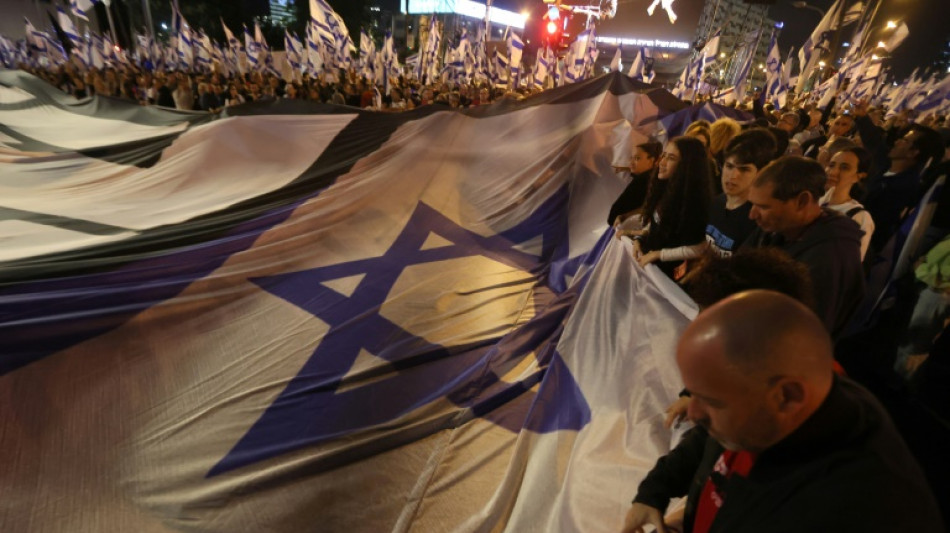
At 75, Israeli society faces sharpening divisions / Photo: JACK GUEZ - AFP/File

 UN to hold fourth informal poll of secretary-general candidates
 Who are the Emiratis behind crisis-hit Manchester City?
 Singer Angelique Kidjo urges Africans to 'create together'
 Alleged Rihanna mansion shooter mentally fit for trial, says judge
 Mystery over UK airbase scare as police find petrol not explosives
 OpenAI unveils low-cost AI model, a day after shelving Astra upgrade
 Premier League confirms Man City guilty of serious financial breaches
 Brazil's Lula turns to Bad Bunny tune to criticise Trump ahead of polls
 Nigerian dancer eyes world record after seven-day marathon
 Swiss regulator concludes Julius Baer bank probe

 Brazil's patron saint pulled into latest election scrap

 Football overload leaves players near 'breaking point', warns Tebas
 Paris Eiffel Tower says chief to step down after uproar over removing women staff
 Amaze Holdings (NYSE: AMZE) Executes Binding LOI to Acquire BullionFX | Alchemy, a Decentralized Gold-Backed Financial Ecosystem for Valued at US$155 Million
 Clashes between French teens, police as school blockades intensify

 Stocks move sideways despite oil moving lower

 African leaders to gather in Egypt for business summit
 UK decides against charging foreign visitors for museums
 Dallaglio to sell England World Cup winners' medal
 Brazil come from behind to beat Australia 4-2 in friendly
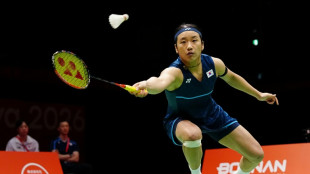 Ruthless An retains Asian Games badminton crown as Kunlavut triumphs

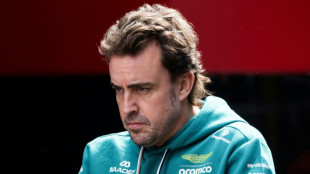 Alonso to stay with F1 team Aston Martin in 2027
 China badminton 'still strong' despite Asian Games slump
 'Exceptional' Turner painting shown in Rome before sale
 European stocks climb as oil dips
Israel has undergone major societal transformations during its 75 years of existence, which have left the nation confronting deepening divisions.
The northern Yiron kibbutz highlights how the country has evolved since its creation on May 14, 1948, as the socialist ideals of some of the founding fathers have given way to greater economic liberalism, and a more multicultural society.
The kibbutzim -- agricultural communities based on collective living -- "played an essential role in the construction of the country," said sociologist Yuval Achouch, from the Western Galilee Academic College in the northern city of Acre.
But despite still being associated with Israel's image abroad, kibbutz residents at their peak only made up 7.5 percent of Israel's Jewish population. Today they are less than two percent, according to Achouch.
Yiron was established in 1949 less than two kilometres (a mile) from the Lebanese border, on the ruins of a Palestinian village destroyed by Jewish forces during the 1948-1949 Arab-Israeli war, unleashed by Israel's declaration of independence.
Its founding stemmed from the will of Israeli leaders to defend the frontiers of their new nation, which defeated the armies of five Arab countries that invaded just hours after the new state was established.
Efrat Pieterse, 69, grew up in Yiron and remembers with nostalgia sharing "the collective lifestyle" with other children.
Entrusted to their educators, the children "saw their parents at the end of the afternoon and returned to the children's homes," where they slept, she recalled.
"We were nine, together all the time like a family," she added.
With the passage of time, Yiron has changed considerably. Now children live with their parents for instance, and much of the collective model has been abandoned.
The old barn currently houses an agri-tech business, while the modest homes have been replaced by more upmarket detached houses separated by fences.
Israel's kibbutz model fell out of favour in tandem with the 1980s economic crisis and the subsequent collapse of communism in the Soviet Union.
More individualistic values and a focus on the family unit came to the fore, causing the majority of these villages to take a liberal turn at the start of the century, Achouch explained.
- Four Israeli 'tribes' -
Israel's population is one of the fastest growing in the world.
The country's population has risen twelvefold since 1948, reaching 9.7 million according to the Israel Central Bureau of Statistics.
The Jewish majority accounts for 7.1 million, while there are two million Arabs and the remaining residents are largely non-Jewish immigrants, according to the official data.
Israel's rapid population growth can be attributed largely to Jewish emigration from various other countries, with a significant number relocating from the former Soviet Union in the early 1990s.
With population growth driven by mass immigration, Israel's policy of mandatory military service has served to construct the country's national identity.
But a significant proportion of citizens are exempt, such as the Arab minority, as well as most ultra-Orthodox Jews who represent 12 percent of the population.
In a landmark 2015 speech, then president Reuven Rivlin said four "tribes" make up Israeli society.
He identified three Jewish tribes -- secular, religious nationalist and ultra-Orthodox -- and the Arab tribe, lamenting that the four don't mix, as they neither live alongside one another, go to the same schools nor read the same newspapers.
The divergent groups had "different visions" of what the state of Israel should be and that "mutual ignorance and the absence of a common language only increases the tension, the fear, the hostility and the competition" between them, Rivlin said.
Within the tribes identified by Rivlin there are further splits, such as the Ashkenazi, who originated in Europe, and Sephardic Jews, new immigrants and "sabra" -- those born in Israel -- and the diverse identities of Christians, Druze and Muslims among the Arab population.
At the helm of the Zionist movement which preceded the state of Israel, the Ashkenazi community for years "held the political, judicial and economic levers," said Sylvaine Bulle, a sociologist at the French National Centre for Scientific Research (CNRS).
Jews who emigrated in the 1950s and 1960s from Iraq, Yemen and Morocco and other Middle Eastern countries -- known as Mizrahim in Hebrew -- were "largely discriminated against by the state," she added.
- Rise of the right -
During this period the government was dominated by the Labor party and its fore-runner, until the right-wing saw its first victory in 1977.
The right-wing has since come to dominate the political sphere, while at the last election Labor just scraped past the electoral threshold.
"In 75 years what has changed is that the Ashkenazi elite has demographically aged; it's no longer representative of the electorate and it's no longer felt to be legitimate by the Mizrahim who are seeking to socially climb," said Bulle.
Achouch has observed a "shift in political opinion to the right" in recent years.
The political identity of Israeli youth has been forged by the "infiltration of the ministry of education by the religious right for decades," he said.
The failure of the Israeli-Palestinian peace process in the 1990s and the subsequent suicide bombings which marked the Second Intifada, or Palestinian uprising, have also left their mark on young voters, according to Achouch.
Since January, Israelis have been deeply divided over judicial reforms tabled by one of the most right-wing administrations in the country's history.
The government led by Prime Minister Benjamin Netanyahu deems the overhaul necessary to rebalance the powers between elected officials and the Supreme Court.
Opponents, meanwhile, have launched one of Israel's biggest protest movements, decrying planned measures they say threaten democracy.
For Bulle, the crisis surrounding the judicial reform reflects the country's social divisions, while at the same time the mass demonstrations stand as a "counter to the extreme fragmentation of Israeli society".
The mass mobilisation "shows that Israelis on the whole remain attached to democratic values, a sense of justice, of ethics and of equality", she said.
- Absence of constitution -
The Arab minority has remained on the sidelines of the debate.
"For them, democracy has always been flawed," Bulle said.
Certain laws "have weakened the notion of democracy and of equality between citizens," said Bulle, pointing to the 2018 Nation State Law, which enshrined Israel as a state for Jews while downgrading Arabic's status as an official language.
Avner Ben-Zaken, a historian and president of the Institute for Israeli Thought research centre in Tel Aviv, said "it's not the presence of these different groups that poses a problem, but the very structure of the state."
Elections are governed by a system of proportional representation, which Ben-Zaken said lends itself to clientelism and competition between different societal groups which come to "hate" one another.
Furthermore, "we don't know what the state is" without a constitution.
Drawing up such a foundational text is imperative to "define the identity of a country as Israeli" and not just Jewish and democratic, said Ben-Zaken.
P.Queiroz--PC