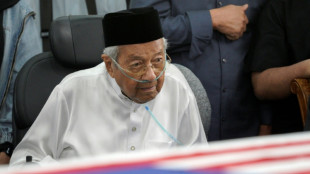
Portuguese parliament legalises euthanasia / Photo: PATRICIA DE MELO MOREIRA - AFP

 'No limits': Marathon world record holder Sawe chasing history

 Countdown begins to biggest-ever Rugby World Cup

 Bangladesh women lose ground after quota reform

 Vietnam admits 'differing opinions' on Hanoi development

 Stocks temper gains as oil pares heavy losses, US data in focus

 New Zealand denies breaching climate commitments to EU

 Albert becomes youngest US scorer in 4-2 win over Chile

 Pirate island's plunging population shows Greece's demographic decline

 With elections ahead, Latvia's Russian-speakers reject Moscow's help

 Brazil football clubs face massive sponsorship blow from betting ban
 ChatGPT maker wants to be the App Store for AI as safety concerns grow

 Women fight fires and sexism in Indonesian Borneo

 Forsling's OT blast lifts Florida over Carolina in NHL opener

 Hurricane Polo sweeps over Mexico's Pacific coast, heads inland

 Grynspan pulls ahead in race to lead UN: diplomat

 Trump touts AI boss pledge to self-regulate

 Oil down, but stocks lower as bond yields rise

 England break down stubborn Czechs to claim first Nations League win

 UN Security Council extends Haiti anti-gang force by 6 months

 Manchester City guilty of Premier League charges: What comes next?
 Man City chief Soriano slams Premier League 'conspiracy theory'

 Hurricane Polo sweeps over Mexico's Pacific coast

 Man City must be relegated after guilty verdict says club's former chairman

 German far-right aims to lead Saxony-Anhalt govt in December

 Little damage as Hurricane Polo sweeps over Mexico's Pacific coast

After a long battle, Portugal on Friday passed a law legalising euthanasia for people in great suffering and with incurable diseases, joining just a handful of countries around the world.
The issue has divided the deeply Catholic country and witnessed strong opposition from conservative President Marcelo Rebelo de Sousa, a devout churchgoer.
Under its provisions, people aged over 18 will be allowed to request assistance in dying if they are terminally ill and in intolerable suffering.
It will only cover those suffering "lasting" and "unbearable" pain unless they are deemed not to be mentally fit to make such a decision.
The law will only be applicable for nationals and legal residents and not extend to foreigners coming into the country to seek assisted suicide.
The euthanasia bill was approved by parliament four times in the last three years but sent back every time for a constitutional review due to opposition from the president.
The definitive version of the law was adopted on Friday with support from the governing Socialists, who hold an absolute majority in the chamber.
"We are confirming a law that has already been approved several times by a huge majority," said Socialist MP Isabel Moreira, a fervent advocate of legalising euthanasia.
The president now has a week to promulgate the new law. It could come into force by the autumn, Portuguese media said.
"We have at last come to the end of a long battle," Moreira told AFP earlier this week.
- Debate continues -
Rebelo de Sousa had vetoed earlier bills due to "excessively undefined concepts" and later said the language used to describe terminal conditions continued to be contradictory and needed to be clarified.
The new version of the law now provides that euthanasia is only authorised in cases where "medically assisted suicide is impossible due to a physical disability of the patient".
Rebelo de Sousa has asked lawmakers to specify who would "attest" to whether a patient was physically incapable of assisted suicide but lawmakers this time refused to modify the text.
Questions raised by the president can be addressed through implementing decrees, said Catarina Martins, the leader of the far-left Left Bloc.
Rebelo de Sousa himself said approval of the law "wasn't a great drama" and did not give rise to "constitutional problems".
The debate over medically assisted dying is far from over in Portugal.
"The adoption of this law has been relatively fast compared with other big countries," said Paulo Santos, a member of the pro-euthanasia group Right To Die With Dignity.
He warned a large number of doctors could raise moral objections to carrying out euthanasia, as they had done over abortions in 2007.
"There's a good chance euthanasia will lead to even stronger resistance," he told AFP.
For their part, critics of medically assisted dying regret that the issue has not been put to a referendum and hope opposition deputies will once again ask the constitutional court to look into the bill.
Euthanasia and assisted suicide are only allowed in a handful of countries, including the Benelux nations and Portugal's neighbour, Spain.
L.E.Campos--PC