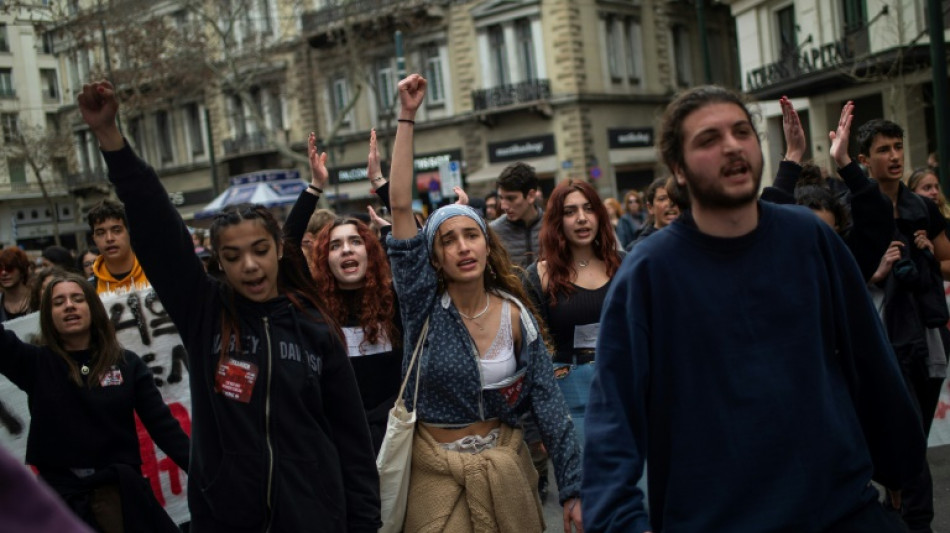
Main parties struggle to excite first-time Greek voters / Photo: ANGELOS TZORTZINIS - AFP/File

 Most equities rise after oil price plunge, US data in focus

 Polar oceans transformed as warming melts ice habitats: research
 Lost shark becomes viral star in South Korea
 Dangote to launch $16bn refinery in Kenya
 North Korean leader 'extremely obese': Seoul spy agency
 Yankees and pope-backed White Sox start MLB playoffs with wins

 Malaysia's ex-PM Mahathir in hospital for observation

 'No limits': Marathon world record holder Sawe chasing history

 Countdown begins to biggest-ever Rugby World Cup
 Bangladesh women lose ground after quota reform

 Vietnam admits 'differing opinions' on Hanoi development
 Stocks temper gains as oil pares heavy losses, US data in focus

 New Zealand denies breaching climate commitments to EU

 Albert becomes youngest US scorer in 4-2 win over Chile

 Pirate island's plunging population shows Greece's demographic decline
 With elections ahead, Latvia's Russian-speakers reject Moscow's help

 Brazil football clubs face massive sponsorship blow from betting ban
 ChatGPT maker wants to be the App Store for AI as safety concerns grow

 Women fight fires and sexism in Indonesian Borneo

 Forsling's OT blast lifts Florida over Carolina in NHL opener

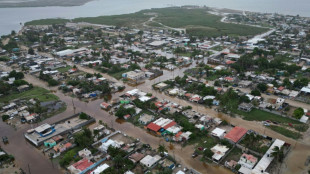 Hurricane Polo sweeps over Mexico's Pacific coast, heads inland

 Grynspan pulls ahead in race to lead UN: diplomat

 Trump touts AI boss pledge to self-regulate

 Oil down, but stocks lower as bond yields rise

 England break down stubborn Czechs to claim first Nations League win

They are Greece's first-time voters, some as young as 16-years-old, who came of age during national bankruptcy, the Covid pandemic and the cost-of-living crisis.
Now they have a chance to decide the country's future when Greece goes to the polls on Sunday, three months after the nation's worst rail tragedy, in which 30 of the 57 people killed were under 30 years old.
The disaster prompted tens of thousands of people to take to the streets to vent fury with the government, which for the last eight years has been led by Prime Minister Kyriakos Mitsotakis or his main rival, Alexis Tsipras.
Conservative Mitsotakis, 55, leftist Tsipras, 48, and Socialist ex-MEP Nikos Androulakis, 44, are dominating the polls and high-school student Nefeli Zouganeli, 16, is eager to have her voice heard.
"I recently learnt that I have the right to vote, and I am enthusiastic about it," she told AFP at her home in the northern Athens suburb of Anixi.
Greece is one of only three EU countries that allow teenagers under 18 to vote. In Sunday's election, that means anyone born in 2006 or earlier.
This time, nearly 440,000 young Greeks are eligible to cast their vote for the first time, representing around eight percent of the electorate.
- 'Sickened' -
Despite politicians' repeated calls and social media stunts, however, young voters are not expected to turn out massively on Sunday.
Only one in four people aged 17-24 voted in the last election in 2019, notes Maria Karaklioumi, a political analyst for polling company RASS.
Zouganeli expects most of her classmates -- fed up with the main parties -- to either skip the vote or pick one of dozens of small parties with little hope of making it to parliament.
"I think we must all go to vote. Abstention is not a solution," says the teen with dyed, cyan-coloured hair.
The February 28 train disaster, on the country's main train line from Athens to the second city Thessaloniki, may help tip the election.
At the height of protests in March, tens of thousands of people demonstrated across the country.
Kostis Smanis, a 25-year-old electronics engineering graduate looking for work, says he was "sickened" by the government blaming the duty stationmaster and ducking responsibility for years of mismanagement and under investment.
"I did not like how they tried to cover it up," he says.
- 'Wages are very low' -
For him, however, the biggest issue in the election is the Greek jobs market.
"Wages are very low compared to living costs," says the graduate, who spent three years studying in England's northern city of Manchester.
Smanis returned to Greece hoping to build his future near his family and friends but does not rule out the possibility of leaving again.
"If I decide to stay here, the idea of renting an apartment seems distant," admits the job seeker, who still lives with his parents the Athens suburb of Neo Iraklio.
Greece is the country with the second highest level of youth unemployment in the European Union, with 24.2 percent of those under-25 jobless, according to the latest available data from EU statistics agency Eurostat in March.
"Despite being better educated... the new generation has a significantly higher participation in professions that are considered badly paid and that have poor working conditions," says Alexis Ioannides, a professor of political economy of labour at Democritus University of Thrace.
Thomas Zoumis, 21, who lives on the tourist island of Paros and works in his family's road assistance company, says a steady income is paramount.
"The main thing that I expect from the government is to help me improve my financial situation," he said.
- 'Mojito instead of voting' -
Though tourism brings money and creates jobs, Thomas wants more for his island.
"We don't have the infrastructure to sustain so many people in the summer: roads, water, electricity, internet. I pay my taxes to the central government, but I don't get much in return," he grumbled.
Caught between last-minute election promises, including a 150-euro "coming-of-age" voucher and increasing the 780-euro minimum wage to at least 880 euros, Greece's first-time voters have little time to decide.
"I think I will vote for the lesser evil," says Smanis, who thinks the Greek political scene is afraid of innovation. "Politicians only try to sell to the people want they want to hear" he says.
For 16-year-old Zouganeli, though, ideology is important. "If we vote according to what we stand for, maybe things can change," she says.
But in a country with an ageing population, no one talks about what Greece will look like in 20 years' time, regrets Karaklioumi.
"It's no wonder that a young person will prefer to go for a mojito instead of voting," she concludes.
P.Serra--PC