G7 to squeeze Russia, weigh risk of China's 'economic coercion' / Photo: Yuichi YAMAZAKI - AFP

 Most equities rise after oil price plunge, US data in focus
 Polar oceans transformed as warming melts ice habitats: research

 Lost shark becomes viral star in South Korea
 Dangote to launch $16bn refinery in Kenya
 North Korean leader 'extremely obese': Seoul spy agency
 Yankees and pope-backed White Sox start MLB playoffs with wins
 Malaysia's ex-PM Mahathir in hospital for observation
 'No limits': Marathon world record holder Sawe chasing history
 Countdown begins to biggest-ever Rugby World Cup
 Bangladesh women lose ground after quota reform
 Vietnam admits 'differing opinions' on Hanoi development
 Stocks temper gains as oil pares heavy losses, US data in focus
 New Zealand denies breaching climate commitments to EU
 Albert becomes youngest US scorer in 4-2 win over Chile
 Pirate island's plunging population shows Greece's demographic decline
 With elections ahead, Latvia's Russian-speakers reject Moscow's help
 Brazil football clubs face massive sponsorship blow from betting ban
 ChatGPT maker wants to be the App Store for AI as safety concerns grow

 Women fight fires and sexism in Indonesian Borneo

 Forsling's OT blast lifts Florida over Carolina in NHL opener

 Hurricane Polo sweeps over Mexico's Pacific coast, heads inland
 Grynspan pulls ahead in race to lead UN: diplomat

 Trump touts AI boss pledge to self-regulate
 Oil down, but stocks lower as bond yields rise
 England break down stubborn Czechs to claim first Nations League win
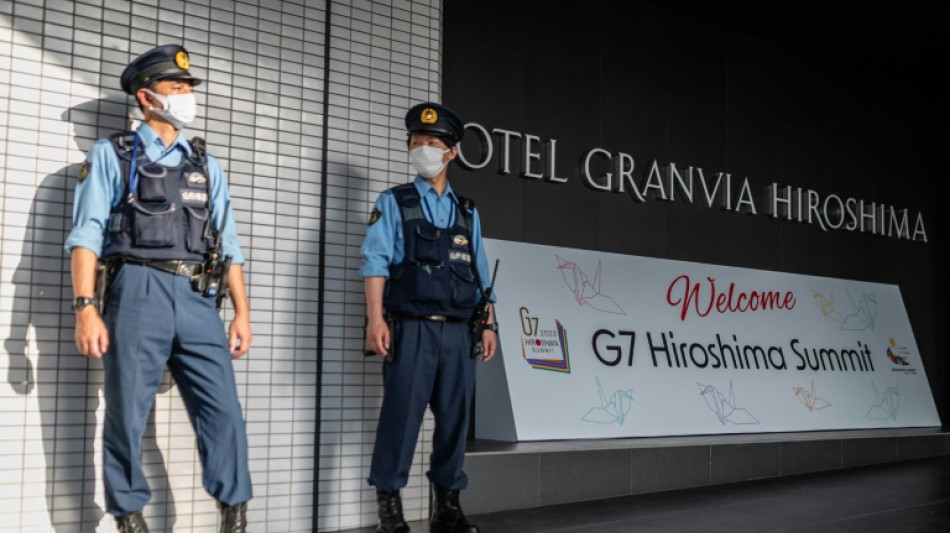
G7 leaders arrived in Hiroshima, Japan on Thursday to weigh tighter sanctions on Russia and protections against China's "economic coercion", surrounded by reminders about the harrowing cost of war.
Japanese Prime Minister Fumio Kishida is hosting leaders from six other wealthy democracies in his hometown -- a city synonymous with nuclear destruction and now peppered with peace monuments.
Over three days, leaders including US President Joe Biden will try to forge a united front on Russia, China and a host of other pressing issues where the allies' interests do not always neatly align.
Biden's delicate diplomatic offensive in Asia hit a bump even before Air Force One left the United States: a domestic budget row forced him to cancel stops in Papua New Guinea and Australia.
He touched down at a Marine Corps base near Hiroshima in driving rain Thursday, becoming only the second US president after Barack Obama to visit the city levelled by the United States' "Little Boy" atomic bomb.
When the G7 summit gets underway Friday, Russia's 15-month-old invasion of Ukraine will top the agenda, as renewed missile bombardments hit Kyiv and after a long winter of grinding warfare in Bakhmut and other frontline towns.
"There will be discussions about the state of play on the battlefield," said US National Security Advisor Jake Sullivan.
The United States and its allies have poured weaponry into Ukraine to help its defence, but a long-anticipated spring counteroffensive by Kyiv's forces has yet to materialise.
Ukrainian President Volodymyr Zelensky is expected to address the group by video link.
Sullivan said leaders would focus on further deterring Russia off the battlefield -- tightening a sanctions regime that, according to official statistics, caused Russia's economy to contract a further 1.9 percent last quarter.
The G7 has already adopted price caps on Russian crude, plunging revenues by about 43 percent, according to International Energy Agency figures.
But Sullivan said leaders would look to close loopholes that help President Vladimir Putin fund his struggling war effort.
"There'll be discussions about the state of play on sanctions and the steps that the G7 will collectively commit to on enforcement," he said.
"The US will have a package of sanctions associated with the G7 statement that will centre on this enforcement issue."
- Nuclear shadow -
Putin's repeated threats to turn the conflict nuclear have been roundly condemned by G7 leaders and dismissed by some commentators as little more than an attempt to shake European and American resolve.
But leaders' planned visit to the Hiroshima Peace Memorial Park on Friday is likely to pull those threats into sharper focus, as they contemplate the events of August 6, 1945, which obliterated a city, claimed an estimated 140,000 lives and forever changed the world.
Kishida wants to use the summit to press his guests -- including Britain, France and the United States, who together possess thousands of warheads -- to commit to transparency on stockpiles and arsenal reductions.
But amid heightened tensions with fellow nuclear powers Russia, North Korea and China, expectations for a breakthrough are low.
- 'Economic coercion' -
Summit discussions on China are expected to focus on efforts to insulate G7 economies from potential economic blackmail, by diversifying supply chains and markets.
In disputes with countries from Australia to Canada, President Xi Jinping's administration has shown a willingness to block, tax or hamper trade with little warning or explanation.
White House official Sullivan said leaders were expected to decry this "economic coercion" and work to bridge transatlantic differences about how to engage with China.
Washington has taken an aggressive approach, blocking China's access to the most advanced semiconductors and the equipment to make them, and has pressed Japan and the Netherlands to follow suit.
But European policymakers -- most notably those in Berlin and Paris -- are keen to make sure that "de-risking" does not mean shattering ties with China, one of the world's largest markets.
"This G7 is not an anti-Chinese G7," an adviser to French President Emmanuel Macron told journalists before the summit.
"We have a positive message for China, which is that we are ready to cooperate on condition that we negotiate together," the adviser added.
Host Japan is also keen to reach out to developing nations that have been wooed by Chinese investment, with leaders from India, Brazil and Indonesia among those invited by Kishida to Hiroshima.
Evidence of Beijing's growing economic and diplomatic clout was on display Thursday in the former imperial capital Xi'an.
There, Xi is hosting the leaders of five Central Asian countries that were once seen as firmly in Moscow's orbit but are increasingly drawn to Beijing.
T.Vitorino--PC