
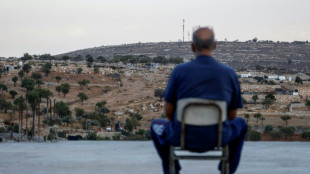
'Startup Nation' Israel hopes to ride out storm / Photo: JACK GUEZ - AFP/File

 South Korea break China hearts to reach Asian Games football final

 Eala storms into Asian Games semi-finals to thrill adoring fans
 Turkey freezes ex-minister's assets as fund crisis grows

 What we know about the North Korean POW dispute

 Most equities rise after oil price plunge, US data in focus

 Polar oceans transformed as warming melts ice habitats: research

 Lost shark becomes viral star in South Korea

 Dangote to launch $16bn refinery in Kenya

 North Korean leader 'extremely obese': Seoul spy agency
 Yankees and pope-backed White Sox start MLB playoffs with wins

 Malaysia's ex-PM Mahathir in hospital for observation

 'No limits': Marathon world record holder Sawe chasing history

 Countdown begins to biggest-ever Rugby World Cup

 Bangladesh women lose ground after quota reform

 Vietnam admits 'differing opinions' on Hanoi development

 Stocks temper gains as oil pares heavy losses, US data in focus

 New Zealand denies breaching climate commitments to EU

 Albert becomes youngest US scorer in 4-2 win over Chile

 Pirate island's plunging population shows Greece's demographic decline

 With elections ahead, Latvia's Russian-speakers reject Moscow's help

 Brazil football clubs face massive sponsorship blow from betting ban
 ChatGPT maker wants to be the App Store for AI as safety concerns grow

 Women fight fires and sexism in Indonesian Borneo

 Forsling's OT blast lifts Florida over Carolina in NHL opener

 Hurricane Polo sweeps over Mexico's Pacific coast, heads inland

The global economic slowdown and domestic political turmoil have not impaired the long-term prospects of Israel's vaunted hi-tech industry, officials and insiders say, despite a recent decline in hiring in the sector.
Nearly 18 percent of Israel's gross domestic product comes from the tech sector, which employs 12 percent of the workforce, generates nearly a third of its income tax and constitutes half of exports, official figures show.
Worldwide inflation and climbing interest rates had caused a drop-off in Israeli tech jobs in 2022, with the number of hirings in the sector dipping 0.2 percent in the first quarter of 2023 -- its first fall since 2008, said a newly issued report.
The "stagnation" in tech hiring, however, had yet to negatively impact Israel's GDP or exports, said Dror Bin, director of the Israel Innovation Authority (IIA) which compiled the report together with the Start-Up Nation Policy Institute (SNPI).
"It's more of a concern" for the future of Israel's tech sector, for which the country is often dubbed "Startup Nation", he told AFP.
As of last month, nearly a third of Israeli technology companies said they were "reducing recruitments", with one in four saying they had completely halted new hirings, according to the report.
Concerns over the global market's negative impact on Israel's economy were exacerbated by controversial legal reforms the Israeli government introduced in January, triggering mass protests, some spearheaded by leaders from the tech sector who said it endangered the country's democracy.
Prime Minister Benjamin Netanyahu's government has halted its bid to push through the legislation it says is needed to rebalance power between the government and the judiciary, as talks continue between his right-wing coalition and the opposition.
- 'Prepare the talent' -
The political "uncertainty" is "very bad for the Israeli economy, for the hi-tech" sector, said Uri Gabai, the head of the SNPI, a non-governmental organisation that promotes Israeli technology.
But, he added, "there are positive indications that the global roller coaster will calm down, and we'll return to stability".
IIA's Bin noted the data indicated no immediate effect of the legal crisis on Israel's economy.
"I don't see companies taking the operations outside of Israel," he said. "We do see a trend of more entrepreneurs deciding to establish their legal entity outside of Israel, but the operation remains in Israel."
But he noted risks remained because of the political situation.
"Investors do not like uncertainty, especially not when you're in the middle of a global slowdown," he said. "So we might see something in the next quarters."
The slowdown's impact was "very much felt" among the Arab minority, said Maisam Jaljuli, CEO of Tsofen, an NGO that works to establish tech hubs in Arab Israeli locales and integrate Arab engineers into tech companies.
Her organisation helped 500 Arabs find tech jobs in 2021, but the number slipped to 300 in 2022 and less than 60 so far this year, with dozens of workers fired, Jaljuli told AFP.
"The crisis will end sometime, and we need to be ready when it does –- see what jobs are needed, prepare the talent," she said.
- 'Hunger and demand' -
Even well-established tech giants were feeling the heat, albeit differently.
Gil Messing, head of product incubation at Israeli cyber security firm Check Point Software, said his company was still recruiting rather than shedding staff.
But, he said, "our growth is a function of what goes on among our customers, which are companies of all sizes from all around the world."
"You clearly see how the market's slowdown causes companies to put off projects and change priorities. They're more cautious with their expenses," he added.
Despite the slowdown, the IIA's Bin was confident the Israeli tech sector, which has moved over the decades towards disruptive technologies to face challenges in fields such as agriculture, food and the environment, would not be negatively impacted in the "mid- and long-term".
"The world needs technology-based solutions for those problems," he said.
"This hunger and demand are meeting a very capable ecosystem here of entrepreneurs, of investors or researchers, which can provide the solutions, and therefore I'm optimistic."
Recalling past crises and slowdowns, Bin noted the sector had emerged from them "stronger than before".
"I hope and believe that this will be the case also this time."
A.S.Diogo--PC