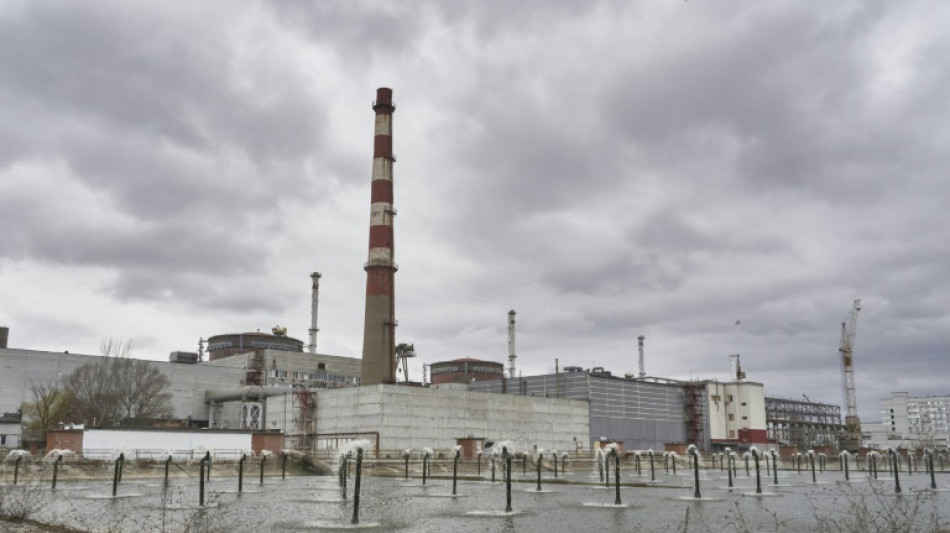
UN nuclear chief encouraged by Russia, Ukraine support of 'principles' / Photo: Andrey BORODULIN - AFP/File

 Oil companies close in on Venezuela despite hurdles
 Turkey freezes ex-minister's assets as fund scandal grows

 Guardiola backs Man City after bombshell guilty verdicts

 G20 trade ministers open talks under strain of Trump tariffs

 France in talks with UK to end 2025 migrant accord: ministry

 Europe's surging inflation spreads gloom in stock markets

 Truth commission demands compensation for Sweden's Sami people

 Japan win marathon penalty shootout to set up South Korea gold-medal clash

 Djokovic grinds out opening-round win at China Open

 Northern Ireland police probe blockade of disputed parade
 UK PM Burnham reopens divisive debate on rejoining EU

 Man City future in doubt after guilty verdict
 'Do something,' begs Iranian woman after death sentence over protests

 China extends 52-year unbeaten record as Games organisers say sorry
 In Manchester, people say City scandal is 'shame for football'
 Stocks lacklustre as inflation data weighs on sentiment
 Israel-bound plane rerouted, pilots wounded in reported fight

 Truth commission on Sweden's Sami people seeks redress

 Energy costs spark inflation surges in France, Italy

 South Korea break China hearts to reach Asian Games football final
 Eala storms into Asian Games semi-finals to thrill adoring fans

 Turkey freezes ex-minister's assets as fund crisis grows

 What we know about the North Korean POW dispute

 Most equities rise after oil price plunge, US data in focus

 Polar oceans transformed as warming melts ice habitats: research

UN nuclear watchdog chief Rafael Grossi said Tuesday he was encouraged by the reaction of Ukraine and Russia to "concrete principles" laid out by the body to prevent catastrophe at Ukraine's Zaporizhzhia nuclear plant.
The safety of Europe's largest nuclear power facility, located in Ukraine's southeastern region of Zaporizhzhia, has been a concern since Russian forces seized it over a year ago during Moscow's war on its neighbor.
It has been subject to frequent shelling that caused several outages of power that is vital to cooling the plant's reactors.
Ahead of an expected Ukraine counteroffensive, fears have increased that a nuclear disaster could occur amid increased military activity.
Grossi, director general of the International Atomic Energy Agency (IAEA), briefed the UN Security Council in New York on his proposals to ensure the plant's safety after months of negotiations.
"Today constitutes a step in the right direction when it comes to the safety and the security of the Zaporizhzhia nuclear power plant," Grossi told the council.
"We are encouraged by the expressions of support to our work, including on... the five principles that I have established today."
Chief among them, said the diplomat, "there should be no attack of any kind from or against the plant."
Grossi added that Zaporizhzhia "should not be used as storage or a base for heavy weapons," including rocket launchers, tanks or military personnel.
He also said "all efforts should be made to ensure that off-site power remains available and secure at all times."
And he stressed that all structures and components essential to the safe and secure operation of the plant "should be protected from attacks or acts of sabotage."
The IAEA intends to start monitoring the principles on-site, added Grossi, who visited the plant in March.
At a press conference later, he said he was encouraged that the principles were "widely supported and there was no voice opposing them."
The Russian and Ukrainian envoys at the United Nations blamed each other's countries for the crisis at Zaporizhzhia, although they did not reject the principles put forward by the IAEA.
"Mr. Grossi's proposals... are in line with the measures that we've already been implementing for a long time," said Russia's UN Ambassador Vassily Nebenzia, accusing Kyiv and its Western allies of creating "threats" to the plant's safety.
For his part, Ukraine's Ambassador Sergiy Kyslytsya said: "We take note of the director general's principles to help ensure nuclear safety and security" at Zaporizhzhia.
Kyslytsya had sought a "full demilitarization" of the area around the plant but the effort did not advance.
The IAEA's Grossi said he acknowledged the "different approaches" of the two sides.
But "the important thing is that the minimum common denominator, which are these basic five principles, have been widely supported and there was no voice opposing them."
Zaporizhzhia used to supply around 20 percent of Ukraine's electricity and continued to function in the early months of Russia's offensive despite frequent shelling, before halting power production last September.
None of its six Soviet-era reactors has since generated electricity, but the facility remains connected to the Ukrainian power grid for its own needs, notably to cool the reactors.
X.M.Francisco--PC